

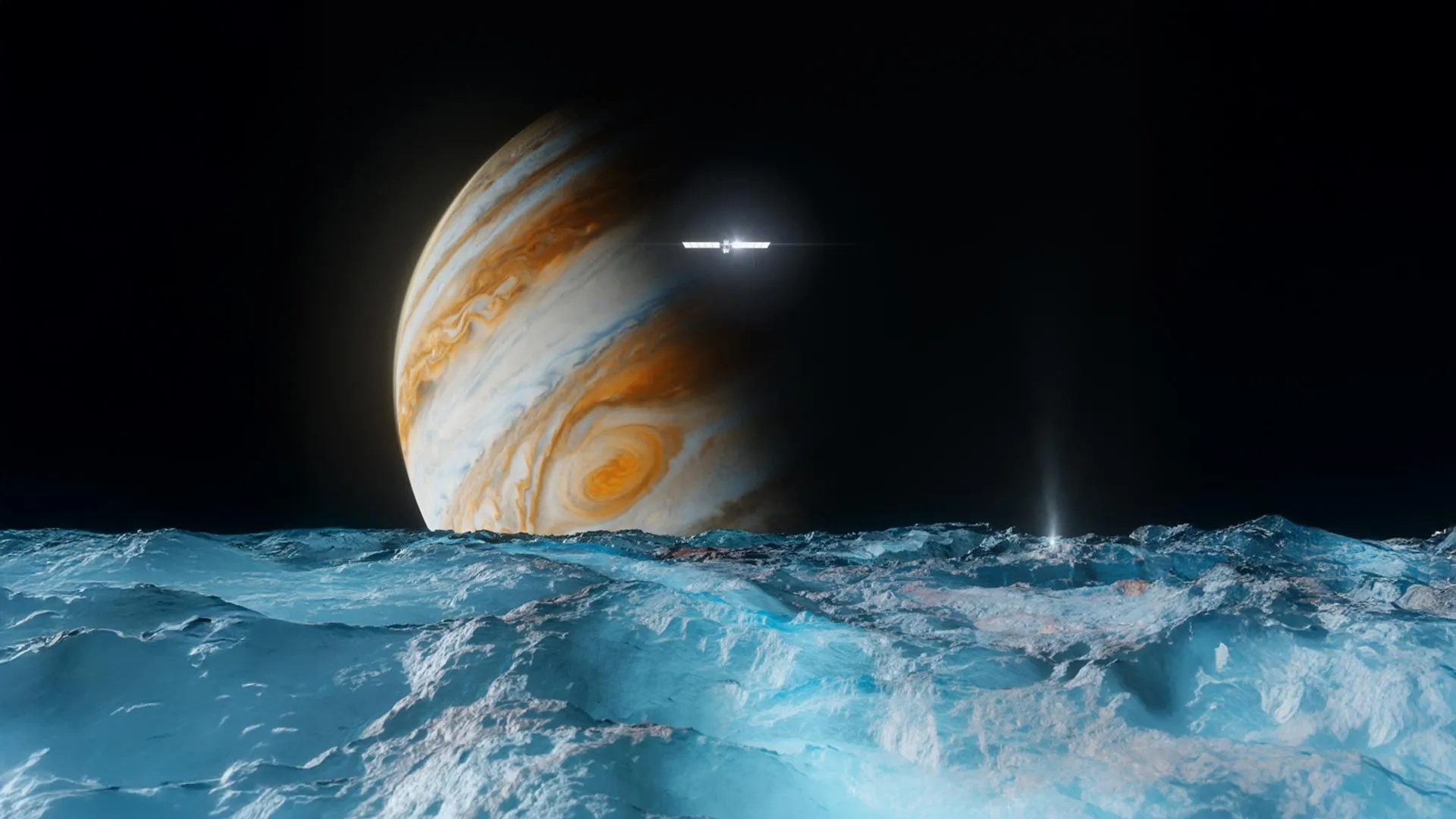
Scientists have long viewed Jupiter’s moon Europa as a prime location for investigating potential life beyond Earth, given evidence that a substantial ocean of liquid water exists beneath its icy crust. A research team from Rutgers University led by Lujendra Ojha has challenged assumptions about how accessible that subsurface water might be to future exploration efforts.
Ojha’s study, published in Nature Astronomy, used computer modeling to test whether water from Europa’s deep ocean could migrate upward through fractures in the ice shell and collect in shallow subsurface reservoirs. Such shallow pockets would be significantly easier for spacecraft to detect and sample compared to the distant ocean below. The modeling revealed that the journey from the deep ocean to upper ice layers faces major obstacles, suggesting that water movement upward is considerably less probable than many researchers had previously assumed.
The research indicates that turbulent water flow would cool rapidly as it rises through fractures, causing ice crystals to form and potentially block the pathways within hours or days. Even in larger fractures, the chaotic movement and heat loss would prevent sufficient quantities of water from reaching the surface to account for observed features. This means that if spacecraft discover shallow pockets of liquid water on Europa, those reservoirs may have originated from localized melting rather than originating from the deeper ocean.
This distinction carries implications for assessing whether Europa could support life. Scientists view the combination of liquid water, chemical composition, and internal heat as essential conditions for habitability. Shallow water disconnected from the deeper ocean may offer limited insight into the moon’s most scientifically promising environment, though it would still be more accessible for investigation.
Two major missions are currently en route to the Jupiter system. NASA’s Europa Clipper launched in October 2024 and is scheduled to arrive in April 2030, while the European Space Agency’s Jupiter Icy Moons Explorer launched in April 2023 with an expected arrival in July 2031. Both missions will provide detailed observations of Europa’s ice shell, surface composition, and subsurface characteristics that can help researchers interpret findings in light of Ojha’s conclusions about water movement through the moon’s frozen layers.
Article Attribution | Read More at Article Source
Article summary produced by Claude AI