

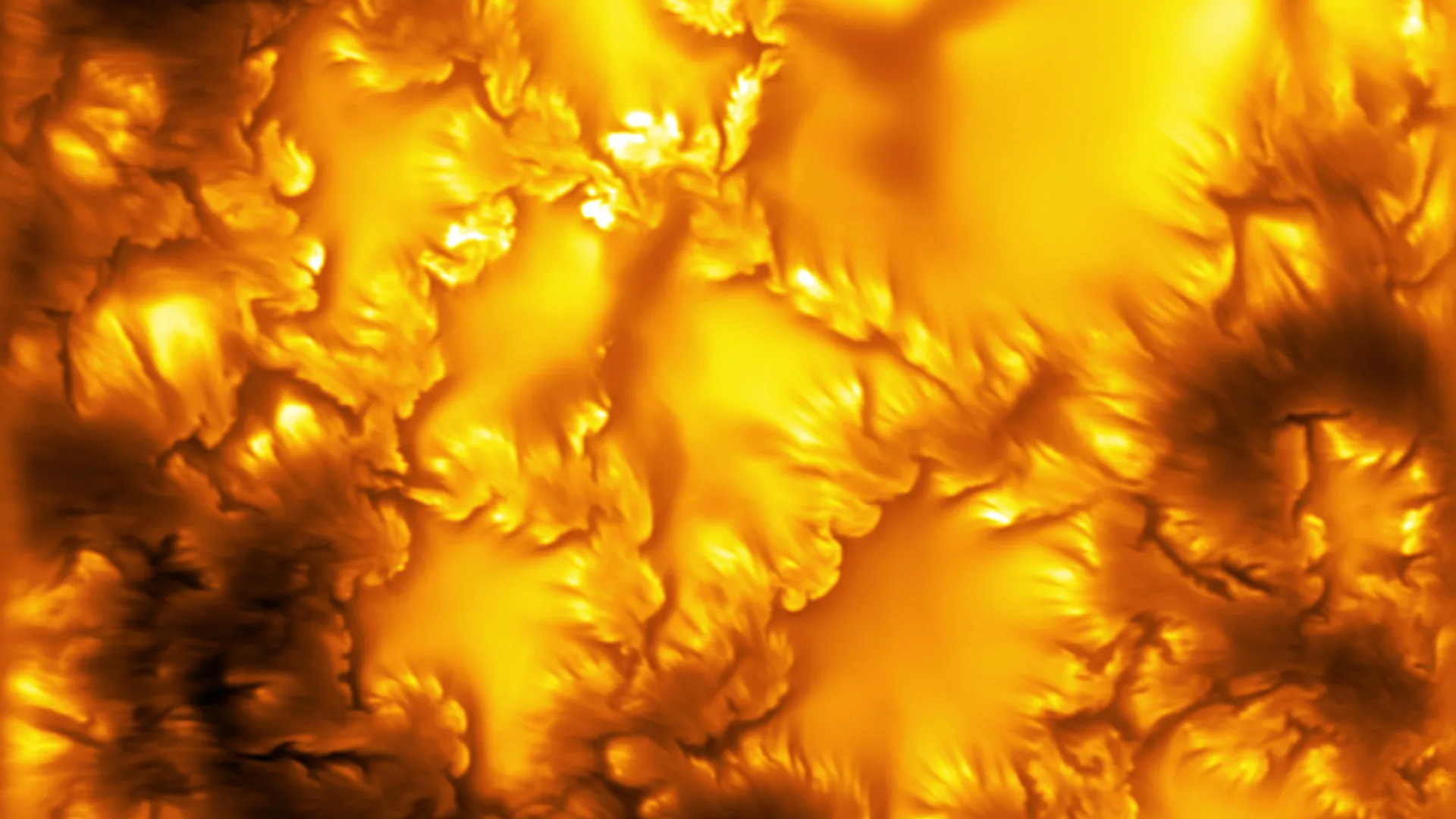
Researchers from the U.S. National Science Foundation National Solar Observatory, the Max Planck Institute for Solar System Research in Germany, and the High Altitude Observatory have identified previously unobserved plasma vortices on the Sun’s surface. The discovery was made possible through observations from the NSF Daniel K. Inouye Solar Telescope in Hawaii, the world’s largest solar telescope, combined with advanced computer simulations. The observations achieved sufficient resolution to detect structures approximately 20 kilometers in size on the solar surface.
The newly detected vortices appear along the boundaries of solar granules, which are large-scale structures ranging from 500 to 2,000 kilometers across that cover the Sun’s visible surface. The granules form as hot plasma rises from the Sun’s interior, cools near the surface, and sinks back down, creating a pattern resembling bubbles in boiling liquid. Scientists observed fine structures along granule edges that develop swirling motions comparable to breaking ocean waves, with some measuring slightly more than 20 kilometers across.
Researchers believe the observed swirling flows represent Kelvin-Helmholtz instabilities, a phenomenon occurring when two fluids move at different velocities alongside one another. This instability generates shear forces at the boundary where the flows meet, which can grow into waves or vortices. Similar processes occur in various environments, including lake and ocean surfaces, cloud formation, and planetary atmospheres.
The discovered vortices may provide insight into how the Sun stores and releases magnetic energy, including through small radiation bursts called nanoflares. Magnetic energy accumulates as the Sun’s magnetic field lines become twisted and coiled, similar to mechanical energy stored in a compressed spring. The plasma vortices could supply a mechanism for twisting magnetic field lines, and they appear to be highly effective at mixing magnetized and non-magnetized plasma. This mixing may facilitate the rapid movement of magnetic fields through the solar atmosphere, helping explain how the Sun’s magnetic cycle changes over an eleven-year period.
Article Attribution | Read More at Article Source
Article summary produced by Claude AI