

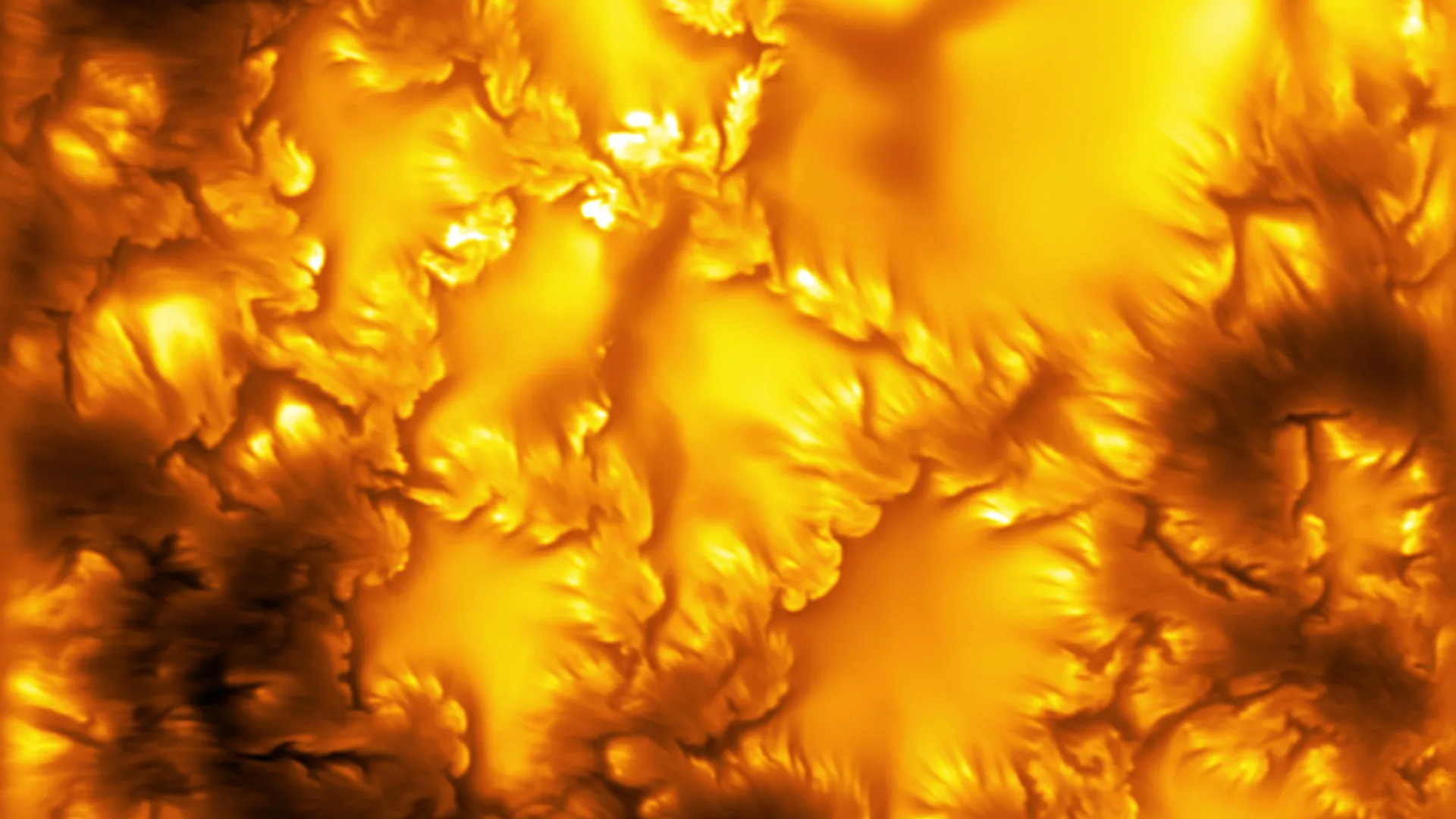
Researchers from the National Science Foundation National Solar Observatory, the Max Planck Institute for Solar System Research, and the High Altitude Observatory have identified plasma vortices on the solar surface previously undetectable by conventional observation methods. The discovery was made possible through combined observations from the NSF Daniel K. Inouye Solar Telescope in Hawaii and advanced computer simulations, allowing scientists to resolve structures as small as 20 kilometers across on the Sun’s surface.
The newly detected vortices appear along the boundaries of granules, the bubble-like structures that densely cover the Sun’s visible surface and range from 500 to 2,000 kilometers across. For the first time, researchers were able to observe fringe-like structures along granule edges that develop swirling motions resembling breaking ocean waves. Some of these structures measure only slightly more than 20 kilometers across, making their observation equivalent to identifying a one euro coin from 180 kilometers away.
Scientists believe these vortices are evidence of Kelvin-Helmholtz instabilities, a fluid dynamics phenomenon that occurs when two fluids move alongside one another at different speeds, creating shear forces that develop into waves or swirling vortices. This process has been observed in various environments across vastly different scales, including lake and ocean surfaces, cloud formation, and planetary atmospheres.
The discovery may provide crucial insights into how the Sun stores and releases energy through its magnetic field, including tiny radiation bursts called nanoflares. The vortices could offer a mechanism for twisting the Sun’s magnetic field lines, which store energy similar to a tightly coiled spring. Additionally, the mini-vortices appear highly effective at mixing magnetized and non-magnetized plasma at the solar surface, potentially explaining how magnetic fields move quickly from the surface into the Sun’s atmosphere—a process central to the star’s roughly eleven-year activity cycle.
Article Attribution | Read More at Article Source
Article summary produced by Claude AI