

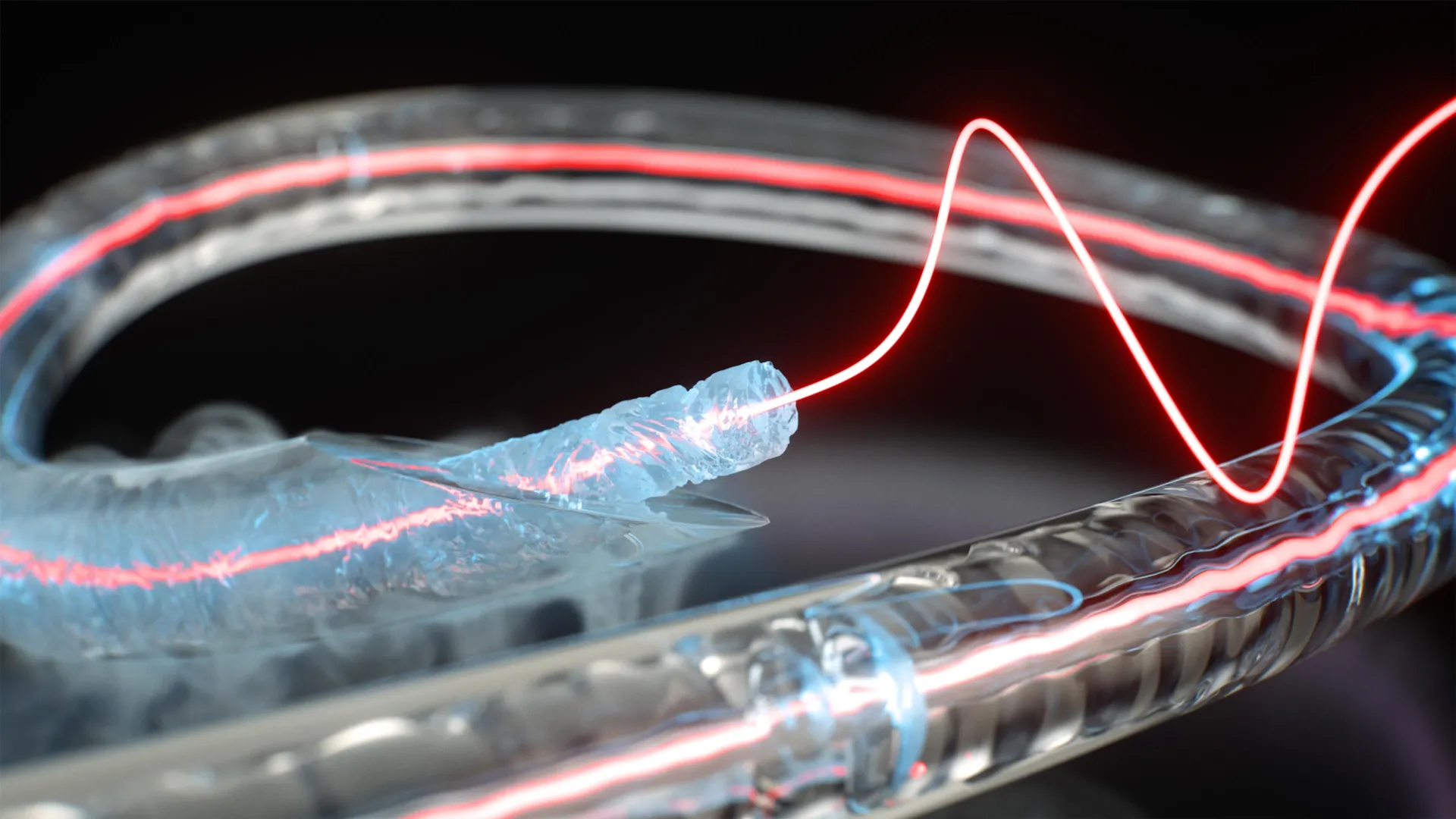
An international team of scientists has developed a novel approach to optical fiber technology by freezing the liquid contents inside specialized fibers at extremely low temperatures. The research involved cooling the fiber cores with nitrogen to -196 °C, causing the liquid material to solidify while maintaining the fiber’s ability to guide light through its structure.
The frozen configuration creates unusually strong interactions between light and sound waves propagating through the fiber. This enhancement, based on a phenomenon known as Brillouin-Mandelstam scattering, occurs because the frozen core establishes a denser and more tightly confined environment. The researchers found that this physical arrangement increases light-sound coupling by more than 1,000 times compared to standard optical fibers currently in use.
The team leveraged this dramatic enhancement to demonstrate optoacoustic memory functionality within the frozen fiber. The technology works by transferring information from rapid light waves to slower-moving sound waves, where the data can be temporarily stored before being reconverted back into light. This approach capitalizes on the vast difference in propagation speeds between light and sound to enable efficient information processing.
The research represents an expansion of work on liquid core optical fibers, a specialized technology previously developed by collaborating scientists. Adding the freezing step produces significantly stronger nonlinear effects within the fiber structure. The researchers suggest that the enhanced light-sound interaction in frozen liquid core fibers could have applications extending beyond optoacoustic memory to include neuromorphic computing, quantum information processing, microwave photonics, and precision sensing technologies. The frozen fiber platform is described as providing extreme nonlinearities while remaining relatively simple to implement and handle in practical applications.
Article Attribution | Read More at Article Source
Article summary produced by Claude AI