

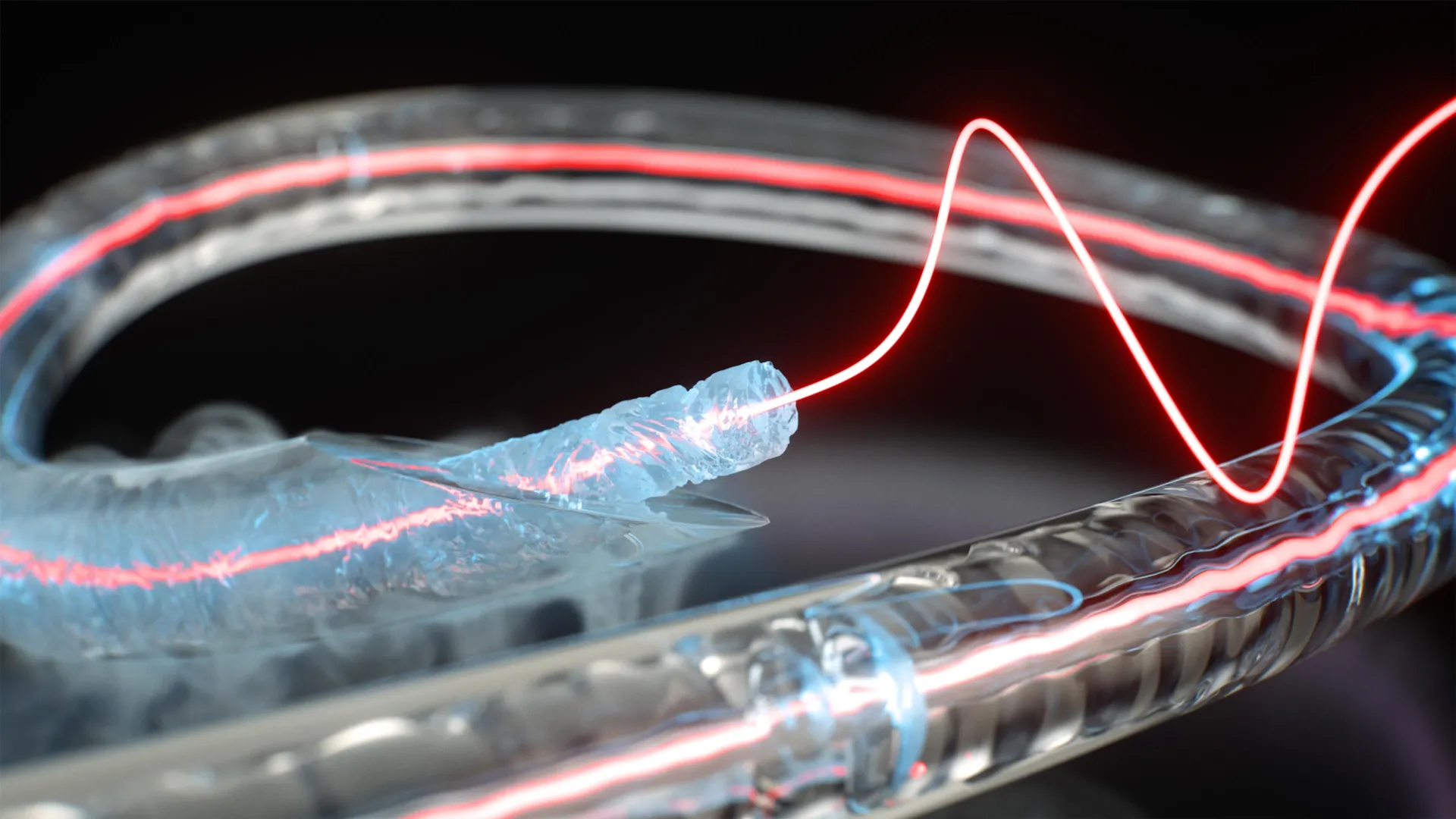
Scientists from German research institutions have developed a novel approach to optical fiber technology by freezing the liquid core at extremely low temperatures. The team, affiliated with the Max Planck Institute of the Science of Light, Leibniz University Hannover, and the Leibniz Institute for Photonic Technologies, cooled liquid-filled fiber cores to -196 °C using nitrogen. The freezing process transformed the core material from liquid to solid while preserving the fiber’s ability to guide both light and hypersonic sound waves.
The frozen core environment created conditions for dramatically enhanced light-sound interactions. The researchers observed a phenomenon called Brillouin-Mandelstam scattering, which occurs naturally in conventional optical fibers but becomes vastly amplified in the frozen configuration. The density and tight confinement of the frozen material increased the interaction strength by more than 1,000 times compared to standard optical fibers, according to Simon Seiderer, one of the project’s lead researchers.
The research team leveraged this enhanced coupling to demonstrate optoacoustic memory, a technology that transfers information from rapidly moving light waves to slower sound waves for temporary storage before converting it back to light. This capability exploits the fundamental speed difference between light and sound propagation. The efficiency of this light-sound interaction in frozen liquid-core fibers could substantially reduce energy consumption in future photonic computing systems.
The work represents a continuation of collaborative research pioneered by colleagues at the Jena institute who originally developed liquid-core optical fiber technology. The addition of the freezing step enabled the team to achieve much greater nonlinear optical effects. According to project leader Birgit Stiller, the frozen liquid-core fiber creates a new physical platform with extreme nonlinearities that is practical to use. Beyond neuromorphic computing applications, the researchers noted potential uses in quantum information processing, microwave photonics, and high-precision sensing technologies.
Article Attribution | Read More at Article Source
Article summary produced by Claude AI