

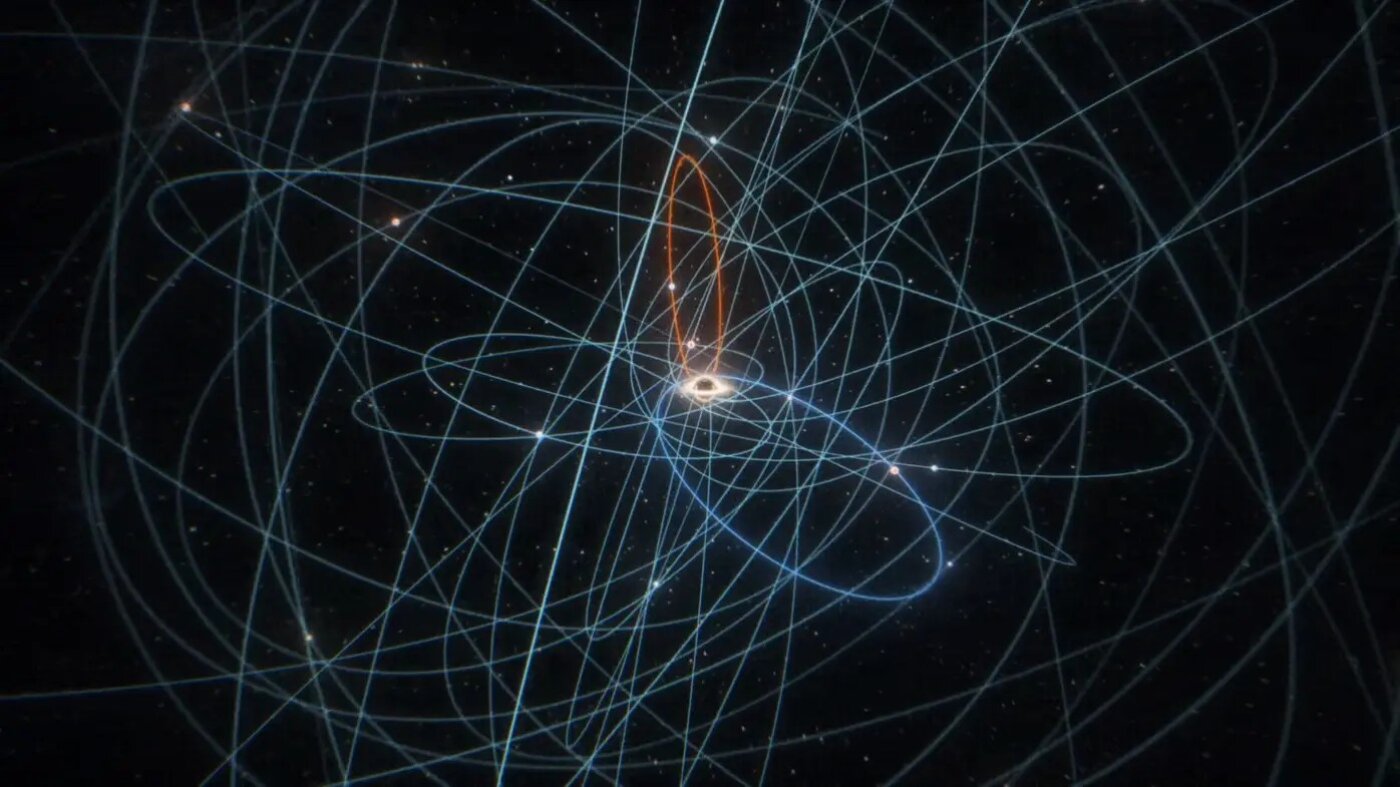
Researchers at the Max Planck Institute for Extraterrestrial Physics have published findings in the journal Nature describing the discovery of the fastest star ever observed in the galaxy. The star, designated S301, orbits Sagittarius A*, the supermassive black hole at the center of the Milky Way, which was determined in the fall of 2002 to have a mass approximately four million times that of Earth’s Sun.
The significance of this discovery lies not primarily in the star’s extreme velocity but rather in its proximity to the black hole, which allows researchers to study gravitational effects in an unprecedented way. At its closest approach to the black hole, S301 travels at speeds exceeding 15,000 miles per second, representing approximately 8% of the speed of light. The star follows an extremely elongated elliptical orbit with a period of 8.7 years, with the black hole positioned at one end of the oval.
Scientists from the Max Planck Institute used four telescopes at the European Southern Observatory’s Very Large Telescope site in Chile to gather infrared observations, enabling them to penetrate cosmic dust and gas that would otherwise obstruct their view. A doctoral student at the institute initially identified the star through a faint signal in the data several years ago and subsequently tracked its position and orbital characteristics. By applying Newton’s law of gravity with corrections from general relativity, researchers confirmed the orbital mechanics and velocity measurements.
The discovery offers researchers an opportunity to study how gravity distorts space and time in the vicinity of a supermassive black hole. Future applications of these observations may include determining the rotation rate of Sagittarius A*, a measurement that has not been previously calculated for a quiescent galaxy. Understanding the black hole’s spin characteristics could provide insights into the formation history of the Milky Way itself and advance comprehension of how supermassive black holes influence galactic development and structure.
Article Attribution | Read More at Article Source
Article summary produced by Claude AI