

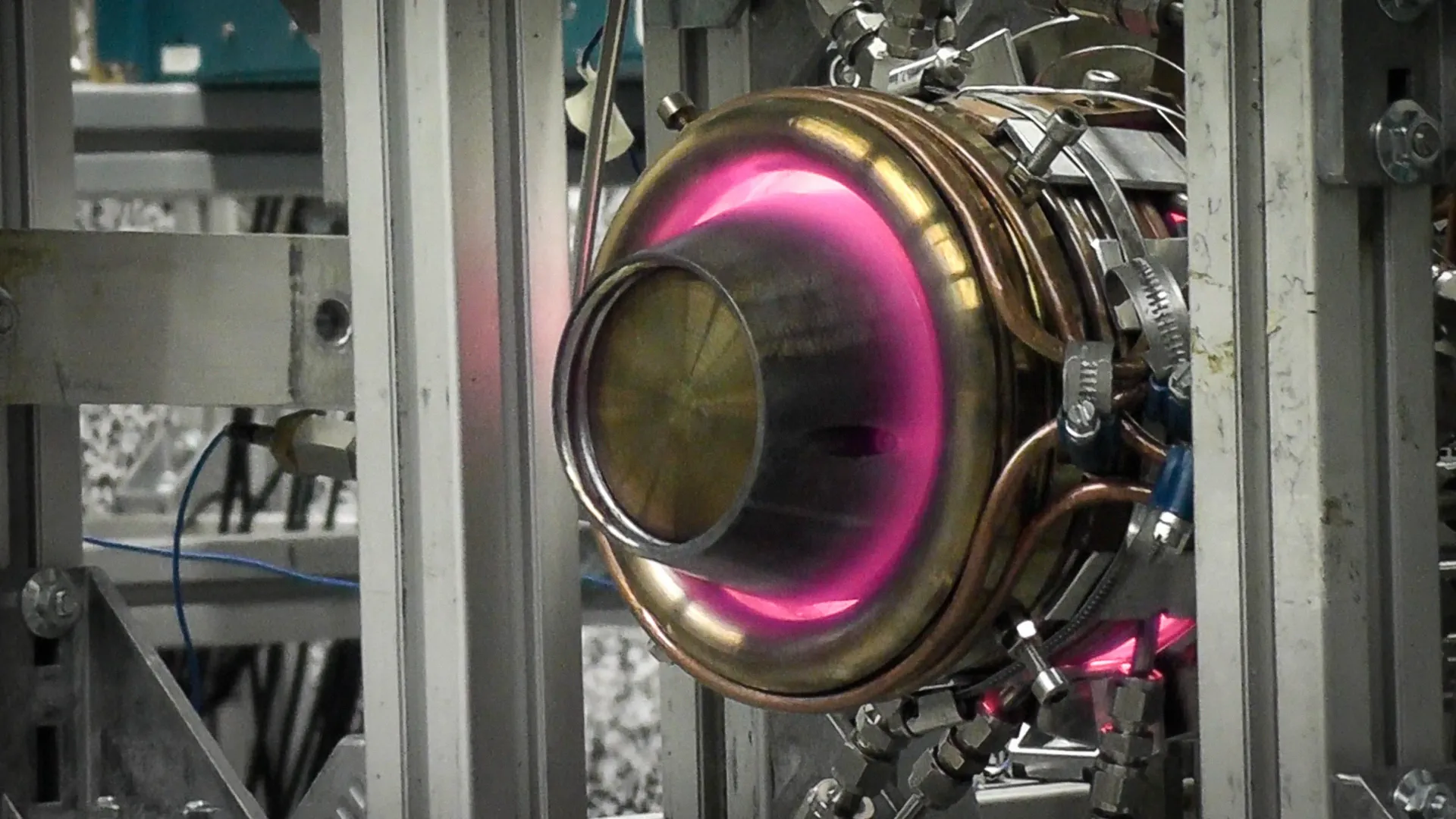
Scientists at the Karlsruhe Institute of Technology have demonstrated significant progress in hydrogen-based power generation by successfully operating an experimental turbine for over five minutes. The device achieved 303 seconds of continuous operation, exceeding the previous record of 250 seconds established by NASA. This advancement represents a notable development in the application of hydrogen as a fuel source for electricity production.
The turbine employs pressure-gain combustion technology, a novel approach that fundamentally differs from conventional gas turbine designs. Rather than relying on a mechanical compressor to pressurize air before combustion, the system generates the necessary pressure within the combustion chamber itself through the formation of detonation waves. These waves emerge from fluid mechanical instabilities involving wave and vortex patterns in the flowing gases. This design eliminates the energy-intensive compression step that typically consumes approximately half of a conventional turbine’s power output.
Hydrogen proves particularly effective for this application due to its rapid reaction rate and capacity to produce stable pressure increases within the combustion chamber. The technology is not limited to hydrogen alone and can operate with alternative fuels, though hydrogen offers superior performance characteristics. The removal of mechanical compressor components could potentially result in lighter turbines, reduced manufacturing costs, and improved overall energy efficiency.
A significant engineering hurdle involved integrating the combustion chamber with a turbine to convert the intense combustion reactions into usable electricity. The extreme speed and power of the combustion processes created challenges for stable energy transfer to the turbine. Researchers reported that they achieved a first-time success in operating such a system while simultaneously generating electrical power.
Longer-term applications for this technology may extend beyond stationary power generation to aviation, though such developments would require further advancement. The research team emphasized that the achievement represents progress toward establishing efficient and flexible hydrogen-based energy systems suitable for a fossil-free energy infrastructure.
Article Attribution | Read More at Article Source
Article summary produced by Claude AI