

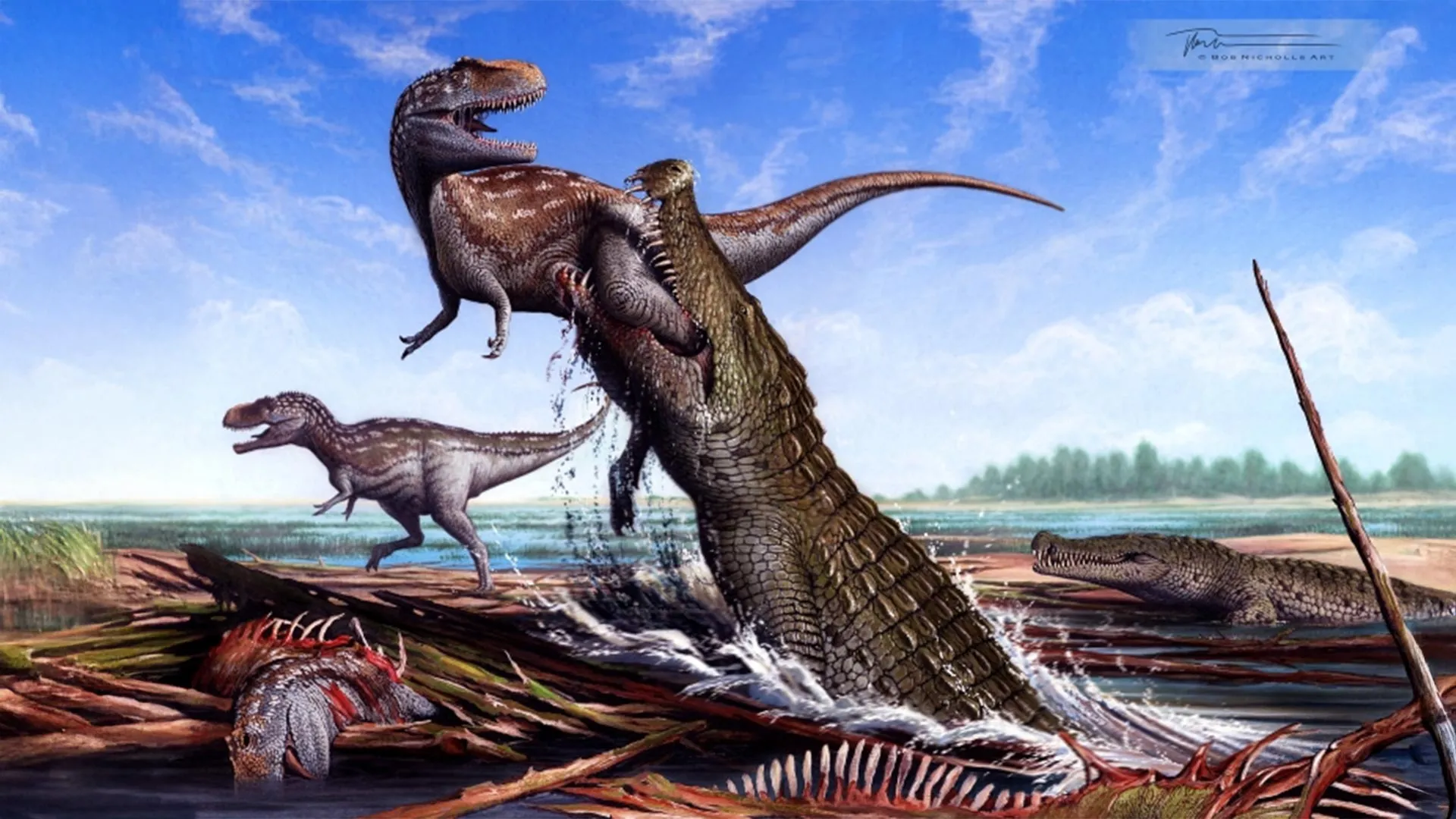
The Tellus Science Museum in Cartersville, Georgia has unveiled the first scientifically accurate, life-size mounted skeleton replica of Deinosuchus schwimmeri, a massive crocodilian that inhabited the eastern United States between 83 million and 76 million years ago. The 31-foot predator, roughly the length of a school bus, was among the dominant apex predators of its ecosystem during the Late Cretaceous epoch and possessed powerful jaws capable of attacking large dinosaurs and other animals near water sources.
Dr. David Schwimmer of Columbus State University, a leading authority on the genus Deinosuchus, collaborated with Triebold Paleontology Inc. over two years to create the replica. The species was formally named Deinosuchus schwimmeri in 2020, honoring Schwimmer’s four decades of fossil research, excavation, and study across Alabama, Georgia, and Texas. Major fossil collections from his work are preserved at institutions including the Smithsonian Institution, the American Museum of Natural History, and the Tellus Science Museum.
The reconstruction required sophisticated methods beyond simple bone arrangement. Scientists produced high-resolution 3D scans of fossil records to accurately rearticulate skeletal elements and dermal armor—the protective bony plates embedded in the animal’s skin. According to Schwimmer, the completed mount serves multiple purposes: it conveys the predator’s intimidating scale to visitors while also providing paleontologists with a connected skeletal structure for anatomical examination and research into predatory behavior and adaptation strategies.
Schwimmer’s research career began in 1979 when he discovered his first Deinosuchus remains, a year after joining Columbus State. His 2002 book, “King of the Crocodylians: The Paleobiology of Deinosuchus,” became an Amazon category bestseller and shaped modern scientific understanding of the species. His work has contributed to several paleontological firsts in Georgia, including discoveries of flying reptiles, dinosaurs, and Deinosuchus itself. According to museum officials, the Tellus Science Museum is currently the only institution displaying a Deinosuchus schwimmeri cast, offering visitors an educational experience available nowhere else.
Article Attribution | Read More at Article Source
Article summary produced by Claude AI