

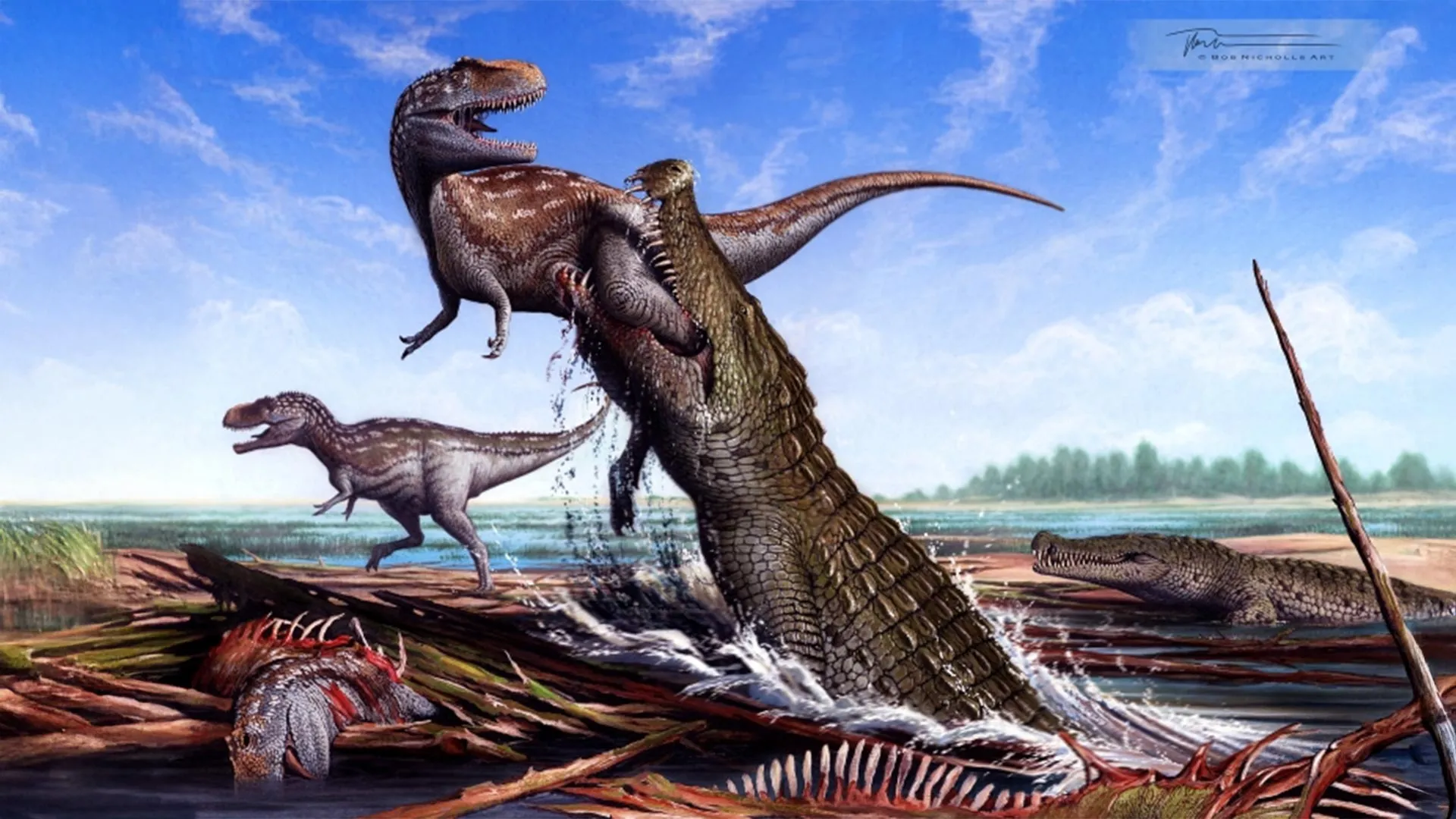
Deinosuchus schwimmeri, a 31-foot predatory crocodilian that inhabited the eastern United States between 83 million and 76 million years ago, has been reconstructed in scientifically accurate, life-size skeletal form for the first time. The mounted replica was commissioned by the Tellus Science Museum in Cartersville, Georgia, and represents a collaboration between Dr. David Schwimmer of Columbus State University and Triebold Paleontology Inc. The ancient predator, which resembled an enormous alligator but belonged to a distinct crocodilian lineage, would have been capable of attacking dinosaurs and other large animals that approached water sources in its Cretaceous Period ecosystem.
Dr. Schwimmer, an internationally recognized expert on Deinosuchus, spent more than four decades searching, excavating, and studying fossils of this species. The crocodilian was formally identified as a distinct species in 2020 and named in Schwimmer’s honor, recognizing his decades of research on Late Cretaceous paleontology in the southeastern United States. His interest began in childhood after viewing a Deinosuchus skull at the American Museum of Natural History in New York, and he discovered his first fossil remains in 1979, shortly after joining Columbus State. His influential 2002 book, “King of the Crocodylians: The Paleobiology of Deinosuchus,” became an Amazon top seller and shaped modern scientific understanding of the species.
Construction of the full-scale replica involved sophisticated paleontological methods, including high-resolution 3D scanning of fossil records to accurately reconnect skeletal elements and reconstruct missing portions using evidence from related animals. The completed mount serves multiple purposes beyond displaying the creature’s intimidating size, offering paleontologists opportunities to examine its anatomy and understand how the apex predator lived and hunted. Museum officials note that Tellus is currently the only museum housing a cast of Deinosuchus schwimmeri, providing visitors with an experience unavailable elsewhere and a tangible sense of the scale of Late Cretaceous fauna that is difficult to convey through words or images alone.
Article Attribution | Read More at Article Source
Article summary produced by Claude AI