

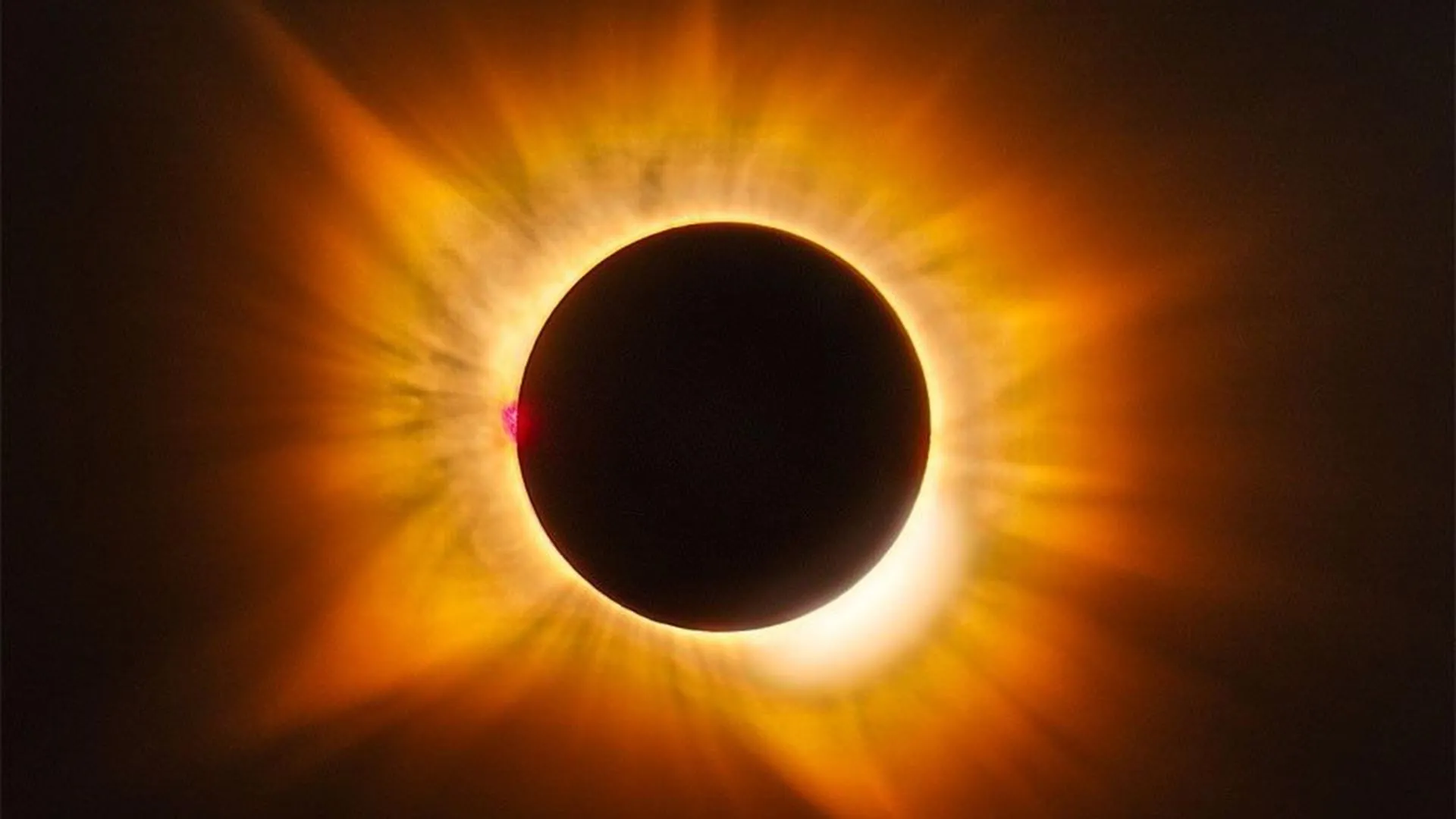
A total solar eclipse occurring last week produced distinctive atmospheric conditions that resulted in an uncommon golden appearance of the Sun’s corona, particularly as observed from Spain. During most total solar eclipses, the corona—the Sun’s extremely hot outer atmosphere—typically appears white or silvery when the Moon blocks the bright solar disk. However, observers in Spain witnessed a notably different phenomenon as the corona took on a rich golden hue.
The distinctive coloration resulted from specific timing and atmospheric conditions. When the eclipse occurred in Spain, totality took place while the Sun was already positioned low on the horizon. At such a low angle, solar light must traverse a considerably greater thickness of Earth’s atmosphere to reach observers on the ground. As light travels through this extended atmospheric path, air molecules scatter shorter wavelengths of visible light, particularly blue wavelengths. This same fundamental scattering process creates the orange and red colors visible in typical sunsets. With increased blue light removed from the visible spectrum, the warmer colors that remained became substantially more prominent.
Atmospheric conditions on the day of the eclipse further intensified the golden effect. An unusually high concentration of smoke from nearby forest fires added additional filtering to the light path. These smoke particles scattered even greater amounts of the remaining blue wavelengths, thereby enhancing the golden tones surrounding the eclipsed Sun.
Images captured from Benavente, Spain, documented the striking visual effect through multiple exposures and high dynamic range imaging processing, which combines different brightness levels to preserve both bright and faint details. During the eclipse, a large solar prominence remained visible along the Sun’s edge. These prominences are substantial structures of glowing plasma extending from the Sun’s surface, typically shaped by powerful magnetic fields. The prominence emitted strongly in light associated with hydrogen, which allowed its bright pink coloration to remain visible despite the atmospheric filtering effects, creating a vivid contrast against the golden corona.
Article Attribution | Read More at Article Source
Article summary produced by Claude AI