

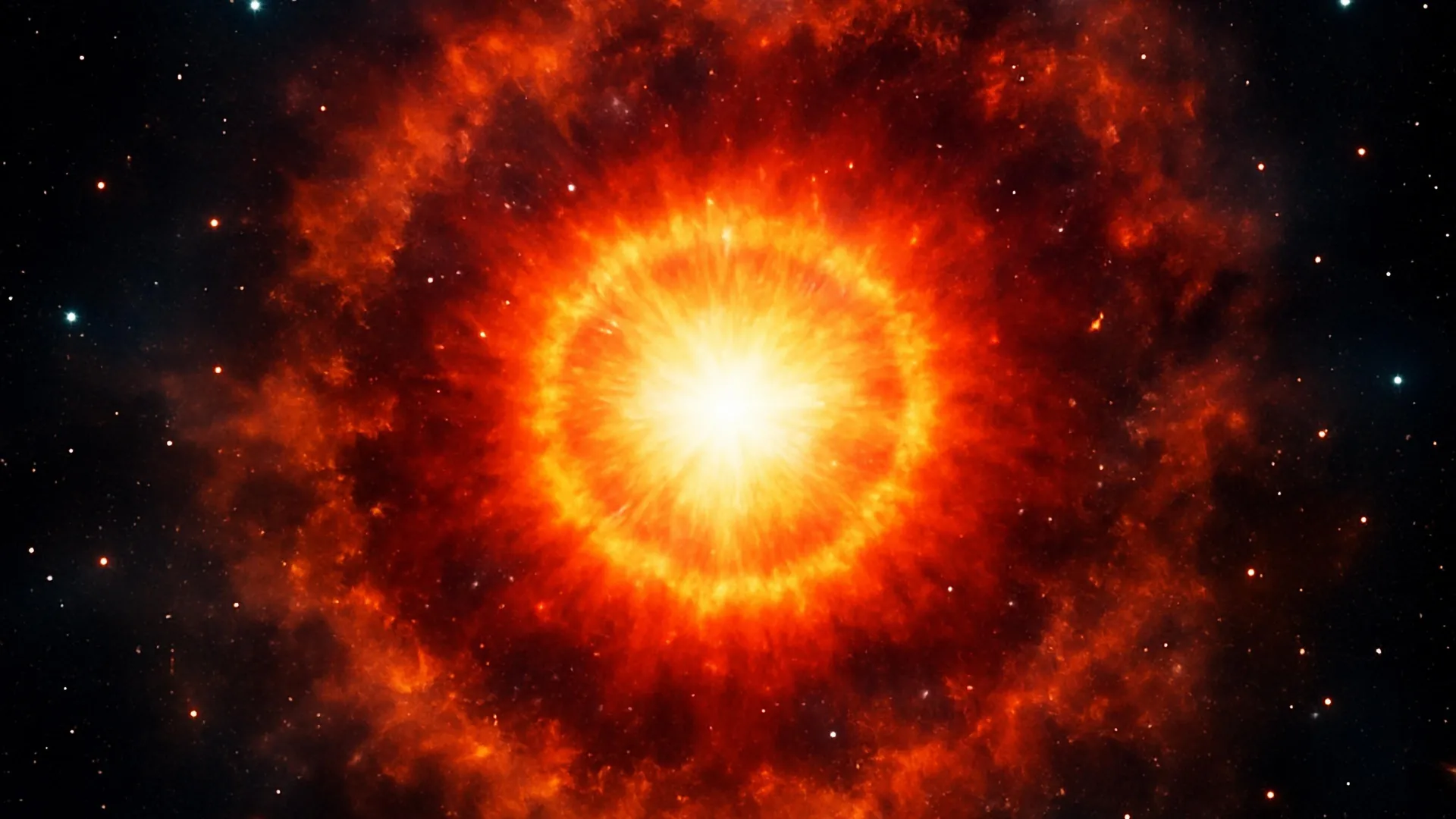
An international research team has proposed that primordial black holes may be responsible for triggering some Type Ia supernovae through interactions with white dwarf stars. The study, published in The Astrophysical Journal, suggests this explosion mechanism could help account for specific chemical abundance patterns detected among stars throughout the Milky Way.
Primordial black holes are theoretical remnants believed to have formed during the universe’s earliest moments of cosmic inflation. These objects have been proposed as potential candidates for dark matter, the invisible material estimated to comprise approximately 90% of all matter in the universe by mass. As primordial black holes travel through space, previous research indicated that if one passed through a white dwarf star, the intense gravitational effects could destabilize the star and trigger a thermonuclear explosion.
The investigation was led by researchers from SUNY Polytechnic Institute and The University of Tokyo’s Kavli Institute for the Physics and Mathematics of the Universe. The team analyzed the motion, brightness, and chemical characteristics of supernovae that could result from primordial black hole interactions. They compared their models against well-known supernova remnants, including Tycho and Kepler, as well as nearby supernovae observations and chemical data from Milky Way stars.
The analysis focused on radioactive isotopes and stable elements present in supernova remnants, which provided signatures allowing researchers to estimate the properties of the parent stars. The results indicated that primordial black hole-triggered Type Ia supernovae could reproduce several observed characteristics of actual supernovae. Furthermore, the chemical abundance patterns suggest that a measurable fraction of observed Type Ia supernovae may originate from primordial black hole interactions.
The researchers indicated that this explosion mechanism could influence galactic chemical enrichment, as supernovae distribute newly synthesized elements throughout space. The team plans to expand their investigation by examining how primordial black hole-triggered explosions might affect the broader population of conventional supernovae and the combined rates of these cosmic events.
Article Attribution | Read More at Article Source
Article summary produced by Claude AI