

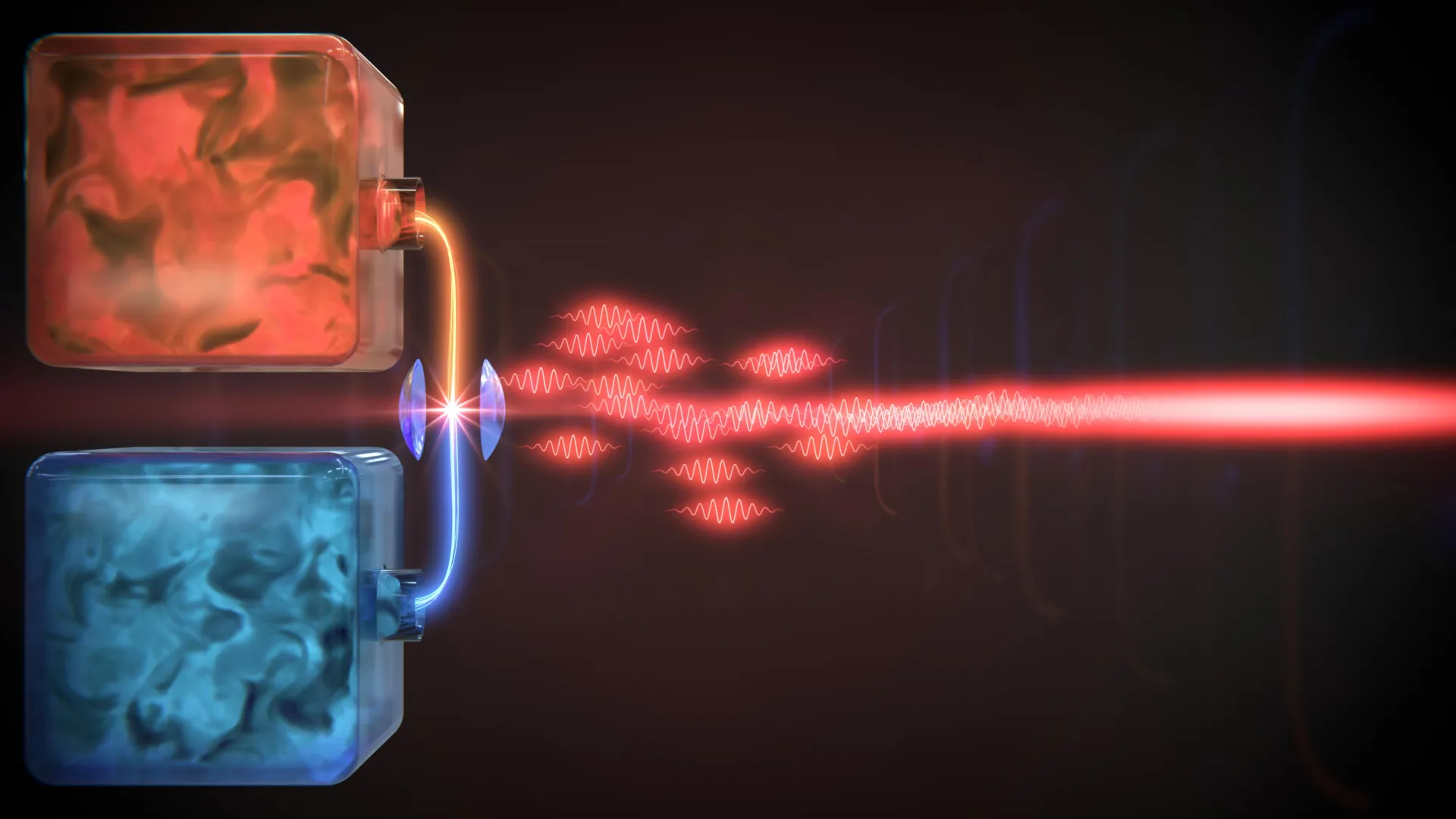
Scientists at the University of Basel have introduced a unified theoretical approach addressing a fundamental challenge in quantum technologies: describing how thermodynamics and quantum physics operate consistently within the same system. Historically, these two disciplines developed separately to address different scales and phenomena. Thermodynamics emerged during the 19th century to explain energy conversion in large machines like steam engines, while quantum physics arose in the early 20th century to describe behavior at atomic and subatomic scales. As researchers increasingly design microscopic devices constructed from atoms and photons that can absorb, transform, and release energy, integrating these two frameworks has become essential.
A primary obstacle involves finding a description that maintains validity both when a system is treated entirely using quantum mechanics and when it approaches the semi-classical limit, where one component is quantum while another follows classical physics principles. Professor Patrick Potts and his research group at the University of Basel addressed this challenge through a study published in Physical Review Letters. Their model examines a specific configuration in which an atom sits inside an optical cavity between two mirrors, continuously supplied with additional photons by a laser while some light escapes through partially reflective mirrors.
Previous work by Potts’s team established that photons exiting the cavity should not automatically be classified as “waste heat” in thermodynamic terms. Instead, some energy carried by escaping light can potentially perform useful work on other quantum systems. The latest investigation focused on how this distinction holds when transitioning to the semi-classical limit, where the atom remains quantum mechanical while light is treated as classical electromagnetic waves. The researchers demonstrated mathematically that their approach produces a smooth transition between the full quantum description and this classical limit when part of the emitted light is recognized as useful work.
The findings also revealed that quantum effects can reduce fluctuations in emitted photons. This property holds potential significance for quantum technologies, as disturbances from heat typically complicate quantum system control. Under appropriate conditions, however, this heat-related effect could provide a useful resource. Potential applications include generating specific light states beneficial for precision measurements in quantum metrology. The research demonstrates how clarifying the boundary between heat and useful work may enable researchers to harness energy that previously appeared to be lost.
Article Attribution | Read More at Article Source
Article summary produced by Claude AI