

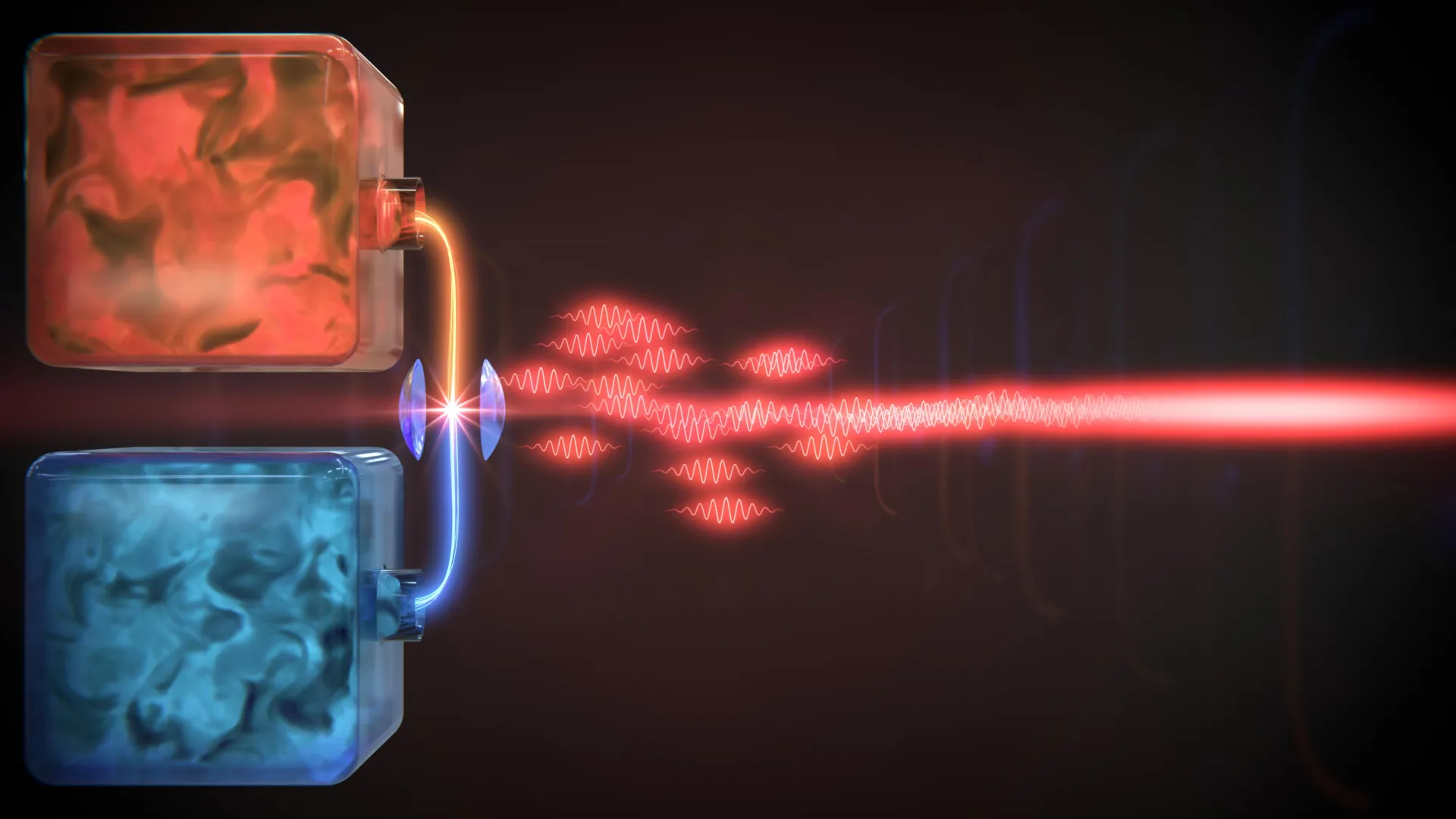
Physicists have long struggled with reconciling thermodynamics—the 19th-century science of energy transformation in large machines—with quantum physics, which emerged in the early 20th century to describe atomic and subatomic behavior. Today these fields increasingly intersect as researchers build microscopic machines from atoms and light particles that can absorb, transform, and release energy. A major challenge lies in creating descriptions that work consistently whether the entire system is treated quantum mechanically or in the semi-classical limit, where one part follows quantum rules while the other operates under classical physics.
Researchers at the University of Basel, led by Professor Patrick Potts, have now developed such a framework and published their findings in Physical Review Letters. Their work examines a concrete model consisting of an atom placed in a cavity between two mirrors, continuously supplied with photons by a laser while light simultaneously escapes through partially reflecting mirrors. Postdoc Marcelo Janovitch explains that this driven-dissipative system, which continuously receives and loses energy, functions as a miniature light engine and provides a way to investigate fundamental questions about open quantum systems.
Previous work by the group showed that photons leaving the cavity should not automatically be classified as waste heat. Instead, some energy carried by escaping light can potentially perform useful work on other quantum systems. The latest study examined how this distinction between heat and useful energy behaves as the system approaches the semi-classical limit, where the atom remains quantum while light is treated as a classical electromagnetic wave. The researchers demonstrated mathematically that their approach allows the theory to transition smoothly into the semi-classical limit when part of the emitted light is classified as useful work—something the conventional approach cannot achieve.
Beyond theoretical consistency, the team discovered that their calculations correctly describe how quantum effects can reduce fluctuations in emitted light particles. This finding could have practical applications for quantum technologies, where heat typically creates disturbances that complicate system control. Under appropriate conditions, however, heat could instead become a valuable resource. Such effects might help generate specific light states useful for precision measurements in quantum metrology, demonstrating how deeper understanding of the boundary between heat and useful work could enable researchers to harness energy that might otherwise appear to be lost.
Article Attribution | Read More at Article Source
Article summary produced by Claude AI