

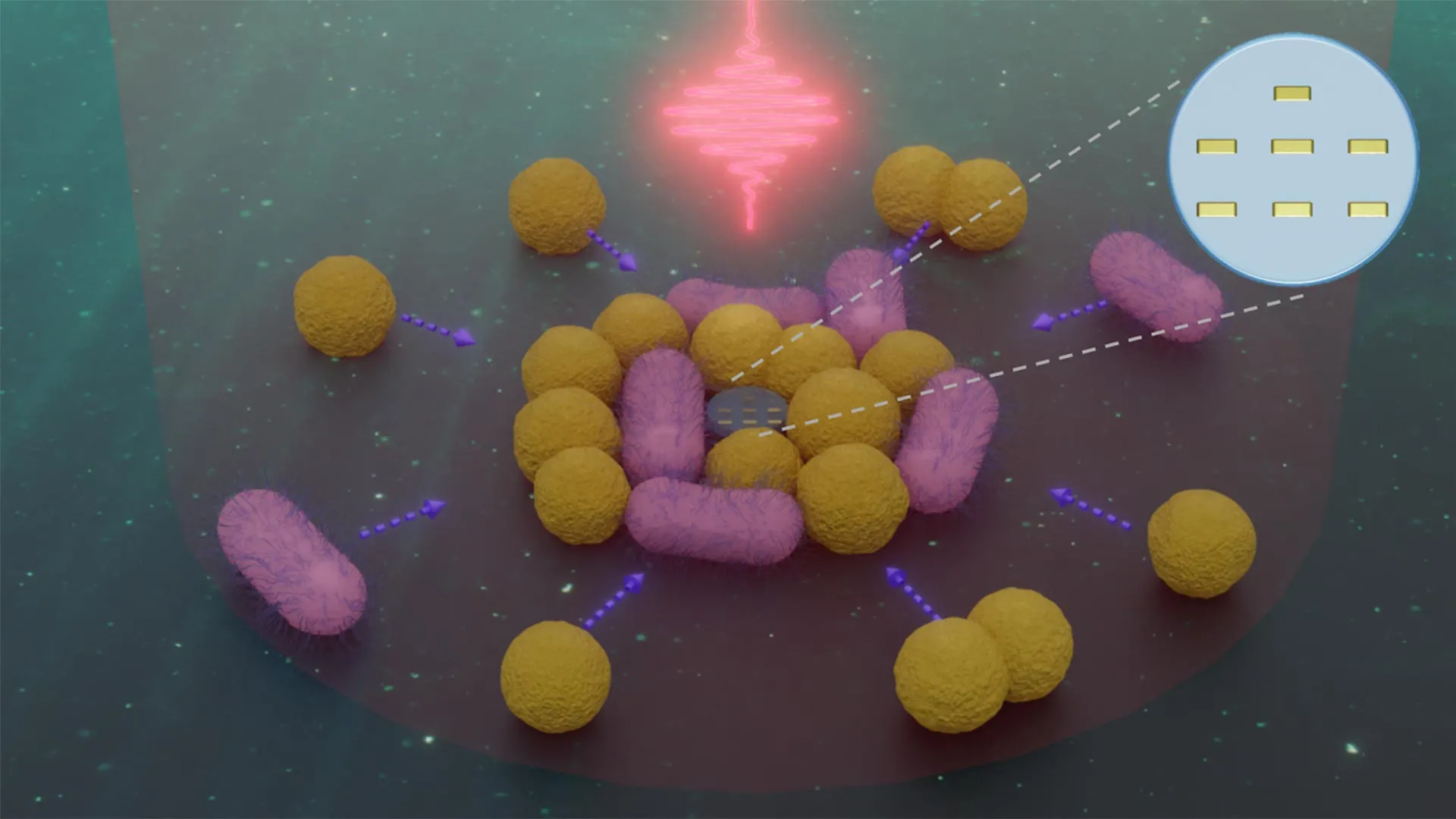
Scientists at Julius-Maximilians-Universität Würzburg have created microscopic robots that operate at scales roughly 50 times smaller than the width of a human hair. These nanorobots represent a significant advance in the long-standing challenge of manipulating objects in the microbial world, where direct manual control has historically been impossible.
The propulsion system uses a novel approach based on photon recoil. The microdrones contain up to four plasmonic nanoantennas that absorb light of specific wavelengths and orientations, then redirect that light to create minute recoil forces. Despite their diminutive size, these forces generate sufficient acceleration and velocity to move the robots effectively. The research team, led by Professor Bert Hecht, has progressively reduced the device dimensions while maintaining functionality.
Steering is accomplished through a simplified control mechanism that exploits nanoscale antenna wires integrated into each robot. These structures naturally align with the polarization direction of incoming light. By adjusting the light’s polarization properties, researchers can control the direction the nanorobot faces while photon recoil continues propelling it forward, similar to directional control systems in larger vehicles.
The robots demonstrate remarkable capabilities in laboratory settings. They can perform rapid 90-degree turns to systematically survey sample areas and can selectively capture, transport, and release significant quantities of bacteria. Even while carrying larger bacterial clusters, the devices remain fully controllable, though their speed decreases under the additional load. These findings suggest potential applications in microbiology, biomedical research, and precision material manipulation at microscopic scales.
Article Attribution | Read More at Article Source
Article summary produced by Claude AI