

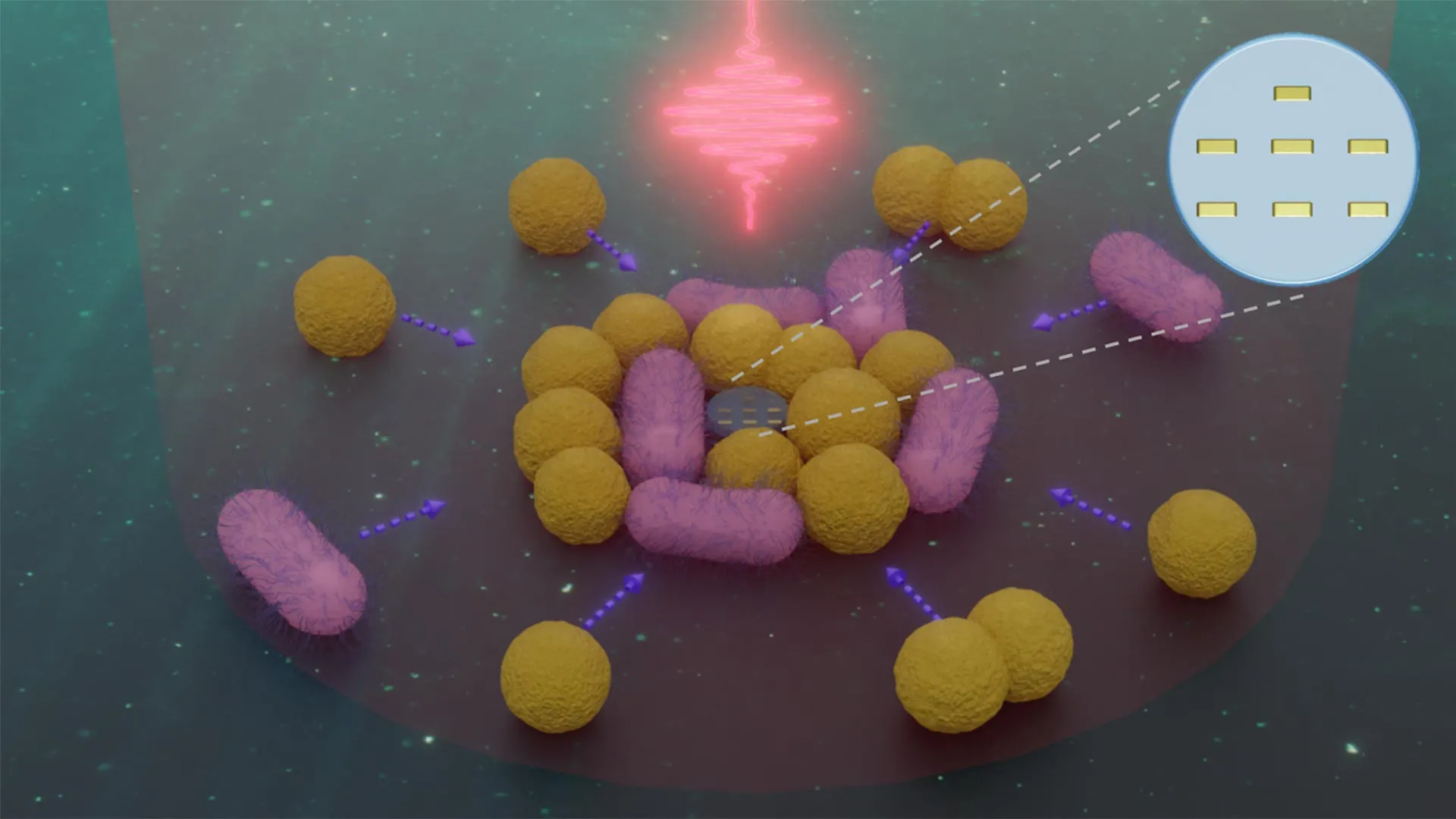
Scientists at Julius-Maximilians-Universität Würzburg have created microscopic robots capable of operating within the microbial environment, representing a significant advance in handling objects at the nanoscale. These devices, measuring less than one micrometer in size, are approximately 50 times smaller than the width of a human hair and enable direct manipulation of biological materials in aqueous solutions, including individual cells and bacteria.
The propulsion system relies on an innovative approach using individual photons to generate movement. Each nanorobot contains between two and four plasmonic nanoantennas that absorb light of specific wavelengths and helicity before emitting it directionally. This redirected light produces recoil forces analogous to the kickback from a fired projectile. Despite the minuscule magnitude of individual photon recoil events, the extremely low mass of the nanorobots allows these forces to generate meaningful acceleration and speed.
Navigation and steering are accomplished through light polarization control. Nanoscale antenna wires integrated into each robot naturally align with the polarization direction of incident light. By adjusting the light’s polarization, researchers can determine which direction the nanorobot faces while photon recoil simultaneously propels it forward, creating a steering mechanism comparable to directional systems in larger vehicles. This streamlined control approach was essential to achieving the reduced size while maintaining reliable propulsion.
In experimental demonstrations, the nanorobots exhibited substantial maneuverability and the ability to execute sharp 90-degree turns, allowing them to systematically scan sample areas. They successfully captured, transported, and released multiple bacteria at predetermined locations within controlled laboratory settings. The robots maintained functional capability even while carrying larger bacterial clusters, though their velocity decreased under the additional load. These findings suggest potential applications in microbiology, biomedical research, and precise microscale material manipulation.
Article Attribution | Read More at Article Source
Article summary produced by Claude AI