

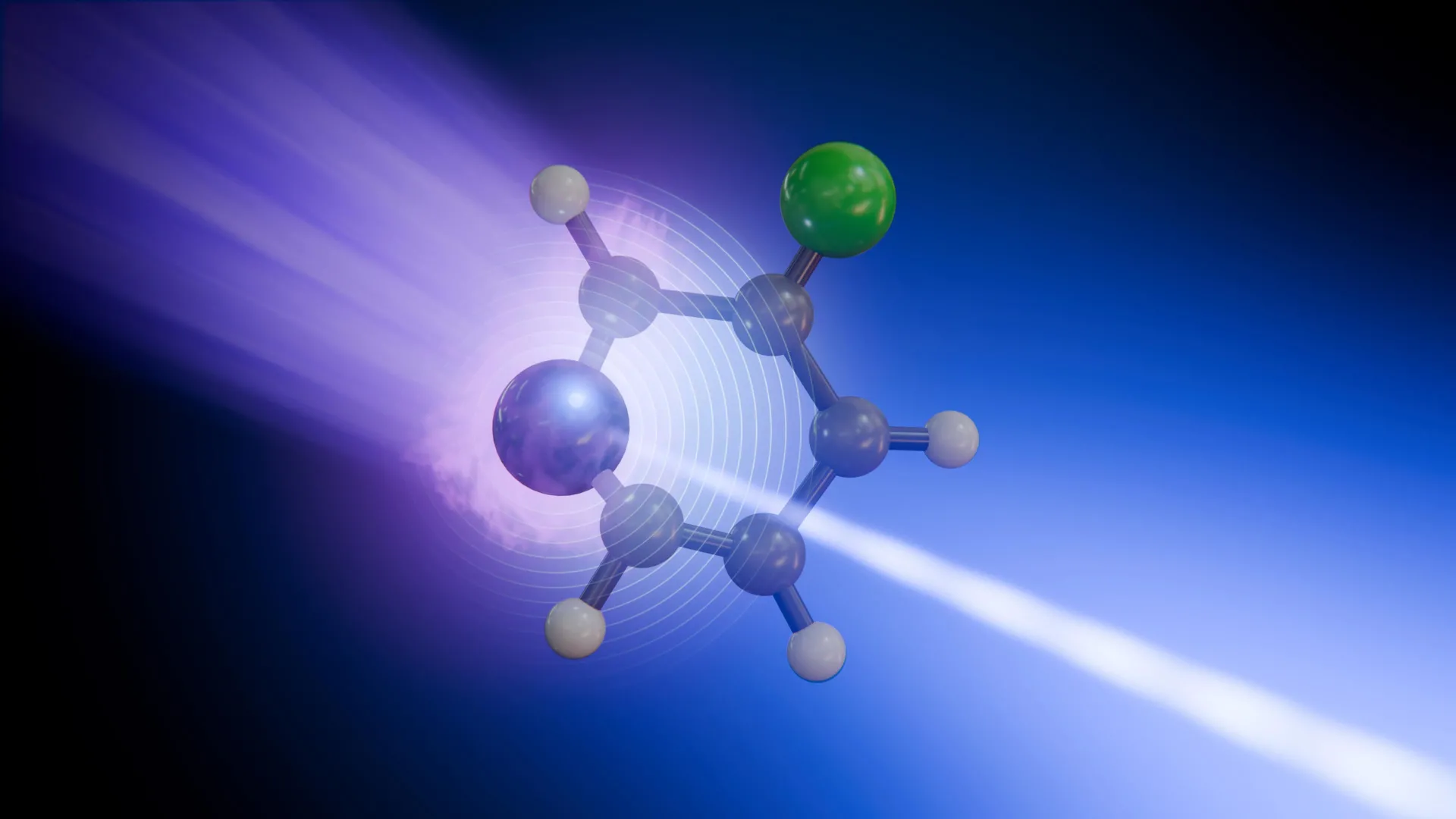
Researchers at the European XFEL facility have demonstrated a new method for tracking ultrafast chemical transformations at the atomic level by monitoring energy redistribution within molecules following light absorption. The team studied 3-fluoropyridine, a small ring-shaped molecule containing nitrogen and fluorine atoms, using time-resolved X-ray photoelectron spectroscopy to capture molecular changes occurring over picoseconds.
When the molecule absorbed energy from an ultraviolet laser pulse, its electrons entered a higher energy state and the molecular structure bent out of its normally flat configuration. The researchers focused on a critical phase called the conical intersection, where electron movements and atomic motion become tightly coupled, enabling rapid energy transfer between electronic and structural components. After this transition, the molecule returned to its ground state while excess electronic energy converted into molecular vibrations.
The measurements revealed that different atoms within the molecule provided distinct information about the energy redistribution process. The fluorine atom clearly indicated how vibrations dissipated over time, while the nitrogen atom produced more complex signals reflecting both electron redistribution and structural changes. This finding highlights that individual atomic sites capture different aspects of the photochemical reaction, offering multiple perspectives on a single molecular transformation.
The technique involved delivering an ultraviolet laser pulse to energize the molecules, followed by a precisely timed soft X-ray pulse that ionized atoms by removing deeply bound electrons. By repeating measurements at various time delays, researchers reconstructed the chemical environment changes surrounding each atom. Computer simulations and theoretical models subsequently interpreted the experimental data to connect observed signals with underlying electronic and structural transformations.
The research demonstrates the capability of European XFEL’s ultrashort, high-brightness X-ray pulses to resolve extremely rapid interconnected processes in molecular systems. While this experiment focused on a relatively simple molecule, the approach could extend to more complex systems including functional organic molecules, biomolecular components, and materials designed to capture light energy, potentially advancing understanding of photochemistry and light-driven processes in biological and materials science contexts.
Article Attribution | Read More at Article Source
Article summary produced by Claude AI