

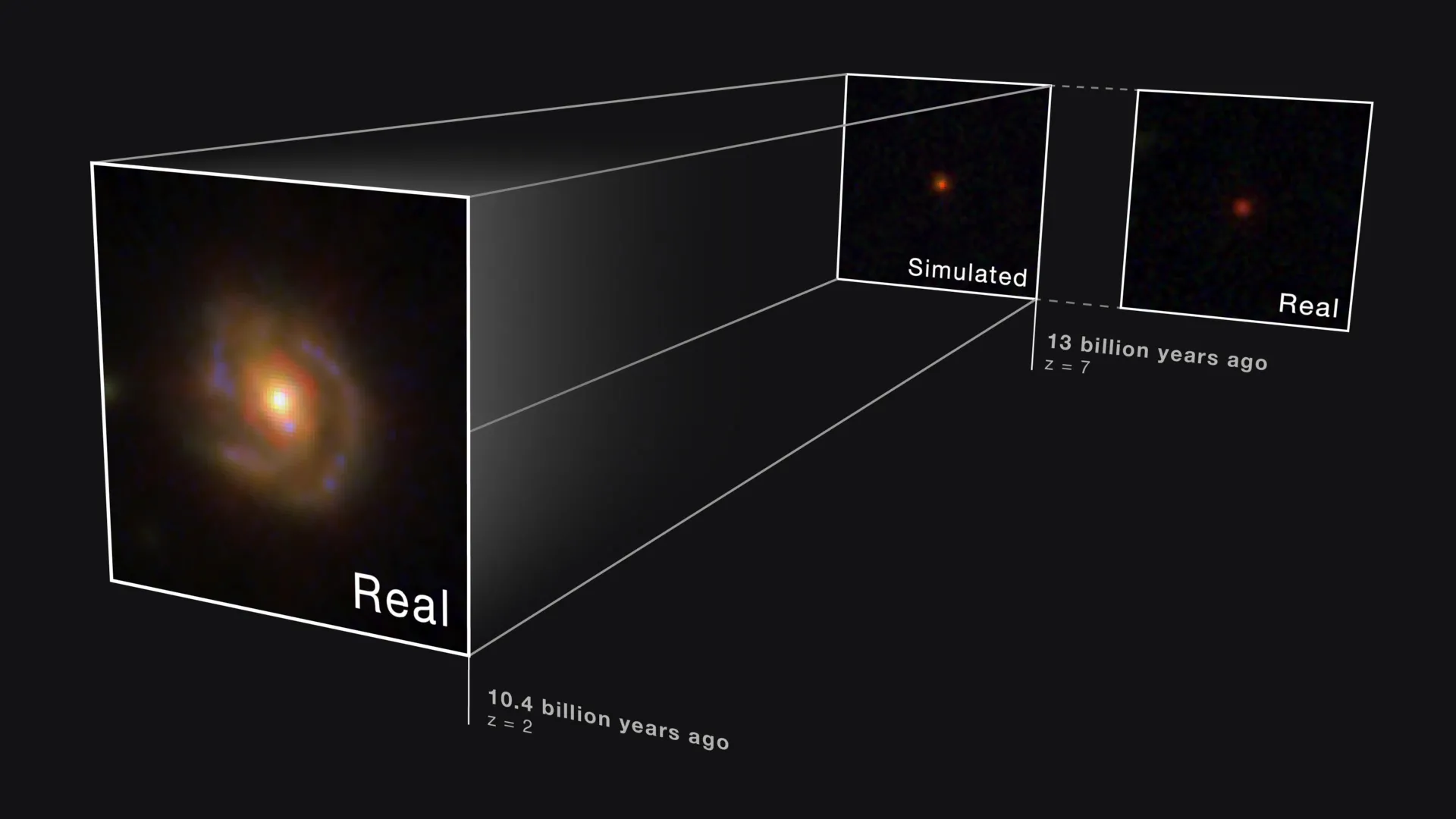
Since 2022, NASA’s James Webb Space Telescope has detected numerous compact red sources at extreme distances, referred to as little red dots, throughout the early universe. Astronomers have struggled to understand their nature, with one theory suggesting they are supermassive black holes known as active galactic nuclei. However, these objects behave differently from active galactic nuclei observed in nearby galaxies, appearing frequently at high redshift but decreasing in frequency at lower redshifts, prompting questions about their evolution over cosmic time.
A research team led by Pierluigi Rinaldi of the University of Arizona’s Steward Observatory, now at the Space Telescope Science Institute in Baltimore, published findings on July 29 in The Astrophysical Journal proposing a new explanation. The team suggests that little red dots may not constitute a separate galaxy population but instead appear unusual due to observational limitations. At extreme distances, surrounding structures become too faint to detect with current instruments, leaving only the bright central source visible to astronomers.
The researchers based their conclusions on detailed study of a lower-redshift spiral galaxy designated WISEA J123635.56+621424.2, nicknamed the “Saguaro” for its spiral arms resembling the cactus species. Located at redshift 2, the galaxy contains a compact red center strongly resembling a little red dot. The team employed observations from the retired Spitzer Space Telescope along with detailed spectroscopic and imaging data from the Hubble and James Webb space telescopes across ultraviolet, visible, and infrared wavelengths.
When researchers digitally simulated how the Saguaro would appear at greater distances, its surrounding galaxy structure faded beyond detection while the central source remained visible—mirroring the appearance of distant little red dots. The Saguaro also demonstrated weak X-ray emission detected by NASA’s Chandra X-ray Observatory, a characteristic that may explain similar X-ray weakness observed in distant little red dots. The findings suggest that observational bias may account for the apparent isolation of many distant red sources, with their surroundings simply too faint for current telescopes to detect.
Article Attribution | Read More at Article Source
Article summary produced by Claude AI