

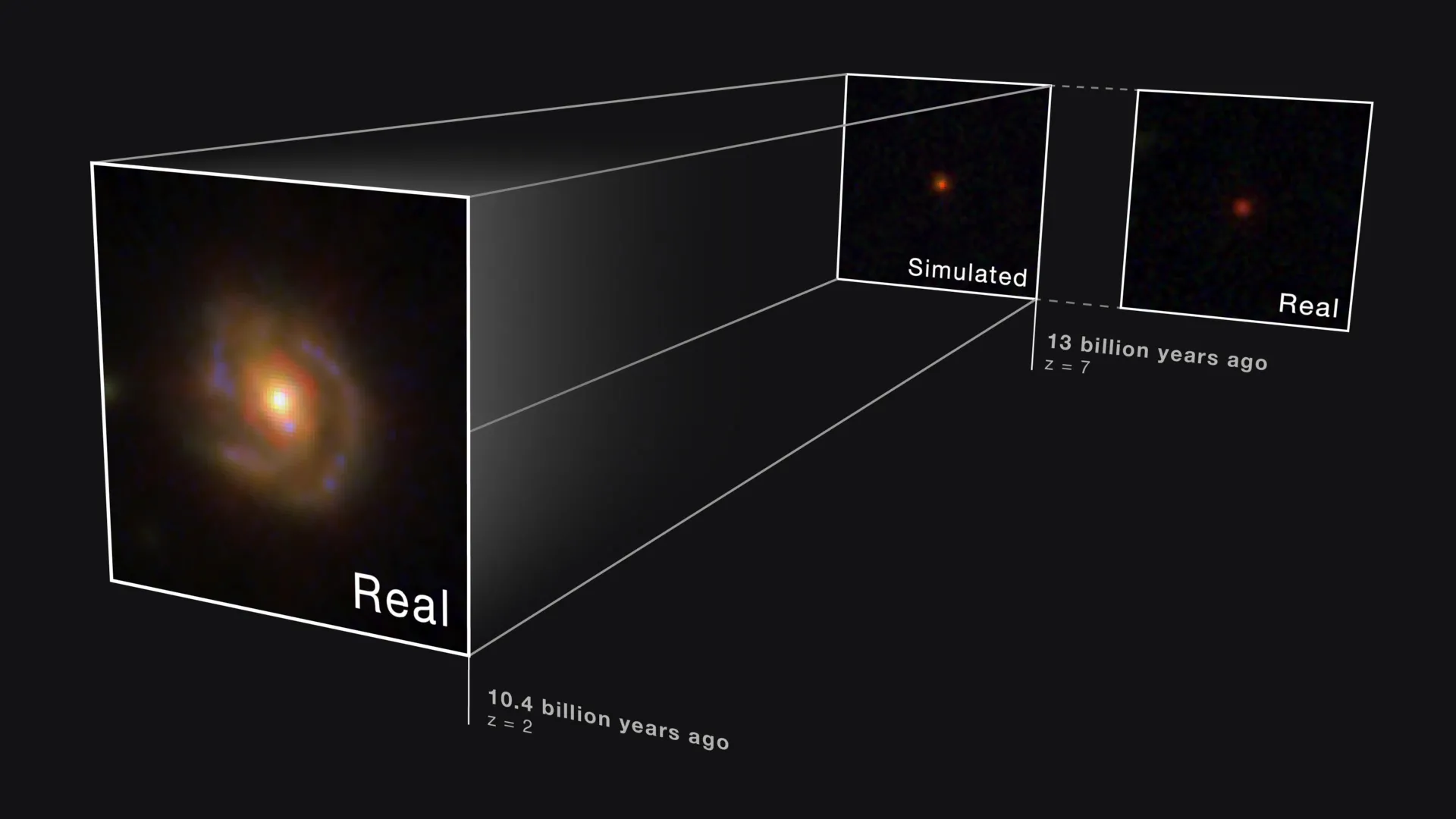
Since its initial observations in 2022, NASA’s James Webb Space Telescope has revealed numerous compact, extremely distant red sources throughout the early universe that astronomers have struggled to classify. Known as little red dots, or LRDs, these objects appear far more frequently at greater cosmic distances but become significantly rarer in the nearby universe, prompting researchers to investigate their nature and evolution over time.
A research team led by Pierluigi Rinaldi of the University of Arizona’s Steward Observatory, now at the Space Telescope Science Institute in Baltimore, published findings on July 29 in The Astrophysical Journal suggesting that little red dots may not constitute a distinct galaxy population. Rather, their unusual appearance could partly stem from observational limitations. At extreme distances, the fainter structures surrounding these bright central sources become undetectable with current telescopes, leaving only the luminous core visible to astronomers.
The team reached their conclusions by studying a spiral galaxy designated WISEA J123635.56+621424.2, nicknamed the “Saguaro” due to its resemblance to the desert cactus. Located at redshift 2, this galaxy is seen as it existed roughly 3.3 billion years after the Big Bang. Its central compact red source closely mirrors the characteristics of a little red dot. Earlier observations from NASA’s retired Spitzer Space Telescope had already provided preliminary evidence of dust-obscured, compact galaxies at lower redshifts, paving the way for more detailed examinations with Hubble and Webb.
The researchers combined archival data from multiple space telescopes to examine the Saguaro across the electromagnetic spectrum. Observations confirmed that the galaxy’s nucleus displayed characteristics typical of little red dots, including stronger emission in ultraviolet and infrared wavelengths. Notably, NASA’s Chandra X-ray Observatory detected weak X-ray emissions from the nucleus, suggesting a heavily obscured active galactic nucleus.
When researchers digitally repositioned the Saguaro to simulate its appearance at greater cosmic distances, the surrounding galaxy faded from view while the bright central source remained visible. This simulation strongly supported the hypothesis that observational bias accounts for the isolated appearance of many distant little red dots. The team concluded that the fainter galactic environments surrounding these objects are simply too dim to observe with current instruments, indicating that little red dots represent far more complex structures than their isolated appearance suggests.
Article Attribution | Read More at Article Source
Article summary produced by Claude AI