

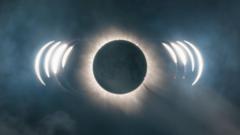
A notable partial solar eclipse will occur on 12 August, with viewers across the West Country positioned to see substantial coverage of the sun. Cornwall and the Isles of Scilly are expected to experience the best views in the region, with approximately 95% of the sun obscured, while Bristol, Somerset, Gloucestershire, and Wiltshire will see around 90% coverage. Astronomers have designated this event as the most impressive solar eclipse visible from Britain since the well-documented total eclipse of August 1999.
The eclipse will commence at 18:17 BST, reach maximum obscuration at 19:12 BST, and conclude at 20:06 BST. Because the event occurs during evening hours, observers will need clear visibility toward the western horizon, as the sun and moon will be descending throughout the phenomenon. Multiple astronomical societies across the region are organizing public viewing events at elevated locations, including Bristol’s Downs Sea Walls Viewpoint, Bath’s Beckford Tower, and sites throughout Devon and Cornwall.
Astronomical organizations are distributing free, safety-certified eclipse glasses to the public and providing access to specialized solar telescopes at designated viewing locations. Safety officials emphasize that observers must use glasses marked with ISO 12312-2 certification and avoid direct observation without proper protection. Photography enthusiasts are advised to use dedicated solar filters on camera equipment rather than attempting to capture images with unprotected devices.
The next total solar eclipse visible from the UK is not anticipated until September 2090, making this partial eclipse particularly significant for regional observers. According to the National Space Centre, while the path of totality will traverse from Northern Russia through Greenland, Iceland, Spain, and Northern Portugal, the UK will miss complete coverage but still experience substantial solar obstruction.
Weather conditions will be critical to the event’s success, with participants encouraged to scout locations in advance and identify westward-facing vantage points. Astronomical societies have prepared guidance materials and assembled volunteer teams to facilitate public engagement with this rare celestial occurrence.
Article Attribution | Read More at Article Source
Article summary produced by Claude AI