

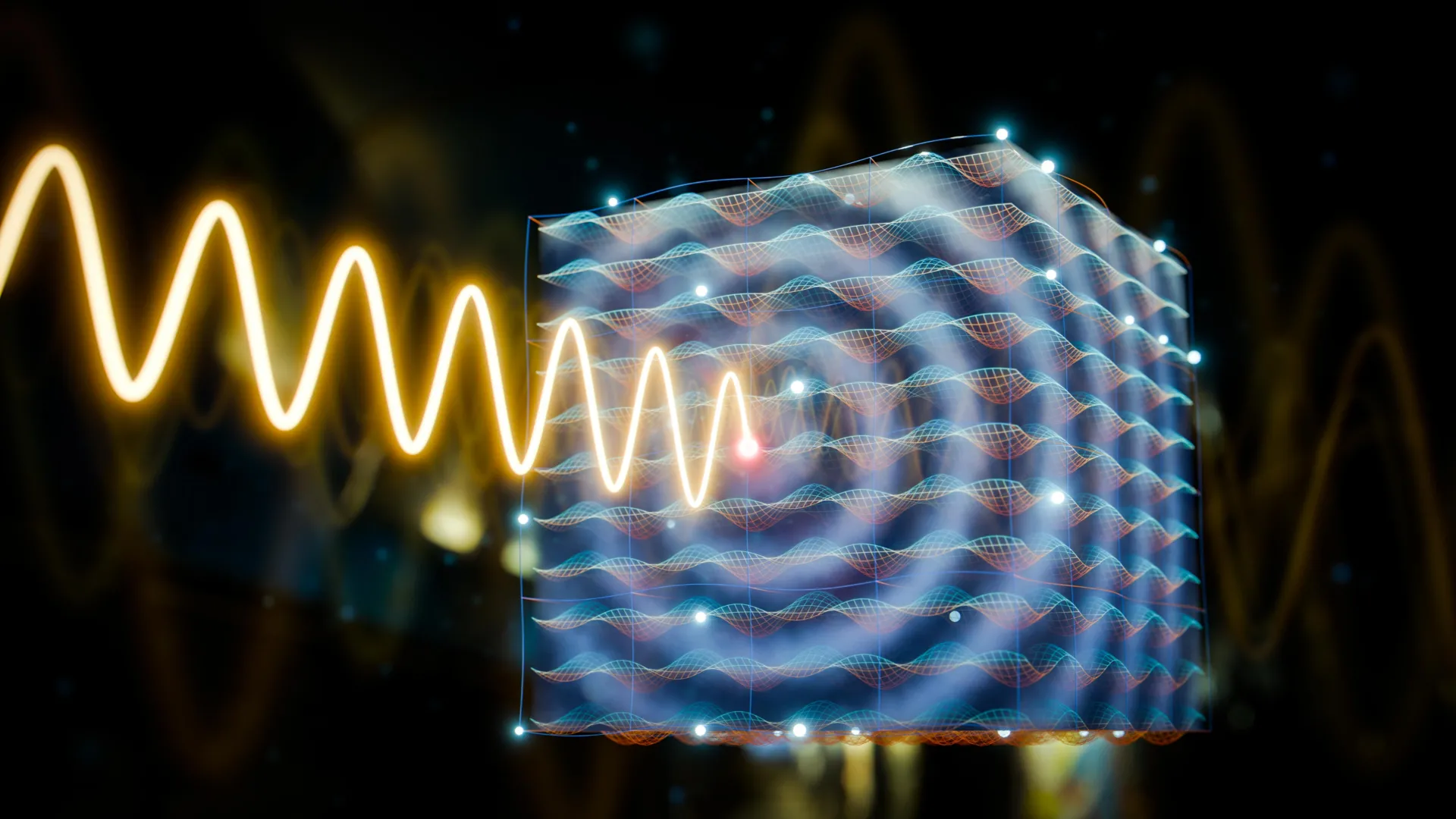
Scientists from École Polytechnique, Collège de France, and Helmholtz-Zentrum Dresden-Rossendorf have successfully demonstrated the first all-optical photonic time crystal in an experiment published in Nature. The achievement represents a significant advancement in controlling light behavior within materials, which has already enabled technologies such as optical fibers, lasers, and optical sensors that are integral to modern communication and scientific applications.
The research focused on the terahertz frequency range, a portion of the electromagnetic spectrum situated between conventional electronics and photonics that remains largely underdeveloped technologically. Terahertz frequencies operate approximately 1,000 times faster than electronic components, offering substantial potential for new methods to examine and manipulate matter. The team utilized HZDR’s TELBE superradiant terahertz source to explore previously inaccessible forms of light-matter interaction in this frequency range.
Unlike conventional photonic crystals that maintain fixed optical properties once established, the new device can dynamically alter its optical characteristics on picosecond timescales—approaching the speed of light’s own oscillations. The researchers constructed a plasmonic metamaterial containing micrometer-scale gold structures positioned above semiconductor layers. When exposed to terahertz laser pulses, the device’s optical properties, particularly reflectivity, changed dramatically and rapidly. The theoretical model supporting the findings also demonstrated that temporal modulation reduced photon dissipation by approximately half.
The team aims to further reduce photon loss and increase photon retention within the crystal structure. If sufficiently strong amplification is achieved, the technology could serve as the foundation for highly adaptable new lasers applicable to medical imaging and communications. The ability to rapidly control light properties such as color and intensity could ultimately enable faster, more intelligent optical systems and contribute to the development of ultrafast optical computers in the terahertz range and beyond.
Article Attribution | Read More at Article Source
Article summary produced by Claude AI