

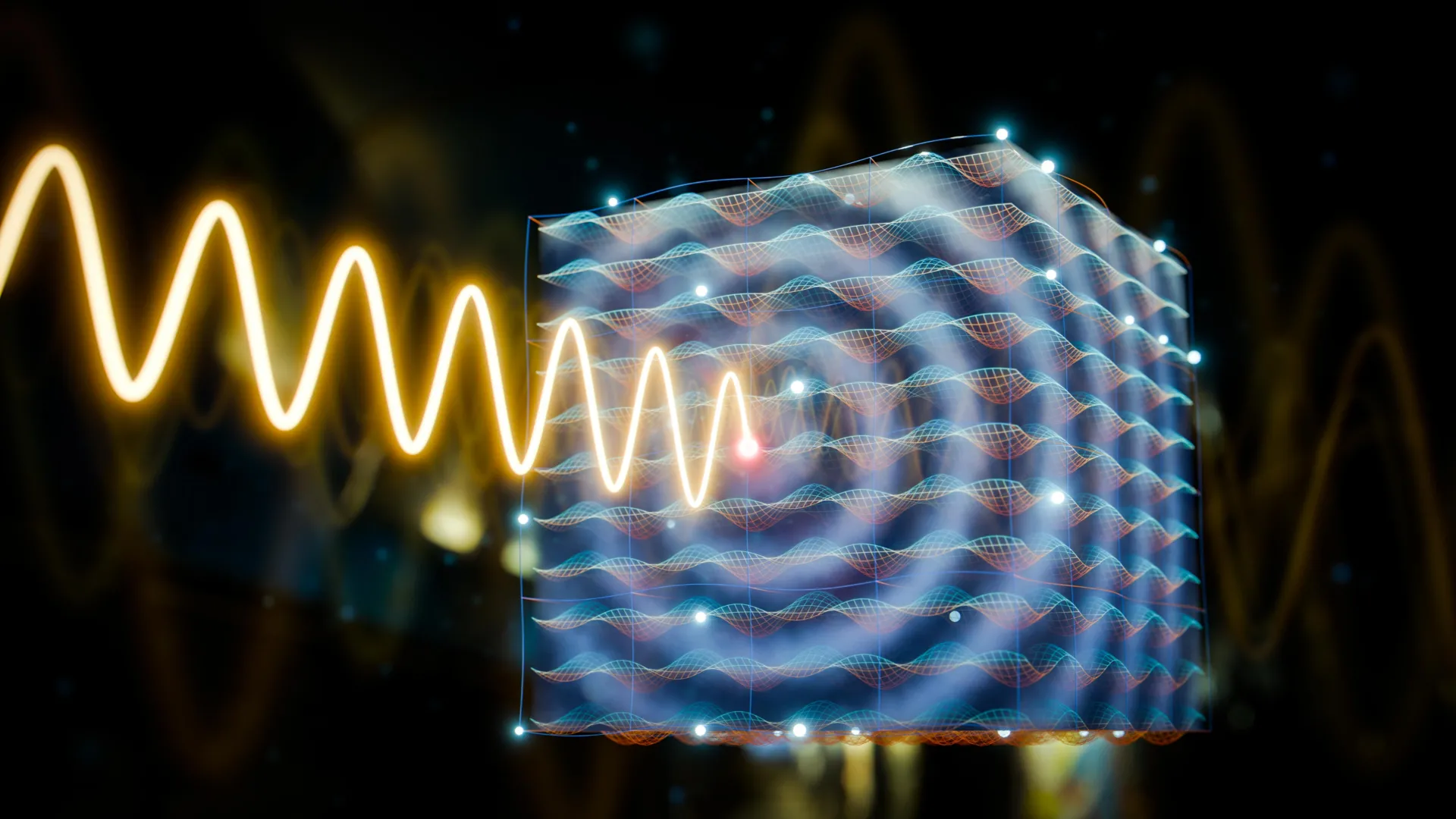
Researchers from École Polytechnique, Collège de France, and Helmholtz-Zentrum Dresden-Rossendorf have achieved a scientific milestone by experimentally producing the first all-optical photonic time crystal. The breakthrough, published in Nature, leverages HZDR’s TELBE superradiant terahertz source to access previously unexplored forms of light-matter interaction in the terahertz frequency range. The discovery could advance ultrafast optical computing, telecommunications infrastructure, and the development of novel terahertz laser technologies.
Conventional photonic crystals are nanostructured materials with repeating optical patterns that control how photons move through them by blocking, guiding, or strengthening specific wavelengths. Prior experiments demonstrated that temperature and magnetic fields could alter these materials’ light-capturing abilities, though their optical behavior remained static once established. The new photonic time crystal extends this concept by introducing a repeating temporal pattern alongside spatial patterns, allowing optical properties such as reflectivity and resonance frequency to change dynamically on picosecond timescales—approaching the speed of light’s own oscillations.
The experimental device employs a plasmonic metamaterial constructed with micrometer-scale gold structures positioned above an insulating layer and a semiconductor composed of indium and antimony. These gold structures create tiny cavities that confine light between layers. When the semiconductor surface is excited, it generates surface plasmons—collective electron waves that capture and maintain light oscillations. This interaction enabled researchers to manipulate trapped photons with unprecedented speed.
The team exposed the device to terahertz laser pulses from TELBE, achieving dramatic changes in optical properties on picosecond timescales while simultaneously producing strong modulation effects. A theoretical model developed by researchers at Collège de France confirmed experimental findings and revealed that temporal modulation reduced photon dissipation by half. Future work aims to further decrease dissipation and increase photon retention, potentially enabling highly adaptable new laser systems. Such advances could support applications ranging from medical imaging to telecommunications, with the ability to instantly tune light properties on demand.
Article Attribution | Read More at Article Source
Article summary produced by Claude AI