

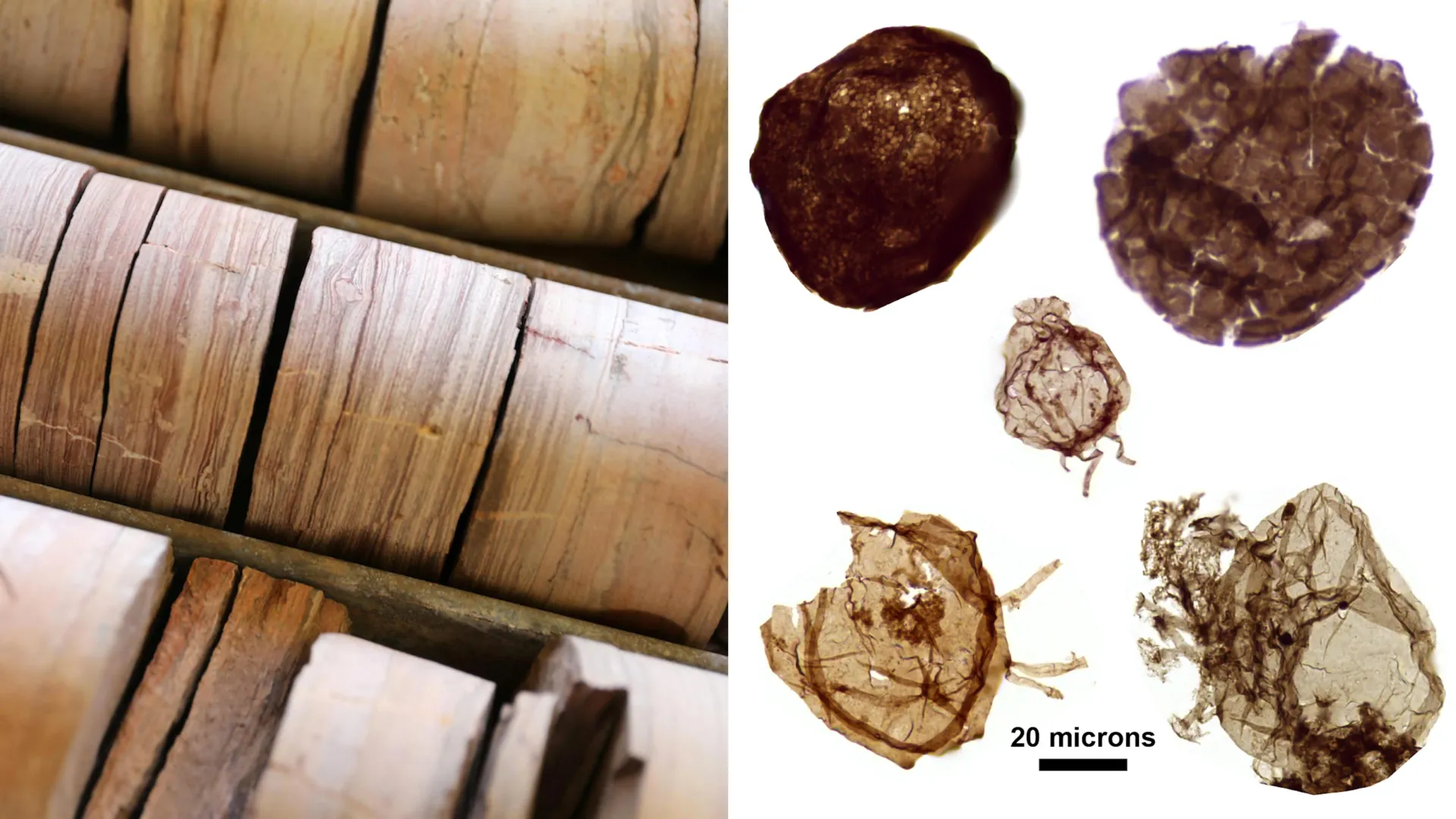
Researchers examining microfossil cores stored in Darwin, Australia have provided new insights into the evolutionary origins of eukaryotes, the cellular foundation for all complex life. The cores, collected decades ago by mineral exploration companies, contain mudstone samples from an ancient inland sea that covered northern Australia more than 1.5 billion years ago. Within these sediments, scientists identified over 12,000 fossils of microscopic organisms that represent some of the oldest known eukaryotic remains on record.
The distinction between prokaryotes and eukaryotes represents a fundamental divide in cellular organization. Prokaryotes, such as bacteria and archaea, possess simple cellular structures and exist primarily as single cells. Eukaryotes, by contrast, feature complex cells with nuclei and specialized organelles, encompassing all animals, plants, algae, and fungi. Scientific consensus holds that eukaryotes arose through a symbiotic merger of at least two prokaryotic microbes, fundamentally transforming planetary life and eventually enabling the emergence of animals and humans.
A long-standing question has concerned the environmental conditions under which early eukaryotes evolved and their dependence on oxygen. While nearly all modern eukaryotes rely on aerobic respiration for energy, recent discoveries have revealed some eukaryotes capable of thriving in oxygen-free conditions. Geological evidence has suggested that oxygen was scarce during early eukaryotic evolution, implying that oxygen-free marine environments may have been prevalent.
The research team analyzed the mudstone samples through dissolution and microscopic examination of organic residues. They also investigated the chemical composition of the mudstones to determine oxygen levels in the ancient seawater. Results demonstrated that eukaryotic fossils appeared exclusively in oxygenated environments, ranging from coastal mudflats to open ocean settings, while oxygen-free samples contained only prokaryotic forms. This pattern indicates that even the earliest known eukaryotes from 1.7 to 1.4 billion years ago required oxygen for survival.
The findings support the hypothesis that oxygen played a crucial role in driving early eukaryotic evolution. The study, published in Nature, contributes to ongoing efforts to understand one of science’s major outstanding questions regarding the origins of complex life and humanity’s place in the evolutionary timeline.
Article Attribution | Read More at Article Source
Article summary produced by Claude AI