

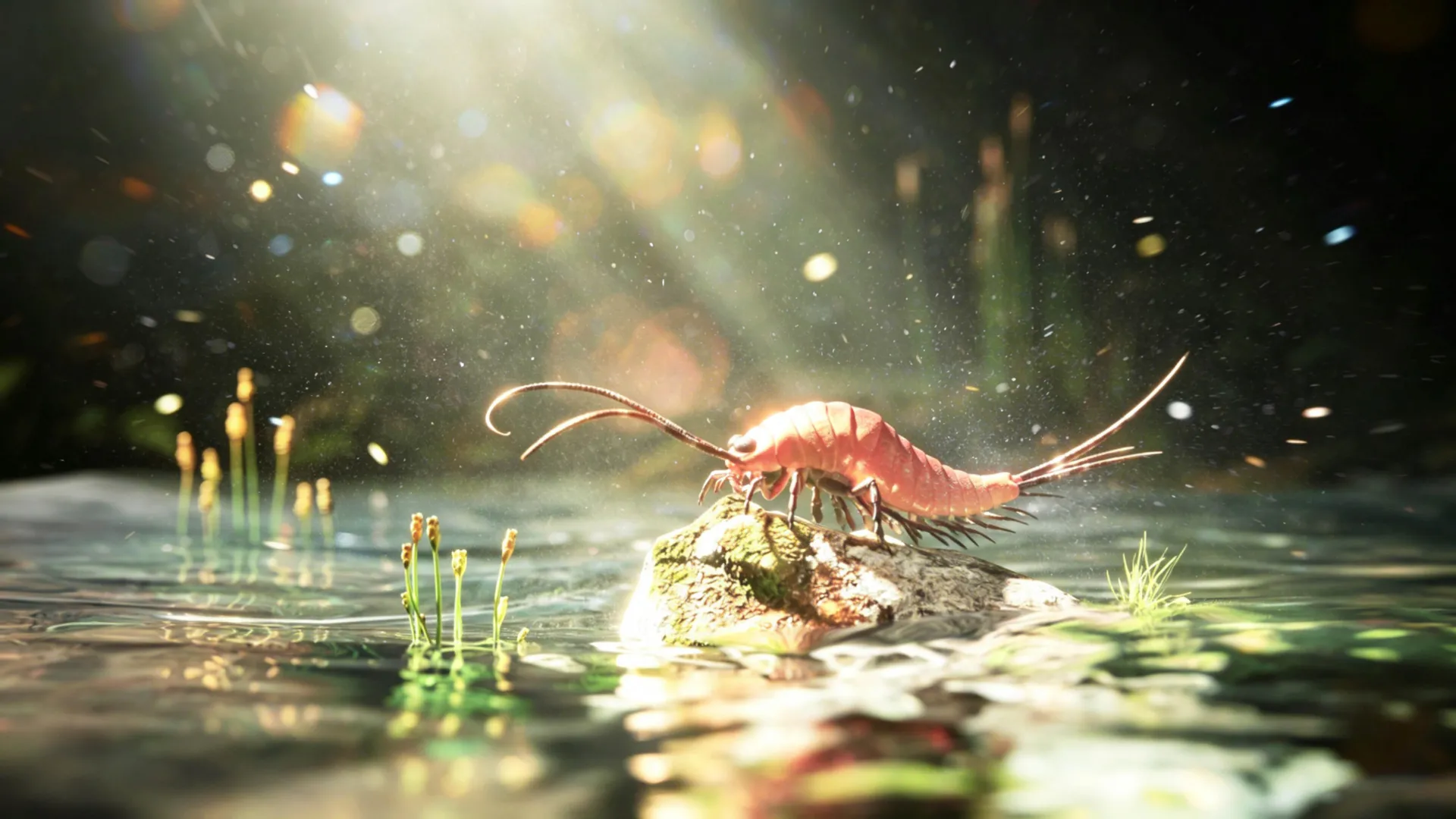
An international research team has described findings from fossil specimens that illuminate how insects transitioned from aquatic to terrestrial environments during Earth’s early history. The work centers on a newly identified species called Chosha praecursor, discovered in Texas and dating to approximately 324 million years ago. The research was led by Prof. Chenyang Cai of the Nanjing Institute of Geology and Paleontology and Erik Tihelka of the University of Cambridge, with results published in Nature on August 26.
The fossils of C. praecursor, which measured roughly 32 millimeters in body length, had previously been misclassified as crustacean larvae. Advanced imaging techniques revealed they were actually adult female insects with distinctive features combining both ancestral and modern insect characteristics. The specimens possessed six walking legs and an ovipositor, traits associated with insects, but also retained segmented appendages along their abdomen that paddled like swimming limbs. Geological evidence indicates these organisms inhabited shallow delta coastal environments, suggesting they lived amphibious, semi-aquatic lifestyles in humid zones between water and land.
These findings address a significant gap in the fossil record. While molecular studies suggest insects diverged from marine crustaceans as early as the Cambrian-Ordovician interval, undisputed hexapod fossils do not appear until the Early Devonian approximately 405 million years ago, with clearly recognizable insects becoming abundant only in the Late Carboniferous period. This creates an approximately 80 million-year interval with sparse fossil documentation. By reexamining additional mysterious specimens from Britain and the United States, researchers identified three specimens as a primitive stem lineage of insects, helping bridge this significant gap.
The research reveals that the transition to terrestrial life occurred gradually rather than abruptly. Early insects retained and modified aquatic features inherited from their ancestors over an extended period. As insects evolved away from their crustacean origins, swimming appendages were progressively simplified and eventually lost, ultimately producing the modern insect body plan with all legs attached to the thorax and abdominal appendages nearly absent. The presence of developed oviposition structures in these early forms suggests that reproductive adaptations may have facilitated their later diversification and exploitation of terrestrial environments.
Article Attribution | Read More at Article Source
Article summary produced by Claude AI