

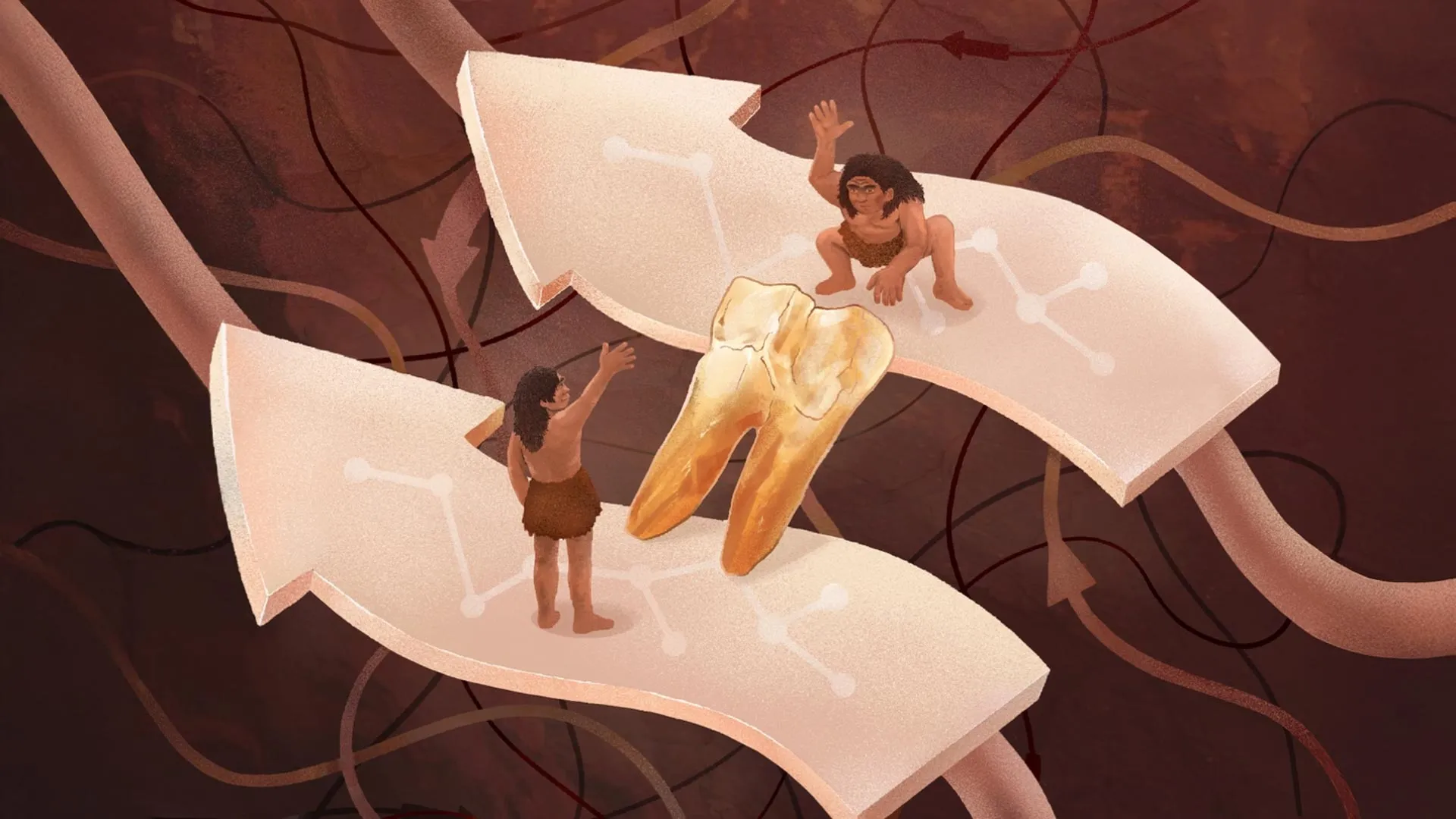
Researchers at the Chinese Academy of Sciences’ Institute of Vertebrate Paleontology and Paleoanthropology have identified molecular evidence in ancient teeth that may illuminate previously unknown genetic relationships within human evolutionary history. The team examined fossils from three Chinese sites—Zhoukoudian, Hexian, and Sunjiadong—dating back at least 400,000 years, employing new techniques to extract protein information with minimal damage to the scientifically irreplaceable specimens.
The analysis revealed two mutations in enamel proteins from the Homo erectus teeth. One previously unknown variant, designated AMBN A253G, appeared across all three fossil sites, suggesting these populations shared a common evolutionary lineage. The second variant, AMBN M273V, had been considered unique to Denisovans but was found in these H. erectus samples as well, indicating a more complex genetic history than previously understood.
Researchers propose that the AMBN M273V variant may have passed from H. erectus to Denisovans through genetic exchange between ancient populations, and subsequently been transmitted to modern humans in Southeast Asia and Oceania. This pathway, if confirmed, would establish the first molecular evidence of a genetic connection between East Asian H. erectus populations and people living today, potentially resolving long-standing questions about H. erectus’s role in human evolutionary development.
Beyond the specific findings, the team developed innovative paleoproteomics methods that could transform how scientists study ancient human remains. Using acid etching techniques that require only minimal sample material, they created new approaches for determining the biological sex of ancient hominins and cross-verifying results through multiple analytical pipelines. These methodological advances establish a framework for conducting protein-based genetic research on fossils while preserving their structural integrity, potentially unlocking information from specimens previously considered too fragile for molecular study.
Article Attribution | Read More at Article Source
Article summary produced by Claude AI