

Cosmic rays originating from distant violent events such as exploding stars continuously strike Earth’s atmosphere, generating secondary particles including muons that can penetrate underground. These otherwise invisible particles have long been of scientific interest, with muon measurements providing early experimental support for Einstein’s theory of special relativity and offering insights into powerful cosmic phenomena including supernovae and gamma-ray bursts.
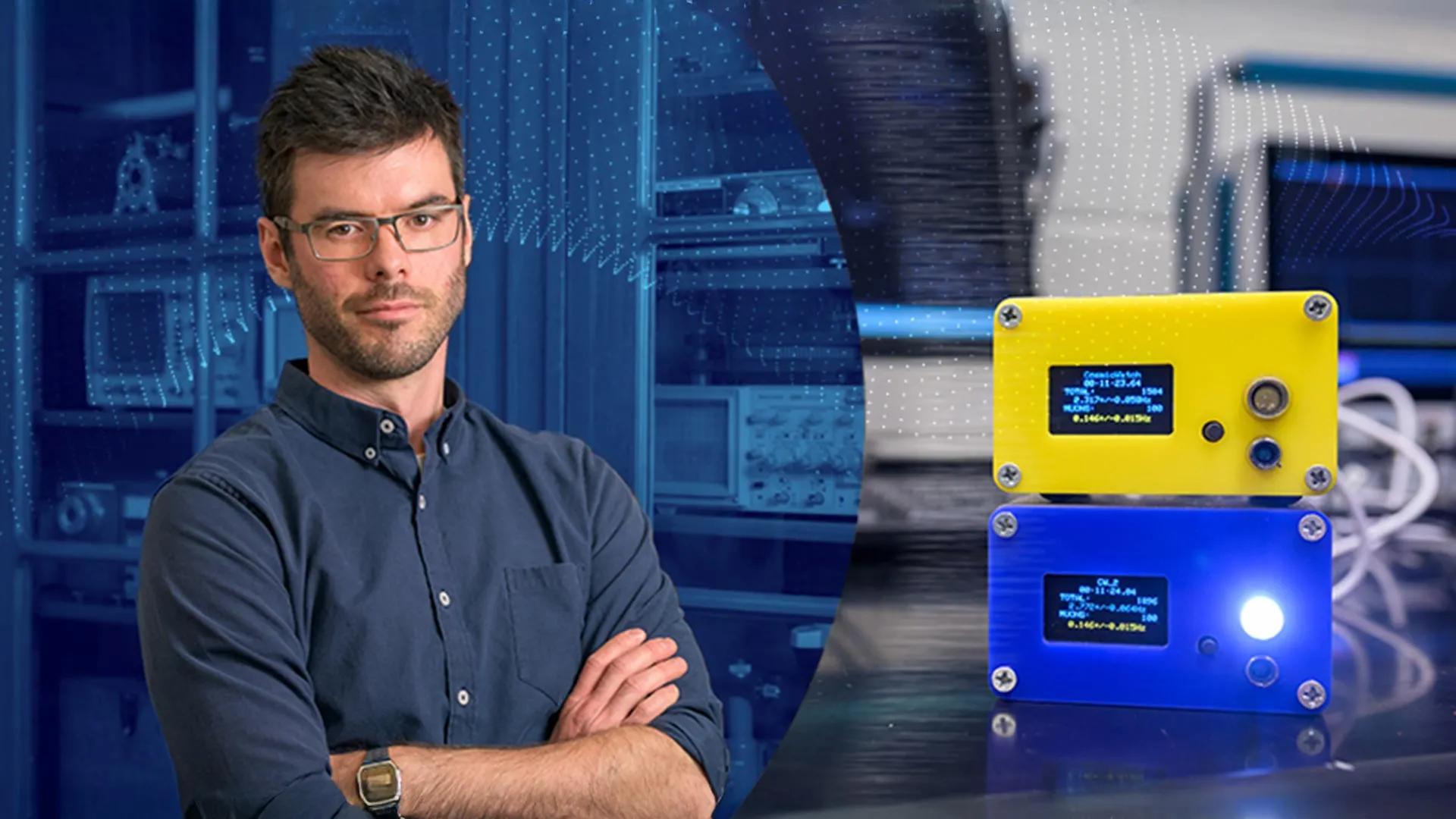
Spencer Axani, a physics professor at the University of Delaware, developed CosmicWatch, a compact muon detector constructed from electronic components costing approximately $100. The device, roughly the size of a box of animal crackers, produces a flash and records a count whenever a muon passes through it, storing data for later analysis. Axani initially created the technology while a graduate student at MIT in 2017, with the original purpose of building a compact detector for the IceCube observatory in Antarctica. He recognized the potential for adapting the design into an affordable educational tool and has continued refining it since joining UD’s faculty in 2022.
The latest version of CosmicWatch, detailed in the Journal of Instrumentation in October, offers improved capabilities including environmental monitoring, enhanced tolerance for high radiation, and faster data collection. The detector is now employed in various research contexts, including the NuDot experiment at the University of Delaware and the Coherent CAPTAIN-Mills dark matter detector in Los Alamos, New Mexico. Researchers are developing variants suited for measuring primary cosmic rays aboard rockets and spacecraft.
Beyond its research applications, CosmicWatch remains central to particle physics education. University of Delaware students assemble the devices themselves, gaining hands-on experience with high-speed electronics and designing their own experiments. One doctoral student added temperature and pressure sensors to his device and launched it aboard a high-altitude balloon to 100,000 feet to study how cosmic ray flow varies with altitude. Similar educational implementations occur at other institutions, including Cornell University, where students build detectors and conduct experiments as part of introductory physics courses.
Article Attribution | Read More at Article Source
Article summary produced by Claude AI