

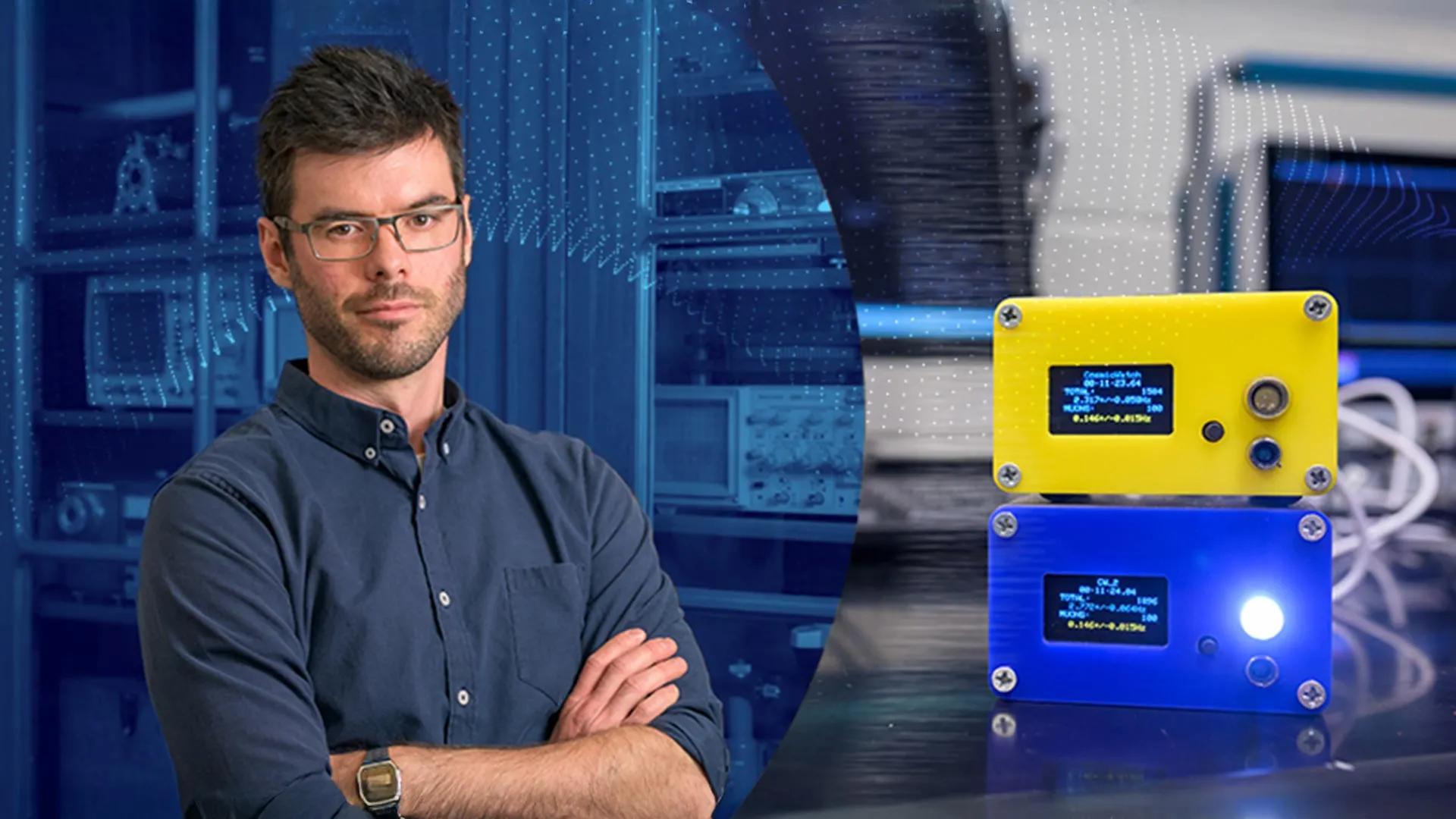
Cosmic rays continuously strike Earth’s atmosphere, creating showers of secondary particles including muons that travel through the atmosphere and penetrate underground. University of Delaware physics professor Spencer Axani developed CosmicWatch, a detector roughly the size of a box of animal crackers built from electronic components costing approximately $100. The device flashes and records data whenever a muon passes through it, with information stored for later analysis and download.
Scientists study muons because they provide insights into powerful cosmic events such as supernovae, gamma-ray bursts, and blazars. Measurements of muons can reveal properties of the original cosmic ray, including energy, mass, and direction. Historically, muon measurements in the early 1940s provided some of the first experimental confirmations of Einstein’s theory of special relativity. Because muons can travel through solid materials without causing damage while leaving detectable energy trails, researchers can use them to image hidden structures. Muon technology was employed in 2016 to uncover an unknown corridor in the Great Pyramid of Giza.
Axani initially created CosmicWatch in 2017 as a graduate student at MIT, aiming to build a compact, energy-efficient muon detector for use at the IceCube observatory in Antarctica. As the project developed, he recognized that the same technology could be made portable and inexpensive for educational purposes. After joining the UD faculty in 2022, Axani continued refining the design, with the third version released recently featuring improvements including environmental monitoring capabilities, tolerance for high radiation levels, and faster data collection.
The latest CosmicWatch design is being used to calibrate large-scale detectors in experiments at UD and at the Coherent CAPTAIN-Mills dark matter detector in Los Alamos, New Mexico. Researchers are developing a version for measuring primary cosmic rays aboard rockets and spacecraft. At universities including UD and Cornell, students assemble the devices themselves and conduct experiments, providing hands-on experience with experimental physics that more closely resembles professional practice than traditional laboratory courses.
Article Attribution | Read More at Article Source
Article summary produced by Claude AI