

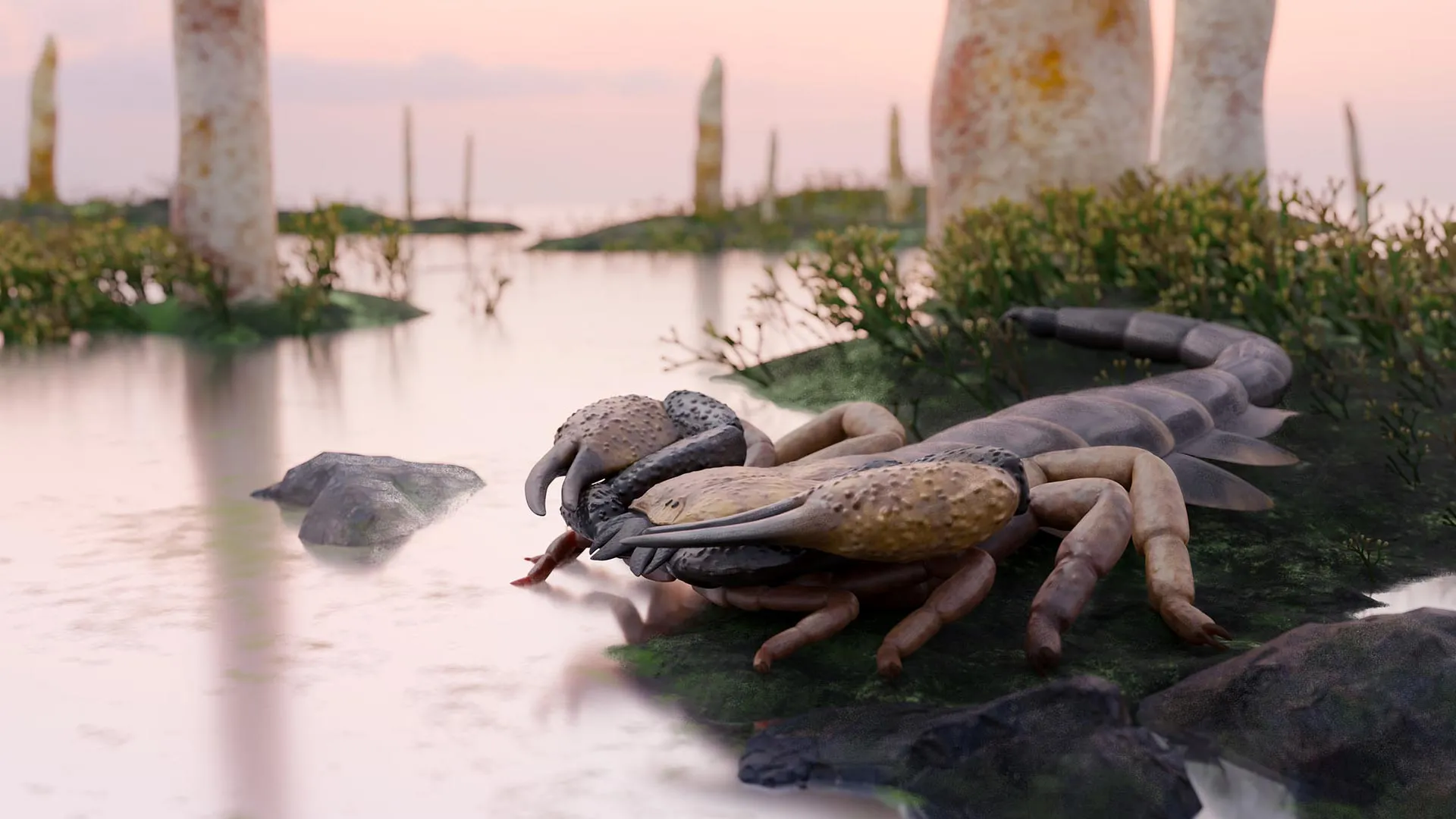
Scientists from The University of Manchester and the Natural History Museum have identified Praearcturus gigas as the largest scorpion ever documented based on fossils held in museum collections for over 150 years. The creature measured approximately one meter in length with pincers exceeding 16 centimeters and inhabited floodplain environments during the Early Devonian period, around 415 million years ago.
The research, published in Palaeontology, used contemporary analytical techniques and comparisons with recently discovered fossil species to conclusively determine that Praearcturus was indeed a scorpion rather than a crustacean. The original specimens were collected in what is now England and Wales and had been catalogued since 1871, when they were initially misidentified. The rediscovery pushes back the timeline of known giant arthropods by at least 50 million years, predating the emergence of forests and more complex terrestrial ecosystems.
Researchers note that Praearcturus lived during a period when high atmospheric oxygen levels, often associated with the later gigantism of arthropods, had not yet developed. Instead, scientists propose that ecological opportunity may explain the animal’s extraordinary size. With few competing large predators present, the scorpion could dominate its environment in ways that became increasingly difficult as terrestrial ecosystems developed greater complexity and diversity.
Fossil evidence suggests Praearcturus may have occupied both aquatic and terrestrial habitats, with some specimens preserving abdominal flap-like structures similar to features found in modern crustaceans. This possibility is supported by an elevated frequency of scorpion fossils in rocks from this period compared with other arachnids, suggesting early scorpions may have inhabited freshwater environments where fossilization was more likely. The findings highlight a significant transitional moment in Earth’s history when animals first began extensively exploring life beyond oceanic environments, with Praearcturus potentially representing a lineage that returned to water after terrestrial ancestors had already begun adapting to land.
Article Attribution | Read More at Article Source
Article summary produced by Claude AI