

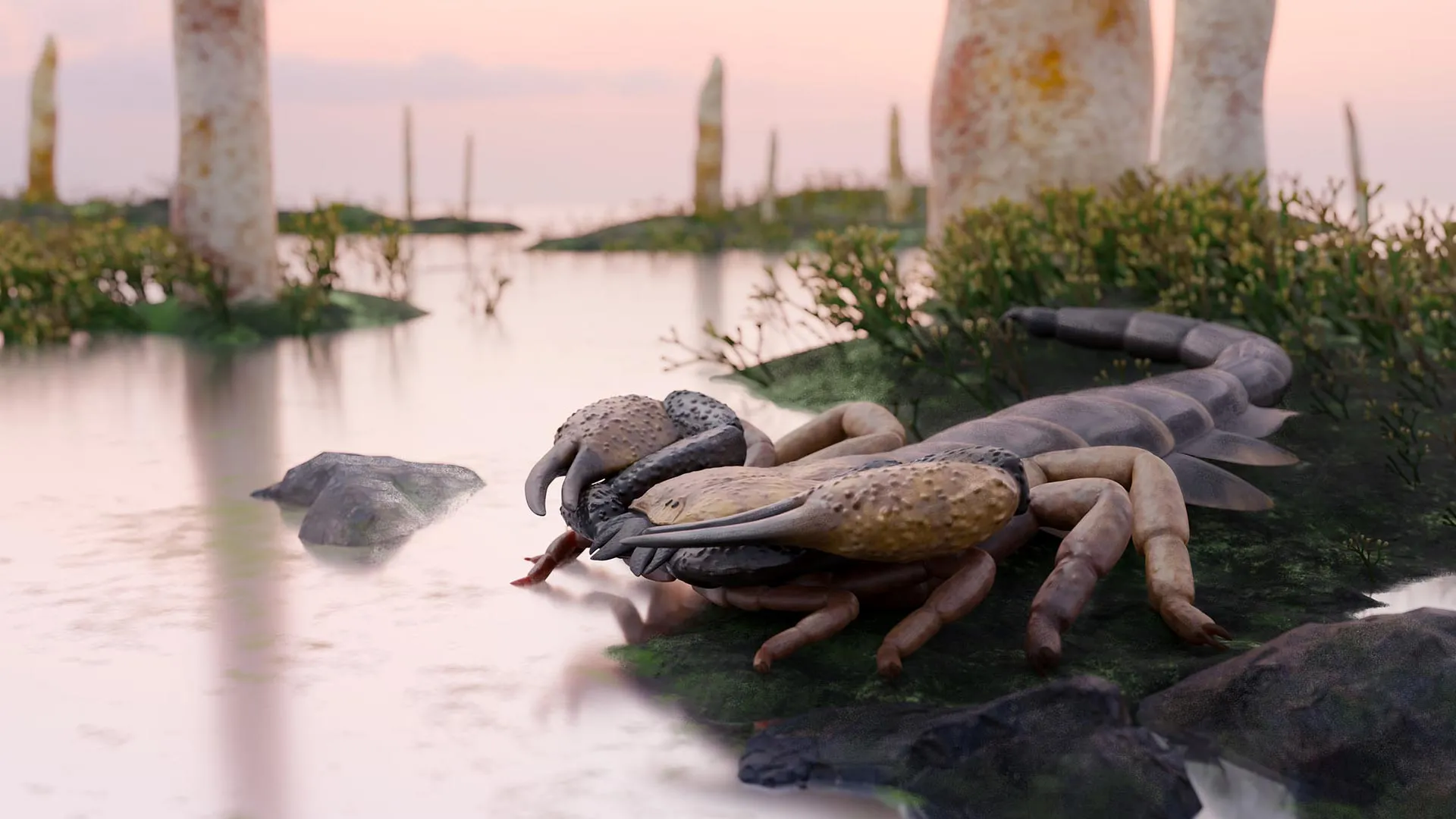
Researchers from The University of Manchester and the Natural History Museum have completed a comprehensive analysis of fossil specimens collected over 150 years ago, leading to the identification of Praearcturus gigas as the largest scorpion ever documented. The creature measured approximately one meter in length with pincers exceeding 16 centimeters, making it a formidable predator in Early Devonian floodplain ecosystems around 415 million years ago.
The findings, published in the journal Palaeontology, represent a significant reassessment of specimens initially classified differently when first described in 1871. At that time, the incomplete fossils were thought to belong to a giant crustacean resembling a woodlouse. Modern analytical techniques and comparisons with more recently discovered fossil species provided the anatomical evidence needed to correctly identify the animal as a scorpion, fundamentally altering scientific understanding of when and how these creatures reached extraordinary sizes.
The timing of Praearcturus’s existence carries particular significance within the context of Earth’s evolutionary history. The creature lived well before the emergence of forests and the associated atmospheric changes typically linked to arthropod gigantism. Instead, researchers propose that ecological opportunity may have enabled this predator’s exceptional size. With few competing large predators in Early Devonian terrestrial environments, Praearcturus could dominate its niche in ways that became impossible as ecosystems grew more complex and crowded.
Additional evidence from the fossil record suggests that Praearcturus may have occupied freshwater environments or moved between aquatic and terrestrial habitats. Abdominal structures preserved in some specimens resemble features found in modern crustaceans, supporting the hypothesis of a semi-aquatic lifestyle. This positioning places the creature at a pivotal moment in Earth’s history when animals were beginning to colonize habitats beyond the oceans and adapt to transitional environments between water and land.
Article Attribution | Read More at Article Source
Article summary produced by Claude AI