

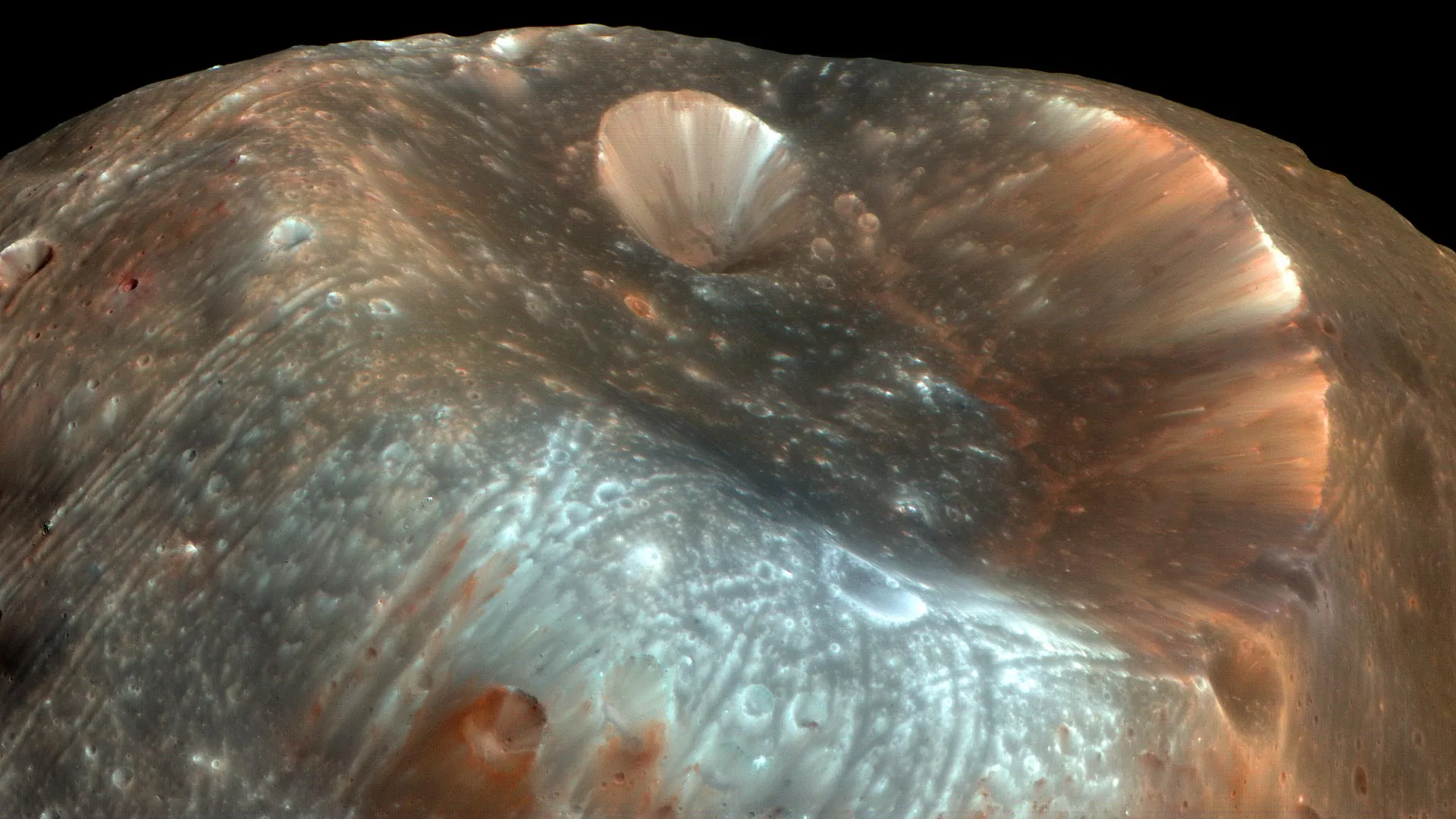
Phobos, the innermost moon of Mars, has long presented a puzzle to planetary scientists regarding its origins. Researchers have proposed two competing theories: that Phobos formed from debris ejected into orbit following a colossal collision with Mars, or that it was an asteroid subsequently captured by Mars’ gravitational pull. The resolution of this question may hinge on understanding the moon’s interior structure, which remains largely unknown despite its significance to planetary science.
The enormous Stickney Crater, spanning 9 kilometers in diameter, has emerged as a focal point in investigating Phobos’ history. If the moon originated from impact debris, the collision that created Stickney Crater may have occurred approximately 4.2 billion years ago. Conversely, if Phobos was captured as an asteroid, the impact could have taken place around 2.6 billion years ago. Recent research indicates that Phobos likely possesses a porous interior potentially containing water ice and a denser concentration of material in its equatorial region.
To advance understanding of the moon’s composition and origin, scientists are studying its gravitational field and motion in greater detail. Researchers presented findings during the recent European Geosciences Union general assembly, focusing on how the Stickney impact may have created a compressed region of denser material beneath the crater. This gravitational signature, if detected, could provide crucial insights into how mass is distributed within the moon and support evidence for one of the competing origin theories.
Phobos presents unusual characteristics that complicate interpretation of its geophysical properties. The moon’s irregular shape resembles what scientists call a rubble pile asteroid, and its extreme proximity to Mars creates challenges for analyzing its gravity and internal structure. Additionally, Phobos is gradually spiraling inward toward Mars, meaning it will eventually either break apart or collide with the planet.
An upcoming opportunity to study Phobos directly is expected through Japan’s Martian Moons Exploration mission, targeted to launch in late 2026. The spacecraft will attempt to operate in a quasi-stable orbit around the moon and return surface samples to Earth, providing researchers with unprecedented data to test existing theories about Phobos’ origin and composition.
Article Attribution | Read More at Article Source
Article summary produced by Claude AI