

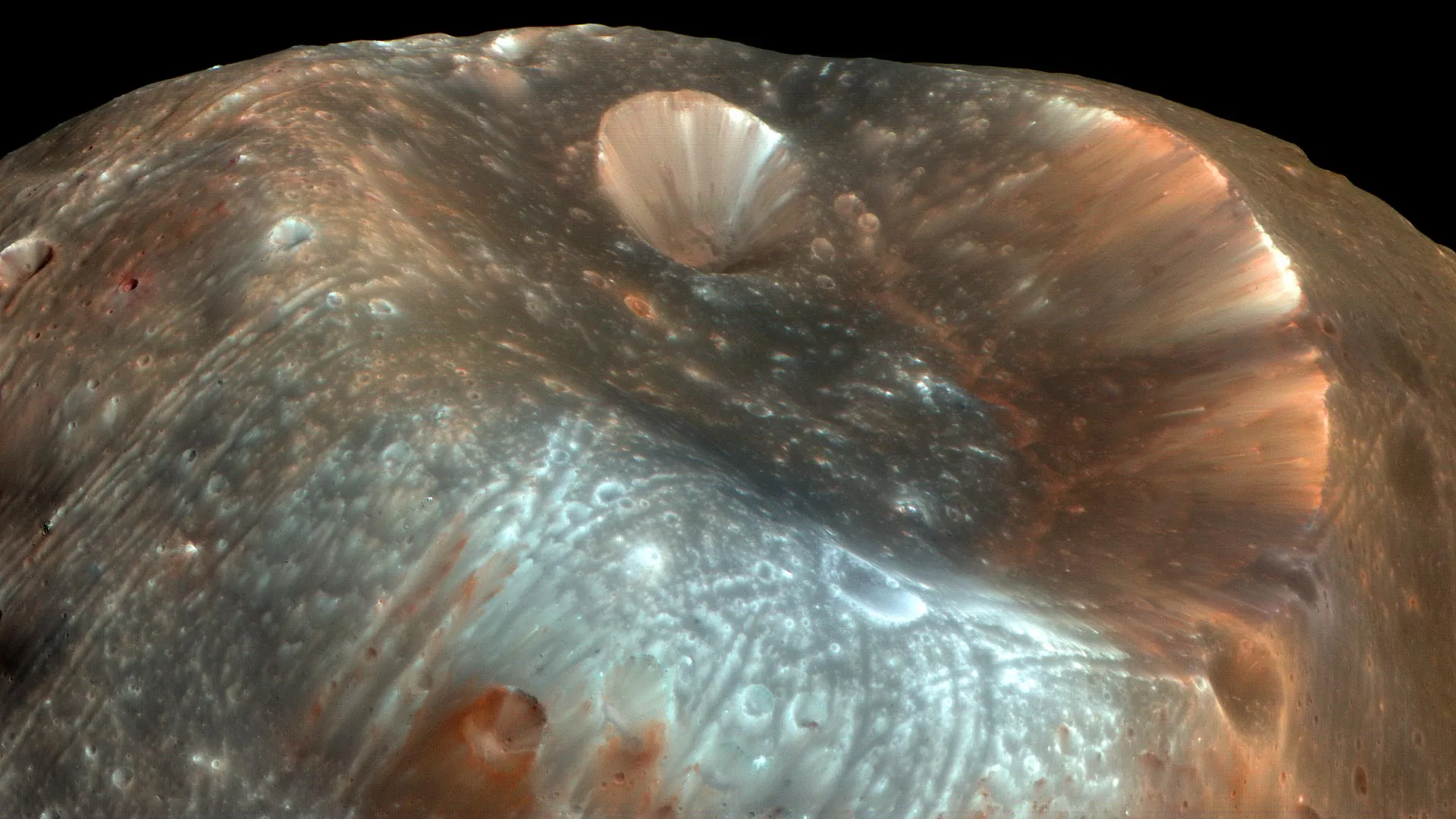
Phobos, the innermost moon of Mars, has long puzzled planetary scientists regarding its origins. Researchers are divided between two primary hypotheses: that Phobos was captured from elsewhere as an asteroid, or that it formed from material ejected into orbit following a massive impact on Mars itself. Understanding the moon’s internal structure and gravitational field may help resolve this fundamental question about its formation history.
The massive Stickney Crater, measuring approximately 9 kilometers in diameter, plays a central role in this debate. Depending on Phobos’ origin, the impact that created this crater may have occurred roughly 4.2 billion years ago if the moon formed from impact debris, or approximately 2.6 billion years ago if it was captured as an asteroid. Researchers presented work at the European Geosciences Union general assembly examining geophysical measurements around Stickney Crater. Current evidence suggests Phobos has a porous interior that may contain water ice, with a potentially denser concentration of material near its equatorial region.
One intriguing aspect of Phobos is how it survived the catastrophic impact that created Stickney Crater. For such a small moon with a mean diameter of only 22.2 kilometers, an impact of that magnitude would typically be expected to cause destruction. Scientists theorize that survival may have been possible if Phobos has an unusually low and uniform density throughout, allowing it to absorb impact forces similar to a sponge. The impact would have generated extreme temperatures that likely melted and compressed stone beneath the crater, potentially creating a detectable gravitational signature.
Phobos exhibits several characteristics consistent with the rubble pile asteroid hypothesis, including its irregular shape. However, reconciling all available evidence—its gravity field, shape, density, spectral properties, and changing orbital mechanics—within a single comprehensive model remains challenging. The moon’s proximity to Mars and irregular form make detailed gravitational and internal structure analysis exceptionally difficult.
Phobos presents an unusual scientific opportunity as both a preserved record of ancient events and an actively evolving system. The moon orbits extremely close to Mars and is gradually spiraling inward, with expectations that it will eventually break apart or collide with the planet. Japan’s Martian Moons Exploration mission, targeted to launch later this year, is designed to study Phobos directly and return surface samples to Earth, offering scientists their best opportunity yet to investigate the moon’s mysteries.
Article Attribution | Read More at Article Source
Article summary produced by Claude AI