

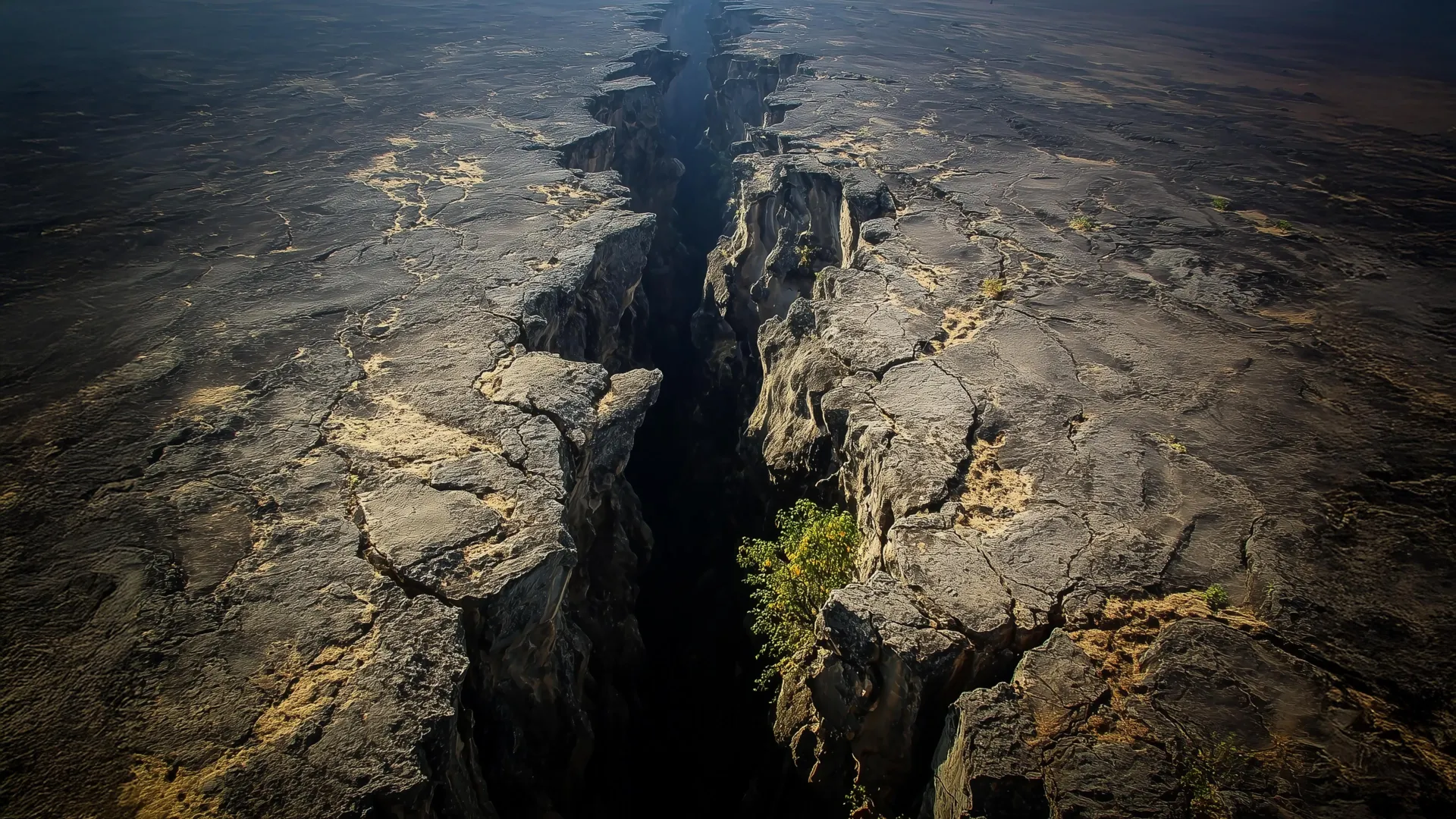
Researchers have identified the African Superplume, a vast region of rising hot mantle material deep beneath the African continent, as the source of unexpected deformation in the East African Rift System. Using three-dimensional thermomechanical models, scientists led by geophysicist D. Sarah Stamps determined that the superplume’s northward flow explains motion running parallel to the rift, a pattern that had puzzled researchers for over a decade.
Stamps initially documented the anomalous motion through GPS measurements spanning more than 12 years. The data revealed that while parts of the East African Rift System showed the expected deformation running perpendicular to the rift—the direction the crust is being pulled apart—other regions were moving in a direction parallel to the rift itself. This rift-parallel motion did not fit the simpler patterns usually associated with continental stretching and became the central focus of investigation for her team at Virginia Tech’s Geodesy and Tectonophysics Lab.
The research, published in the Journal of Geophysical Research, represents a synthesis of prior studies examining what drives the East African Rift System. Earlier work had suggested that both lithospheric buoyancy forces—operating near the surface and influenced by elevation and density differences—and mantle traction forces originating deeper in Earth could play roles. A 2021 study indicated both forces were likely important, with buoyancy forces explaining the expected east-west deformation but leaving the anomalous north-south motion unexplained.
The newer modeling work demonstrates that the African Superplume’s mantle flow produces the observed rift-parallel deformation and also aligns with seismic anisotropy patterns—the directional variation in how seismic waves travel through rock beneath the rift. This alignment provides additional evidence that deep mantle movement influences surface-level deformation. The findings suggest that continental rifting involves multiple mechanisms operating at different depths, with shallow forces primarily responsible for the typical stretching motion and deeper mantle flow contributing to additional complexity.
Article Attribution | Read More at Article Source
Article summary produced by Claude AI