

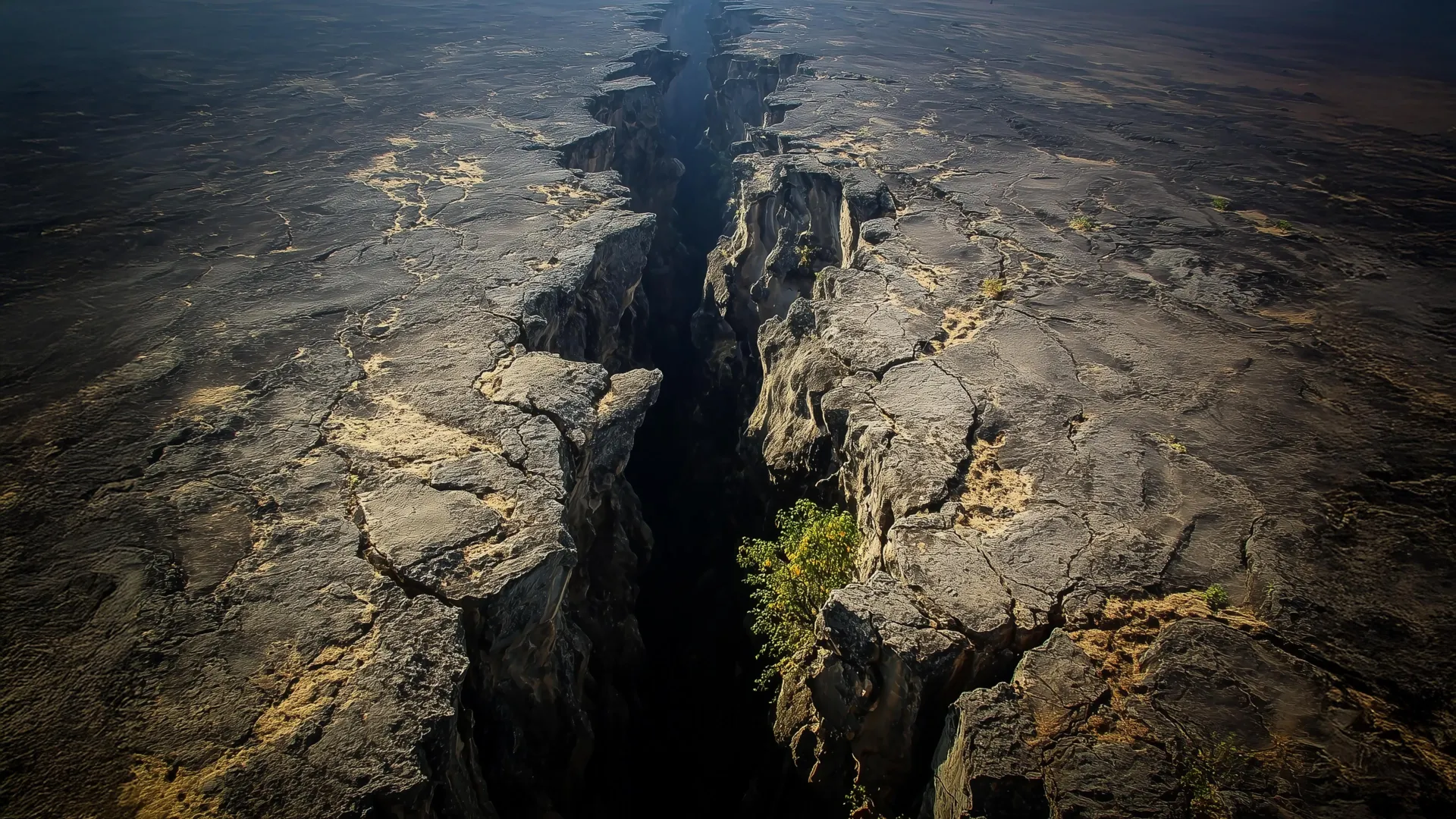
Scientists have used three-dimensional thermomechanical modeling to explain puzzling deformation patterns observed in the East African Rift System, the world’s largest continental rift. Geophysicist D. Sarah Stamps and her team at Virginia Tech documented unexpected motion running parallel to the rift through more than 12 years of GPS measurements. While typical continental rifts show deformation primarily perpendicular to the rift as the crust stretches, the East African Rift System displayed additional movement in a direction parallel to the rift itself, creating a mystery for researchers.
The research, published in the Journal of Geophysical Research, attributes this anomalous deformation to the African Superplume, an enormous zone of rising mantle material beneath the continent. The superplume originates deep beneath southwest Africa and extends northeastward, becoming progressively shallower toward the surface. According to the models developed by postdoctoral researcher Tahiry Rajaonarison, the northward flow of mantle material associated with this superplume can account for the deformation that does not fit conventional rift patterns.
The findings address a longstanding scientific debate about what drives the East African Rift System. Researchers have traditionally focused on two main mechanisms: lithospheric buoyancy forces, which operate relatively close to the surface and are influenced by elevation and density differences, and mantle traction forces, which originate deeper in Earth and result from the movement of mantle material. Earlier studies suggested both forces likely play important roles, but the new research provides more detailed insight into their specific contributions.
The modeling also reproduced rift-parallel seismic anisotropy, a phenomenon in which seismic waves travel at different speeds depending on their direction through rock. The orientation of rock structures matches the direction of the African Superplume’s northward mantle flow, providing additional evidence that deep mantle movement influences surface deformation. The research suggests that lithospheric buoyancy forces drive the typical east-west stretching of the rift, while deeper mantle flow creates the anomalous northward deformation observed at the surface.
The combined findings present a more complex picture of continental breakup than previously understood. Rather than a single force being responsible, multiple mechanisms operating at different depths appear to shape the East African Rift System. These insights from studying this natural laboratory enhance scientific understanding of how continents begin to separate over geological time.
Article Attribution | Read More at Article Source
Article summary produced by Claude AI