

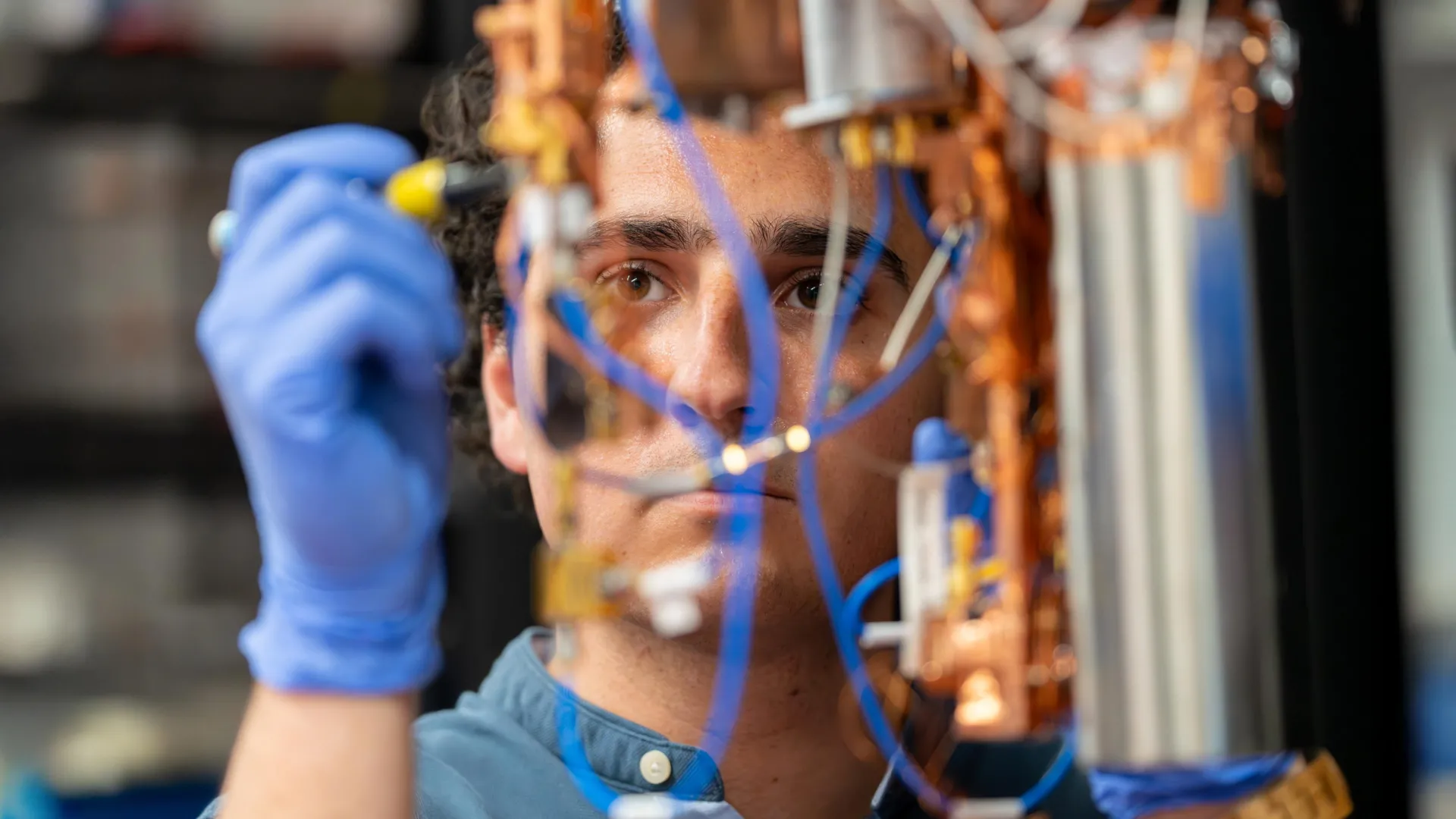
Researchers at the Institute of Science and Technology Austria have successfully demonstrated a new approach to creating distributed entanglement between physically separated quantum bits, potentially advancing the development of larger quantum computers and quantum networks. The work, published in Physical Review X, represents the first experimental realization of a theoretical concept proposed over two decades ago.
Previous methods for entangling distant qubits have relied on active control and repeated measurements, with varying degrees of success. One common approach involves sending controlled photons between qubits, while another has each qubit emit a photon in an attempt to generate entanglement. Although the latter method was recognized with a 2022 Nobel Prize in Physics, it still depends on post-selection and does not guarantee successful entanglement. PhD student Alejandro Andrés-Juanes and professor Johannes Fink, working with international collaborators, developed an alternative strategy using a quantum bath—an environment of correlated light particles that automatically synchronizes distant qubits without requiring active intervention.
The key challenge addressed by the team involved bridging a gap between readily available continuous-variable entangled states and the discrete-variable forms needed for practical quantum applications. By designing qubits’ surrounding environment to generate and stabilize entanglement autonomously, the researchers created a system where the entangled state remains stable and continuously available for quantum processing. This differs from temporary entanglement that must be used during brief windows of existence. The prototype utilized microwave photons to couple the qubits with the entangled photon source, leveraging technology already central to leading superconducting-qubit systems.
The researchers confirmed qubit synchronization using quantum tomography, which reconstructs quantum systems by examining multiple measurement perspectives. While the current prototype transfers approximately 10 percent of the bath’s available entanglement—lower than actively controlled methods—the team describes the approach as relatively simple and scalable to multiple distant qubits. Researchers attributed the extended timeline for experimental demonstration to the difficulty of reproducing the idealized conditions assumed in the original theoretical work, with the ISTA experiments revealing several practical factors previously overlooked.
Article Attribution | Read More at Article Source
Article summary produced by Claude AI