

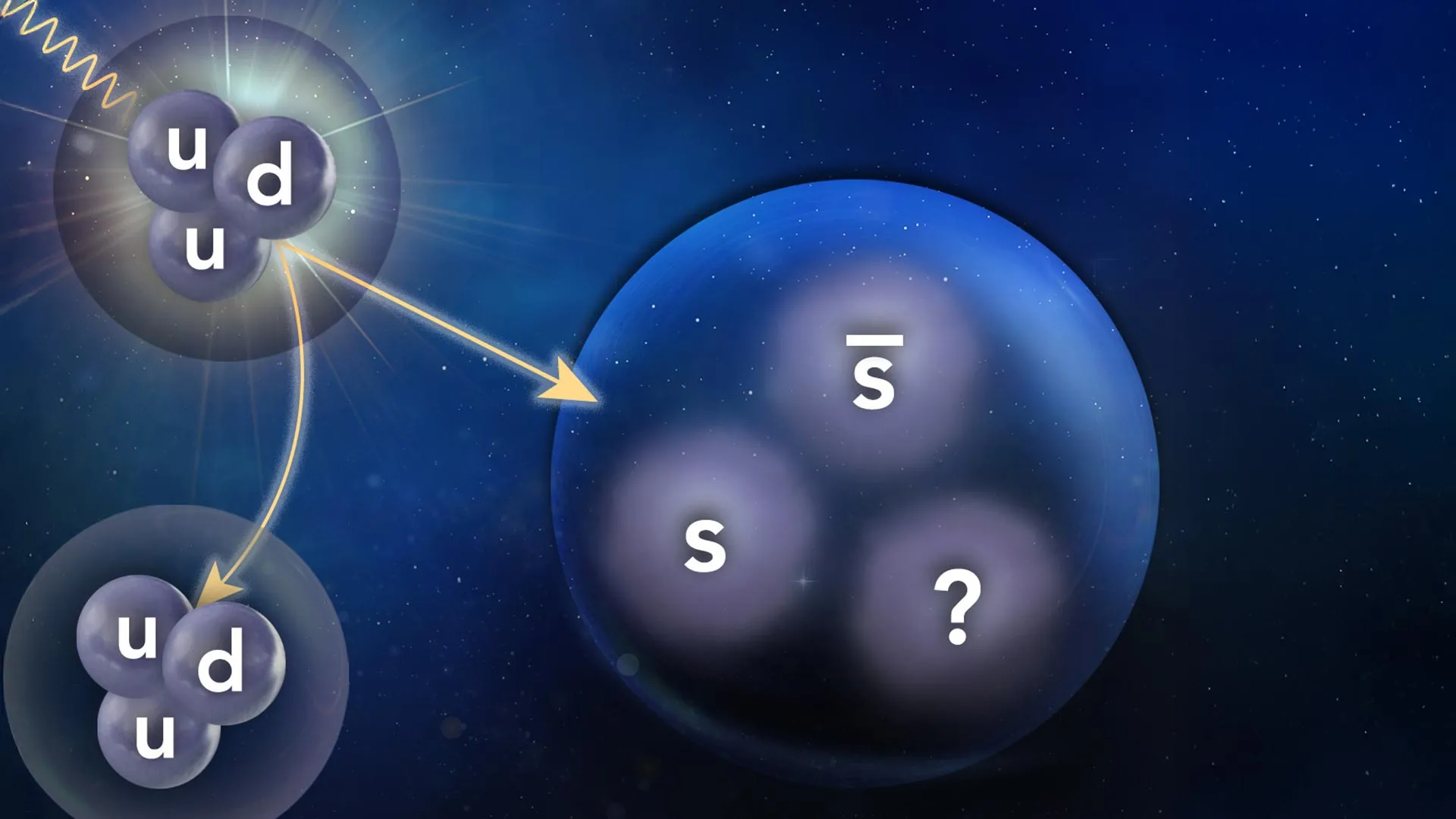
Researchers at the Thomas Jefferson National Accelerator Facility have identified evidence for two previously unknown particle structures that may contribute to understanding the increasingly complex landscape of subatomic particles. The discovery emerged from research conducted by the Gluonic Excitations Collaboration in Experimental Hall D, with findings published recently in Physical Review Letters. The signals were generated through interactions between a high-energy photon beam and a proton target, revealing structures that do not conform to conventional particle classification schemes.
The particles in question belong to a category known as XYZ states, which challenge the traditional framework for understanding matter composed of quarks. Since the early 21st century, particle physics experiments have identified numerous hadrons with unusual quantum properties that resist straightforward explanation within the original quark model established in 1964. This expansion of exotic particles has prompted the scientific community to adopt the general XYZ designation for many poorly understood particles, reflecting what researchers describe as a new era of particle discovery comparable to the hadron explosion observed decades earlier.
The research team was specifically searching for a confirmed XYZ candidate called Y(2175), a strangeonium state previously observed in electron-positron collider experiments but never before detected through photoproduction methods. Rather than confirming Y(2175)’s existence through this new production mechanism, the GlueX experiment instead detected two distinct structures at nearby masses. According to staff scientist Malte Albrecht, this unexpected result represents valuable new information for the field.
The GlueX facility was purpose-built to investigate hybrid mesons, exotic particles in which excited gluons may contribute directly to internal structure. The experiment utilizes the Continuous Electron Beam Accelerator Facility to generate an intense photon beam with parallel spins that strikes protons in a liquid hydrogen target, with a large-acceptance spectrometer recording the resulting particle interactions. Scientists note that the intensity and energy characteristics of this photon beam are unmatched by other facilities worldwide, positioning the research as a significant contribution to understanding how fundamental forces shape matter composition.
Article Attribution | Read More at Article Source
Article summary produced by Claude AI