

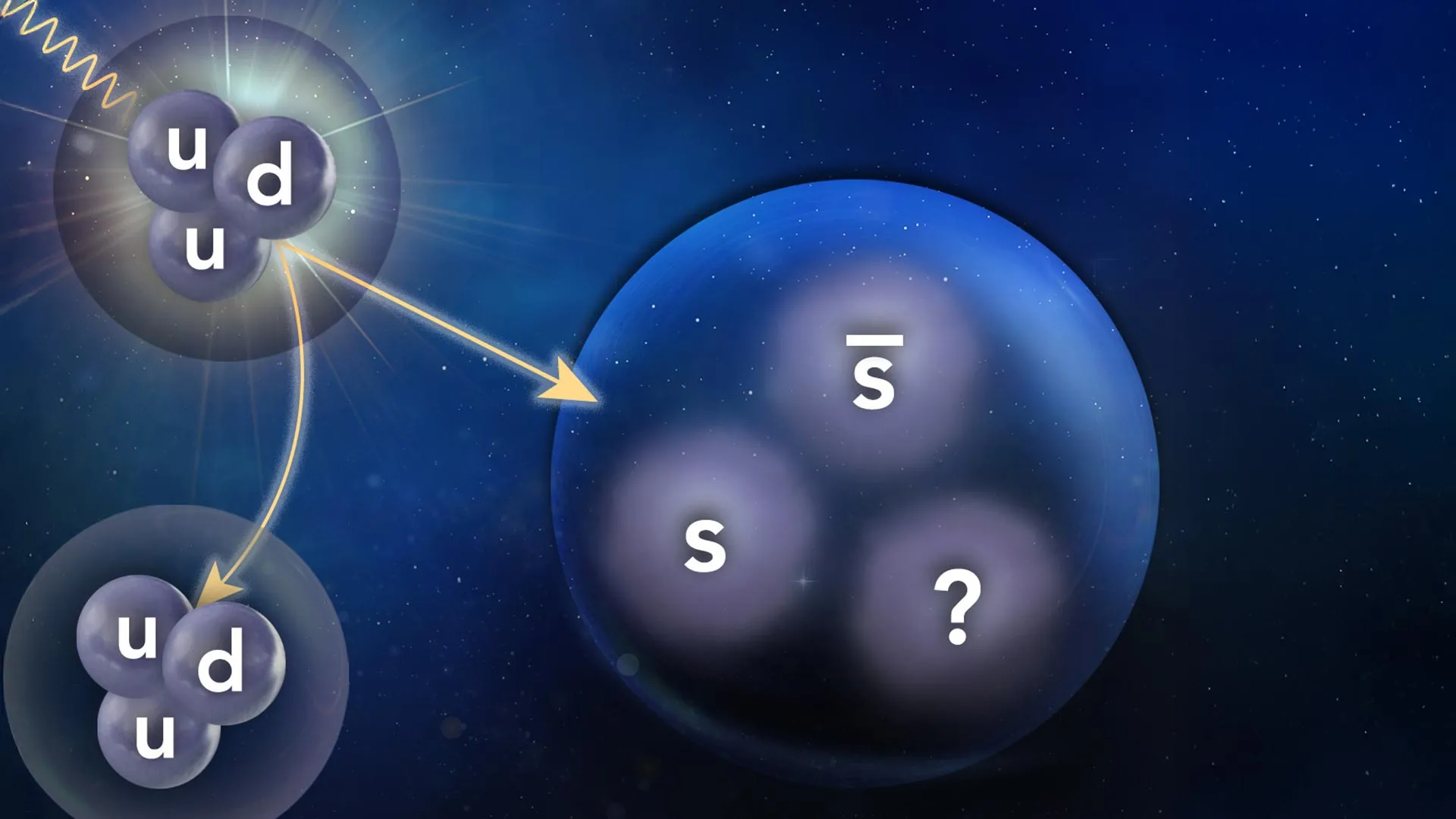
Researchers at the Thomas Jefferson National Accelerator Facility have identified evidence for two previously unknown particle structures that emerged during an investigation into exotic hadrons known as XYZ states. These findings come from the GlueX Collaboration and were published in Physical Review Letters. The newly detected structures may help scientists understand how fundamental forces contribute to the composition of matter, particularly in regions of the particle spectrum not easily explained by conventional quark models.
The discovery represents the latest development in particle physics’ ongoing effort to catalog and classify subatomic particles. Beginning in the 1950s, collision experiments revealed numerous hadrons—composite particles held together by the strong nuclear force. Physicists developed organizational frameworks, including the quark model introduced in 1964 and the subsequent Standard Model. As accelerator technology advanced and detector sensitivity improved over recent decades, researchers began encountering hadrons with unusual properties that resisted classification within existing theoretical frameworks. The accumulation of these mysterious particles led physicists to adopt the umbrella term XYZ states.
The GlueX experiment specifically targets hybrid mesons, exotic particles in which excited gluons—carriers of the strong force—may directly participate in internal structure. The collaboration aimed to detect Y(2175), a strangeonium candidate previously observed only through electron-positron annihilation processes at facilities in Japan and China. Using photoproduction, in which high-energy photons strike protons in a fixed target, the team did not observe Y(2175) but instead detected unexpected signals at nearby masses.
The GlueX facility leverages the Continuous Electron Beam Accelerator Facility at Jefferson Lab to generate an intense photon beam. An ultrathin diamond wafer converts electrons from this accelerator into high-energy photons, which then interact with protons in a liquid hydrogen target. A large spectrometer records the resulting particle interactions. According to researchers involved in the project, no other facility currently provides photon beams of comparable intensity at the available energy levels, positioning these findings as potentially significant contributions to understanding exotic hadron physics.
Article Attribution | Read More at Article Source
Article summary produced by Claude AI