

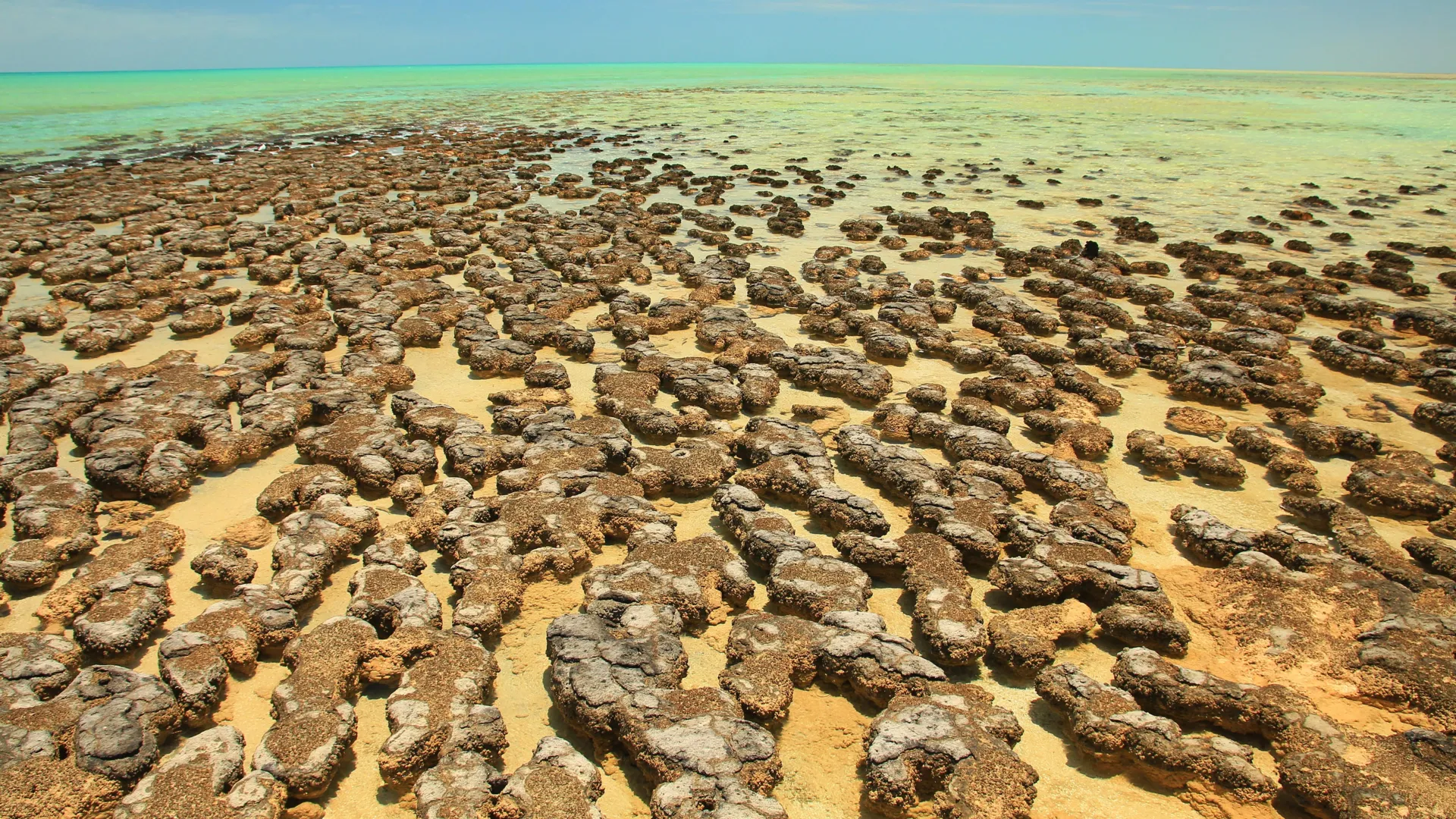
Researchers from Australian universities have published findings in Current Biology examining stromatolites and microbial mats collected from Shark Bay, a World Heritage site in Western Australia. These layered microbial communities, which existed billions of years ago and still form today, are being studied for insights into major transitions in Earth’s biological history. The team, led by Associate Professor Brendan Burns from UNSW Sydney in collaboration with researchers from the University of Technology Sydney and The University of Melbourne, identified a previously unknown member of the Asgard archaea living in close association with other organisms within these formations.
The research addresses a longstanding question in evolutionary biology: how simple cells began cooperating to eventually produce complex life forms. Scientists have theorized that the first eukaryotic cells—which form all plants and animals—developed through an intimate partnership between an ancient archaeon and a bacterium, with one organism engulfing the other to eventually create mitochondria, the energy-producing structures in complex cells. However, direct evidence of such early partnerships has been lacking. The new research provides the first visual documentation of an Asgard archaeon physically interacting with a bacterium through extremely thin, tube-like connections called nanotubes, potentially representing an early model of such partnerships.
Cultivating the microbes for laboratory study proved exceptionally challenging, requiring four or five years of optimization. Asgard archaea are notoriously difficult to grow away from their natural habitats, which researchers suggest may indicate a biological dependence on other organisms for survival. Using electron cryotomography, a high-resolution three-dimensional imaging technique, the team observed the two microbes connected by bacterial nanotubes and appearing to provide each other with essential compounds including vitamins, nutrients, and hydrogen.
The research incorporated advanced machine learning techniques to predict protein structures within the microbes, revealing ancient versions of cellular machinery that later became fundamental to complex life. The newly identified archaeon has been named Nerearchaeum marumarumayae, combining a reference to Nereus, the ancient Greek sea god, with a Malgana word meaning ‘ancient home’. The naming process included consultation with Malgana language experts and elders to respectfully honor the Indigenous heritage of the region, whose traditional inhabitants have occupied the area for thousands of years and continue to protect the Shark Bay environment.
Article Attribution | Read More at Article Source
Article summary produced by Claude AI