

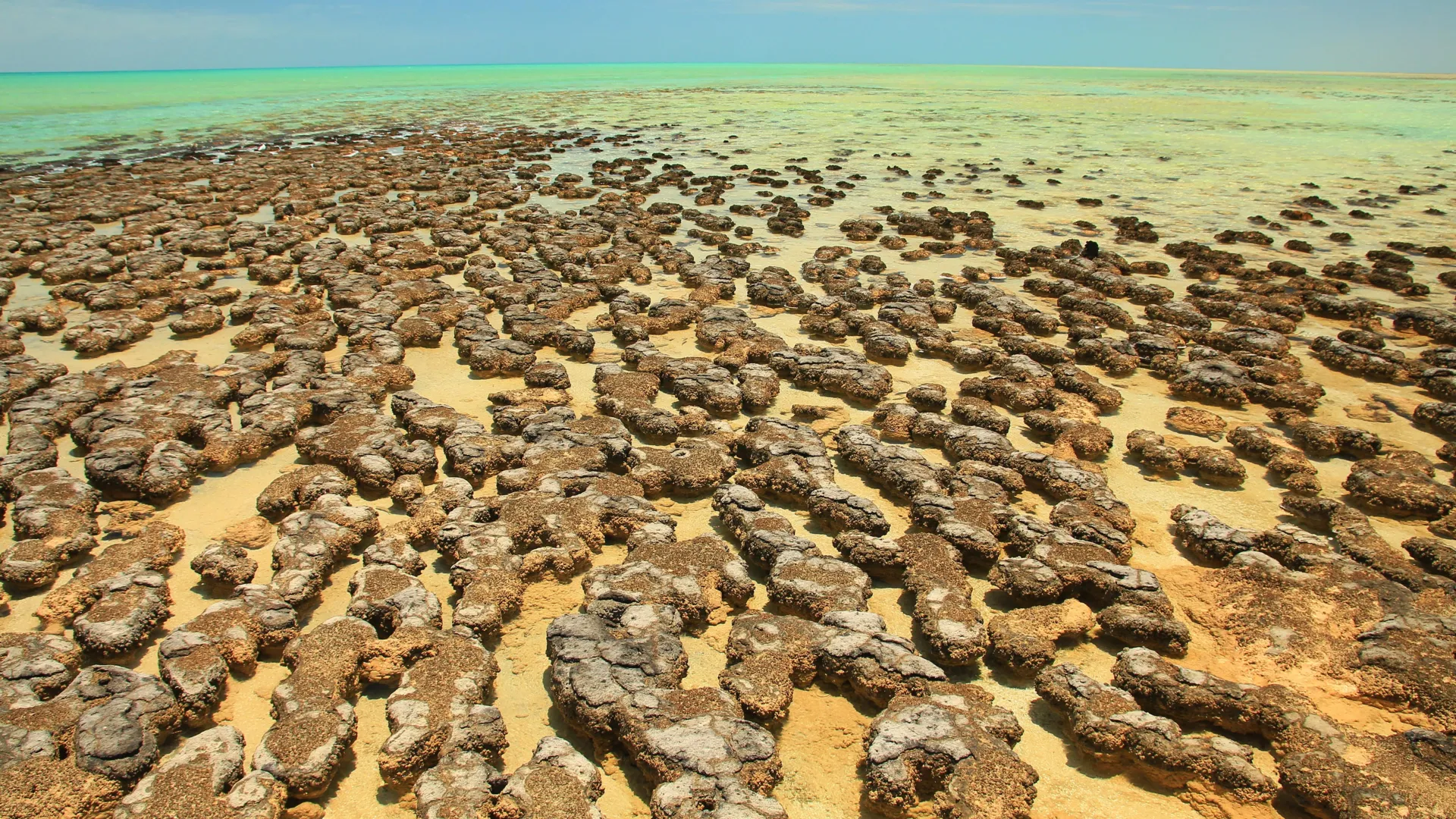
A research team led by Associate Professor Brendan Burns at UNSW Sydney, in collaboration with researchers from the University of Technology Sydney and The University of Melbourne, has published findings in Current Biology suggesting that stromatolites and microbial mats may preserve evidence about the origin of complex life on Earth. These layered microbial formations, which existed billions of years ago and continue to form today in Shark Bay, Western Australia, have long been recognized as significant to early life development. The new study identifies a previously unknown member of the Asgard archaea living in association with another organism within these ancient structures.
The research provides the first visual evidence of an Asgard archaeon physically interacting with a bacterium through thin, tube-like connections called nanotubes. This discovery is significant because prevailing biological theory suggests that the first eukaryotic cells, which form all plants and animals including humans, developed through an intimate partnership between an ancient archaeon and a bacterium. However, scientists have lacked direct evidence of what such early partnerships might have resembled. The newly observed interaction between these microbes offers a potential model for understanding how these kinds of cellular partnerships originated and eventually led to the emergence of complex life.
Cultivating the Asgard archaea in laboratory conditions proved exceptionally challenging, requiring approximately four or five years of research and optimization. The organisms could not be grown in isolation, suggesting they may have an inherent dependency on other organisms for survival. Researchers ultimately made significant progress using electron cryotomography, a high-resolution three-dimensional imaging technique capable of revealing structures at microscopic scales. The imaging revealed that the two microbes were physically connected and appeared to complement each other chemically, with each producing compounds the other could utilize, including vitamins, nutrients, and hydrogen.
The research team incorporated deep learning analysis to predict protein structures within these microbes, allowing them to observe ancient versions of cellular machinery that later became central to complex life. The newly identified archaeon has been named Nerearchaeum marumarumayae, combining a reference to Nereus, the ancient Greek sea god, with the Malgana word marumarumayae, meaning ‘ancient home.’ The naming process included consultation with Malgana language experts and elders, recognizing the traditional Indigenous heritage of Shark Bay and its significance to the region’s Traditional Owners.
Article Attribution | Read More at Article Source
Article summary produced by Claude AI