

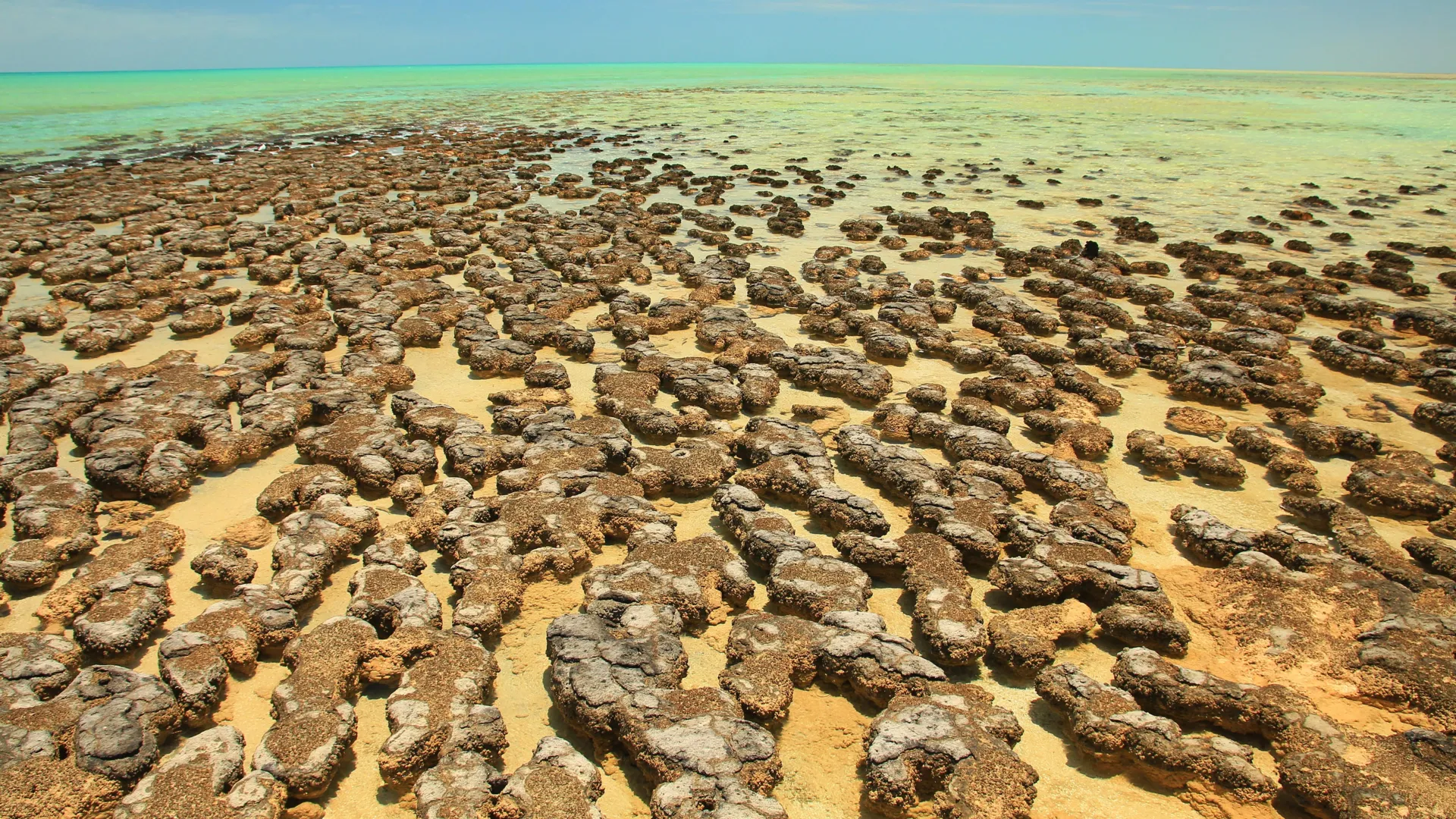
A research team led by Associate Professor Brendan Burns from UNSW Sydney published findings in Current Biology describing the discovery of a previously unknown microbe living in association with another organism within stromatolites, layered microbial structures that are billions of years old. The research suggests these “living fossils” may contain insights into how complex life emerged on Earth, addressing a fundamental question in evolutionary biology.
The study focused on samples collected from Shark Bay, a World Heritage site in Western Australia, where stromatolites and microbial mats continue to form today. Researchers isolated a member of the Asgard archaea, an unusual group of microbes believed to be closely related to the ancestors of eukaryotes—the complex cells that constitute all plants and animals, including humans. Long-standing biological theory proposes that the first eukaryotic cells developed through intimate partnerships between ancient archaea and bacteria, with one organism eventually engulfing the other to produce the energy-producing mitochondria found in complex cells. However, scientists had previously lacked direct evidence of what such early partnerships actually resembled.
The research provided the first visual evidence of an Asgard archaeon physically interacting with a bacterium through extremely thin tube-like connections called nanotubes. Growing the microbes in laboratory conditions proved challenging, taking four to five years of optimization. The researchers ultimately employed electron cryotomography, a high-resolution 3D imaging technique capable of revealing structures at extraordinarily small scales, to observe the physical connections and chemical complementarity between the two organisms. The newly identified archaeon was named Nerearchaeum marumarumayae, incorporating both classical references and Malgana, a traditional language of the region’s Indigenous people.
The research team incorporated deep learning analysis to predict protein structures within the microbes, revealing ancient versions of cellular machinery that later became central to complex life. The discovery underscores the potential of Shark Bay’s microbial communities to illuminate conditions resembling early Earth while honoring the region’s ongoing Indigenous cultural heritage and traditional stewardship.
Article Attribution | Read More at Article Source
Article summary produced by Claude AI