

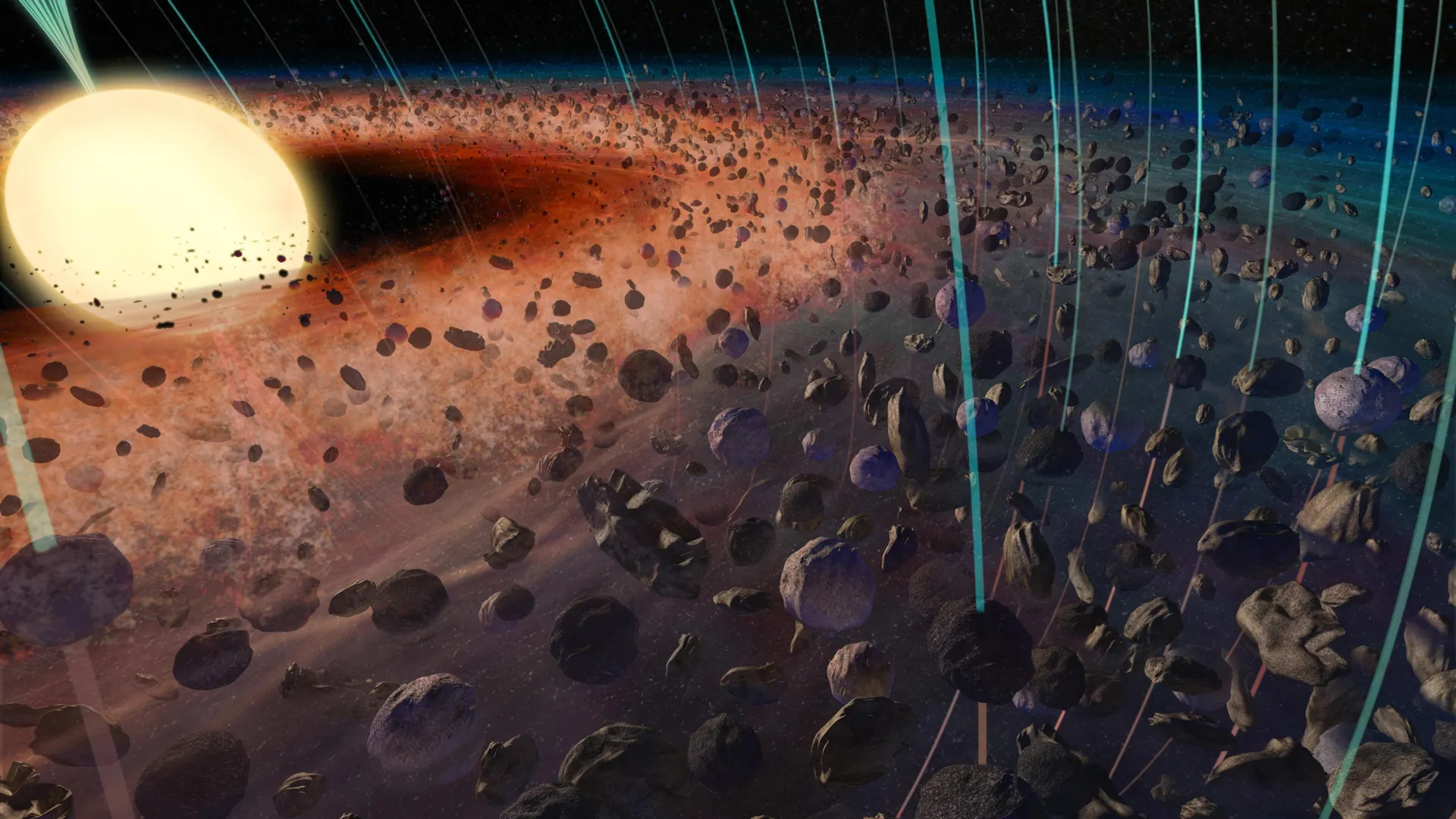
Scientists at MIT have identified evidence of powerful magnetic fields that existed during the solar system’s earliest stages, suggesting that magnetism contributed to the dramatic transformation of the solar nebula. The research examined microscopic mineral grains preserved within a meteorite discovered in Antarctica, which contain some of the oldest material known to science. These calcium-aluminum-rich inclusions formed during the first 200,000 years of solar system history and retained magnetic signatures that indicate the presence of a substantial magnetic field at that time.
The magnetic field strength estimated by researchers ranged from 150 to 600 microteslas, making it three to twelve times stronger than Earth’s current magnetic field. This finding challenges the long-held assumption that gravity alone was responsible for the collapse of the spherical gas and dust cloud into a flattened protoplanetary disk from which the sun and planets eventually formed. The study, published in the Proceedings of the National Academy of Sciences, involved researchers from MIT, Tsinghua University, Cambridge University, Caltech, and UCLA.
Magnetic fields in the early solar system likely arose from the movement of electrically charged particles within the collapsing cloud, according to researchers. As the plasma circulated through the developing disk, it could have generated and maintained magnetic fields strong enough to influence the movement of material throughout the system. The findings build upon earlier research indicating that magnetism played a role in planetary formation about 2 million years after the solar system began developing, extending the timeline further back to the sun’s formation period itself.
The DOM 08006 meteorite proved particularly valuable for this research because it experienced minimal alteration over billions of years compared to other meteorites. While most meteorites were subjected to various transformations, water exposure, and relocation within the solar system, this specimen retained much of its original mineral composition. This preservation allowed researchers to identify and analyze the magnetic signatures contained within specific mineral grains, providing clearer evidence of early solar system magnetism than previously available.
Article Attribution | Read More at Article Source
Article summary produced by Claude AI