

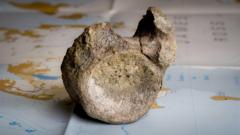
A fossil specimen that remained unexamined in a storage drawer at the British Antarctic Survey in Cambridge for four decades has been identified as the first dinosaur bone ever discovered in Antarctica. The bone was originally collected on James Ross Island in 1985, with the discovery documented in a field notebook by geologist Dr Mike Thomson, who sketched the specimen and noted it measured approximately 10 centimeters wide. The team that initially found the fossil was uncertain of its classification and stored it among thousands of other specimens collected from Antarctic expeditions.
Dr Mark Evans, the collections manager at BAS, recently identified the fossil while reviewing the collection and recognized distinctive dinosaur characteristics. He consulted Prof Paul Barrett from the Natural History Museum, who confirmed the bone as a tail vertebra from a Titanosaur. The expert pointed to identifying features including a hollow depression on one end and a rounded protrusion on the other, which form part of the ball-and-socket joint system running along the dinosaur’s spine.
Titanosaurs represent a diverse group of four-legged herbivorous dinosaurs characterized by elongated necks and lengthy tails. Over 100 species have been identified globally, with the largest specimens exceeding 115 feet in length and weighing approximately 60 tonnes. Based on the size of the Antarctic vertebra, scientists estimate this particular dinosaur reached approximately 23 feet in length, suggesting it may have been either a juvenile or a naturally smaller adult member of the species.
The animal lived approximately 82 million years ago during the Late Cretaceous Period, when Antarctica possessed a dramatically different climate and supported lush forests capable of sustaining large herbivorous megafauna. The discovery contributes to scientific understanding of Late Cretaceous ecosystems in Earth’s southernmost continent, where fossil records remain sparse and challenging to access beneath extensive ice coverage. The findings were published in the journal Acta Palaeontologica Polonica.
Article Attribution | Read More at Article Source
Article summary produced by Claude AI