

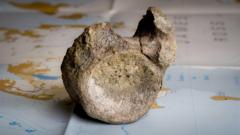
Scientists have confirmed that a fossil specimen stored for four decades in a British Antarctic Survey collection represents the first dinosaur bone ever discovered in Antarctica. The tail vertebra was collected on James Ross Island in 1985 by a research team that initially was uncertain about its classification, leading to it being filed away among thousands of other specimens brought back from Antarctic expeditions. The fossil remained unexamined until recently, when a collections manager at the survey’s Cambridge facility recognized its potential significance.
Palaeontologists have now identified the bone as belonging to a Titanosaur, a group of massive herbivorous dinosaurs characterized by their four-legged bodies, elongated necks, and counterbalancing tails. The distinctive features of the vertebra—including a hollow socket on one end and a rounded protrusion on the other—are unique to this dinosaur family. Based on the bone’s dimensions, researchers estimate the Antarctic specimen was approximately 23 feet in length, suggesting it may have been either a juvenile or an unusually small adult compared to other Titanosaurs.
The dinosaur would have inhabited Antarctica approximately 82 million years ago during the Late Cretaceous Period, when the continent featured a markedly different climate and landscape. Rather than the frozen, inhospitable environment of today, Antarctica was then covered in dense forests that provided abundant vegetation for the plant-eating creature. This discovery provides valuable insight into ancient Antarctic ecosystems and contributes to the limited fossil record from this remote region.
While other dinosaur fossils have been found in Antarctica since 1985, such discoveries remain relatively uncommon due to the extreme conditions and ice coverage that obscure geological layers. The newly confirmed fossil has been documented in the journal Acta Palaeontologica Polonica and underscores how Antarctica was once home to diverse prehistoric life forms adapted to vastly different environmental conditions.
Article Attribution | Read More at Article Source
Article summary produced by Claude AI