

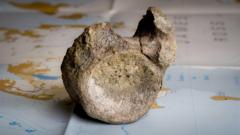
A fossil specimen that remained unidentified for 40 years in a storage collection has been formally recognized as Antarctica’s first dinosaur bone. The tail vertebra was originally collected on James Ross Island in 1985 by a geological expedition team, but the researchers who found it were uncertain of its classification and catalogued it as belonging to a large reptile before storing it away in the British Antarctic Survey’s geology archives in Cambridge.
The specimen recently came to the attention of Dr Mark Evans, the collections manager at the British Antarctic Survey, who recognized its distinctive features while reviewing stored materials. Evans consulted with Prof Paul Barrett from the Natural History Museum to confirm the identification. Upon examination, Barrett identified the bone as belonging to a Titanosaur based on characteristic structural features including a hollow depression on one end and a rounded protrusion on the other, which form part of the ball-and-socket joint system running along the creature’s spine.
Titanosaurs comprised a diverse group of four-legged herbivorous dinosaurs characterized by elongated necks and counterbalancing tails. More than 100 species have been identified globally, with the largest specimens exceeding 115 feet in length and weighing approximately 60 tonnes. Based on the recovered vertebra’s dimensions, the Antarctic specimen is estimated to have measured roughly 23 feet long, suggesting it may have been either a juvenile or an unusually small adult member of its species.
The dinosaur inhabited Antarctica during the Late Cretaceous Period approximately 82 million years ago, when the continent’s climate and environment differed dramatically from its present state. At that time, Antarctica supported dense forests that provided abundant vegetation for plant-eating species. The discovery has been documented in a peer-reviewed publication in the journal Acta Palaeontologica Polonica and contributes to scientific understanding of ancient Antarctic ecosystems, despite the continent’s limited paleontological record and challenging research conditions.
Article Attribution | Read More at Article Source
Article summary produced by Claude AI