

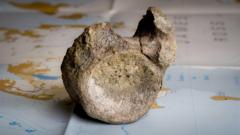
A fossil specimen collected from James Ross Island in 1985 has been identified as Antarctica’s first confirmed dinosaur bone after spending four decades in storage at the British Antarctic Survey in Cambridge. The original discovery team, uncertain of the specimen’s classification, documented it in field notes as a “vertebra of large reptile” measuring approximately 10 centimeters in width. The fossil remained unexamined until recently, when collections manager Dr. Mark Evans recognized its paleontological significance and consulted with Professor Paul Barrett of the Natural History Museum for verification.
Based on distinctive anatomical features including a hollow socket on one end and a rounded protrusion on the other, experts confirmed the bone as a tail vertebra from a Titanosaur, a group of massive herbivorous dinosaurs that inhabited the Earth. The formation of ball-and-socket joints between vertebrae is a characteristic unique to this dinosaur type. Researchers estimate the specimen came from an individual measuring approximately 23 feet in length, possibly representing either a juvenile or an unusually small adult member of the species.
The dinosaur lived during the Late Cretaceous Period approximately 82 million years ago, when Antarctica possessed a dramatically different climate and geography than today. The region featured lush forests that provided sustenance for plant-eating creatures. The recent identification adds to a limited fossil record from Antarctica, where paleontological fieldwork remains challenging due to extensive ice coverage obscuring geological layers beneath the surface.
Despite the sparse number of dinosaur discoveries in Antarctica since this initial find, the specimen contributes valuable insight into ancient ecosystems at extreme southern latitudes. The discovery underscores how regions now considered inhospitable once supported diverse prehistoric fauna and flora. Findings have been formally documented in the journal Acta Palaeontologica Polonica, establishing this vertebra as a significant addition to Antarctic paleontological history.
Article Attribution | Read More at Article Source
Article summary produced by Claude AI