

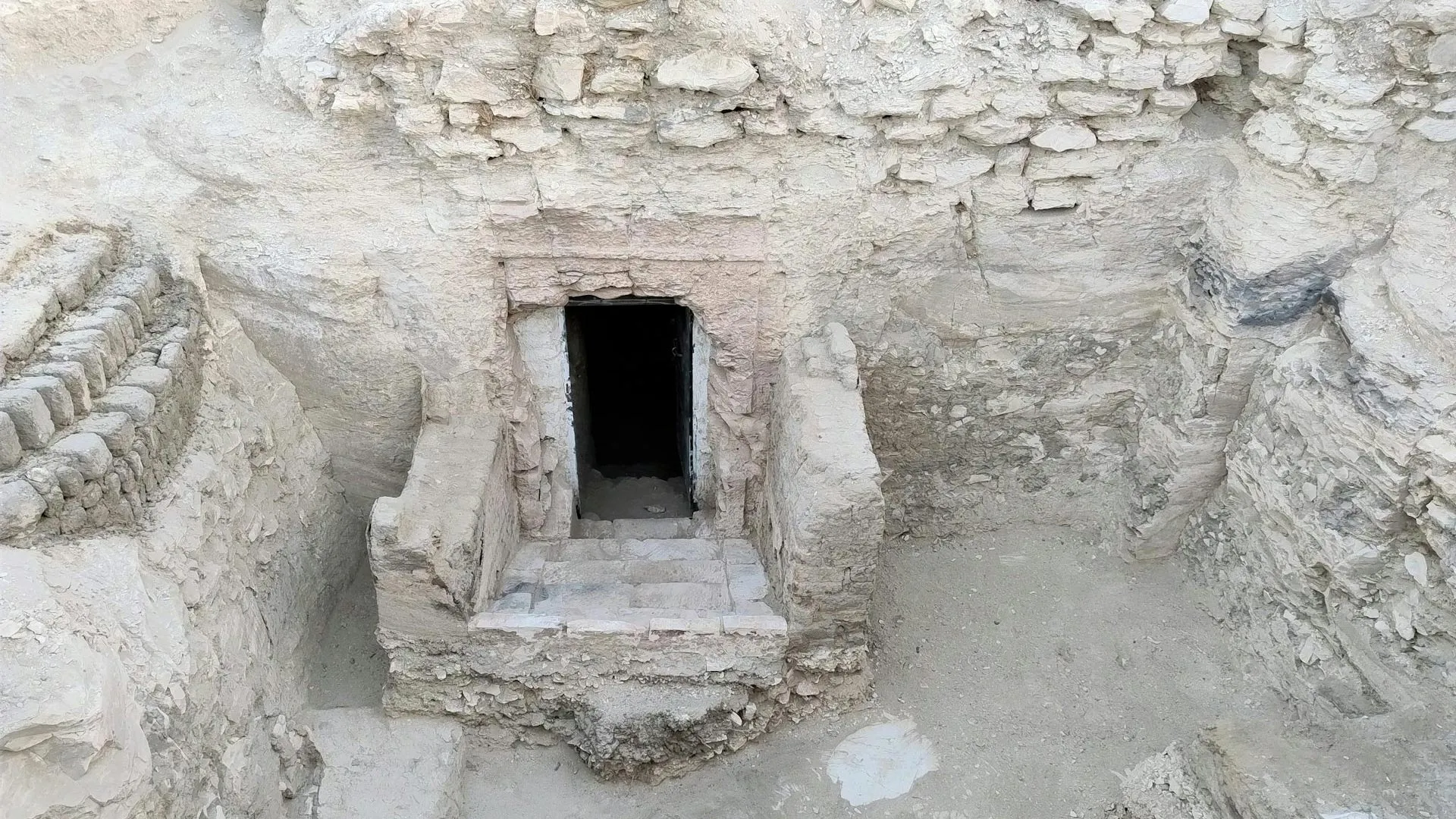
An international research team directed fieldwork at the Theban necropolis, a UNESCO World Heritage site located near Luxor in Egypt. The primary objective of the project involves establishing a conservation and risk management program for the necropolis of Lower Sheikh ʿAbd el-Qurna, which sits at the foothills of the Theban mountain and faces significant vulnerability to flash flooding from intense rainfall. During systematic debris removal and archaeological excavation designed to redirect floodwater away from tombs, the team discovered a previously unknown tomb dating to approximately 3,000 years ago.
The newly discovered tomb exhibits the typical layout of elite tombs from Egypt’s New Kingdom period (circa 1550-1069 BC), when Thebes, now known as Luxor, served as Egypt’s capital and primary religious and political center. The structure includes an outer courtyard, a rock-cut chapel, and subterranean burial chambers. The courtyard features a well-preserved mudbrick platform with a niche for a stela and a staircase with ramps providing access to the interior chambers. Based on iconography and painting style, researchers determined the tomb dates to the Ramesside period (circa 1292-1069 BC).
The tomb’s rock-cut chapel walls contain vivid painted decorations depicting the main tomb owner venerating various deities and scenes of daily life with his wife at an offering table. Preliminary analysis identified the primary tomb owner as a male official named Paser. These wall paintings provide valuable information about ancient Egyptian daily life, society, and the tomb owner’s position in the Ramesside hierarchy. Conservation specialists are expected to clean the painted surfaces and reveal additional details about the identities and personal narratives of individuals buried in the tomb.
The Theban necropolis spans approximately 10 square kilometers and functioned as Egypt’s main royal and elite cemetery for roughly half a millennium beginning around 1550 BC. The site contains numerous renowned historical locations, including the Valley of the Kings and Valley of the Queens. The research team has conducted fieldwork since 2018 in collaboration with the Egyptian Ministry of Tourism and Antiquities, investigating questions about tomb placement, reuse patterns, and how features of the ancient mortuary landscape influenced burial site selection during the Ramesside period.
Climate change poses an increasing threat to the site, as the frequency and intensity of flash flooding is expected to rise significantly in coming years. Flooding can cause immediate and extensive damage including moisture-activated salt crystal growth, loss of painted decoration, and potential structural collapse. The conservation and risk management program aims to safeguard these monuments for future generations while simultaneously enabling archaeological exploration of an area that has received minimal scholarly attention compared to nearby famous sites.
Article Attribution | Read More at Article Source
Article summary produced by Claude AI