

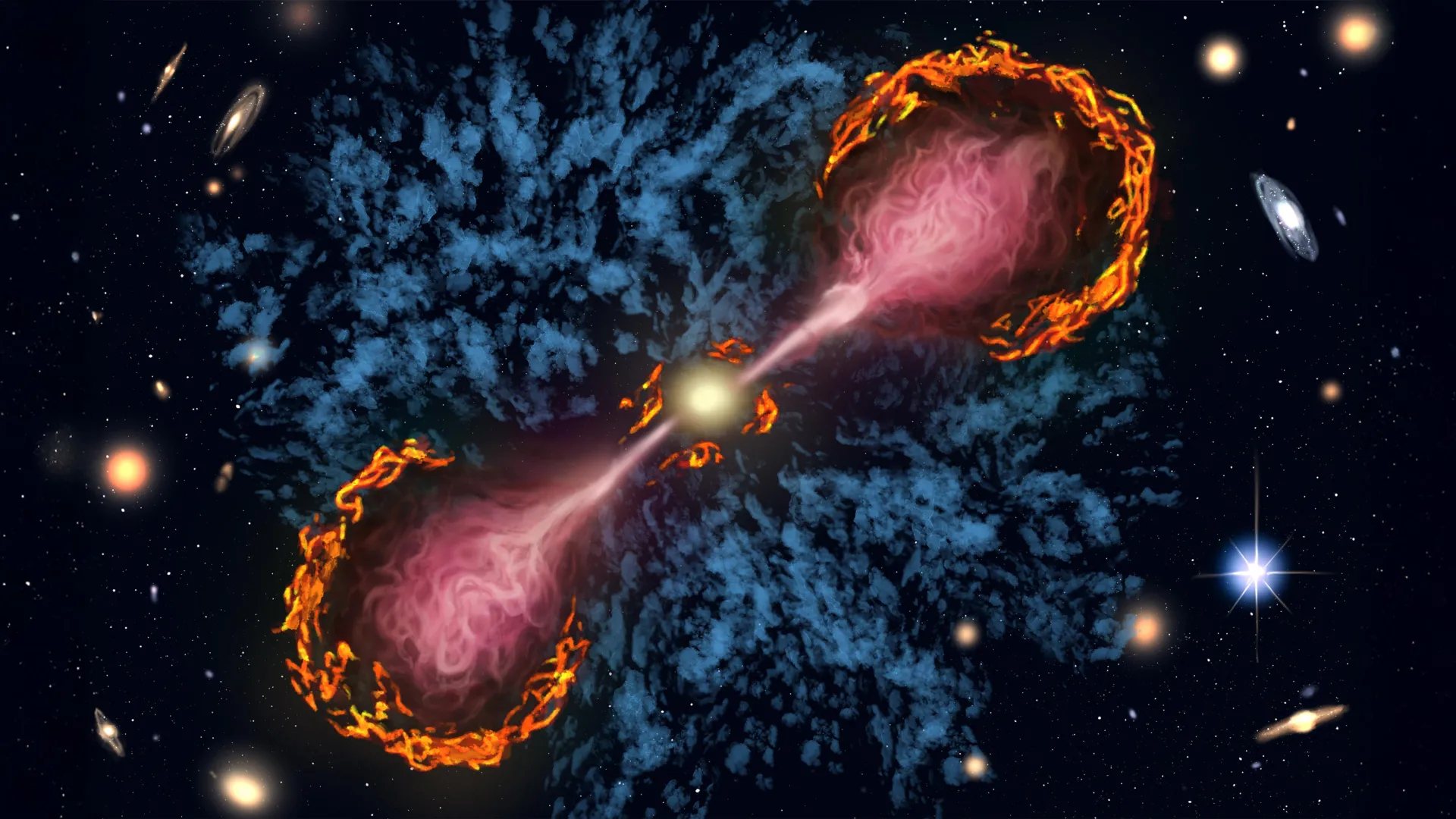
A study published in the Astrophysical Journal Letters provides evidence that narrow jets of hot plasma from supermassive black holes at galaxy centers can influence gas reservoirs far beyond visible galaxy boundaries. The research, led by astronomers from Arizona State University and the Raman Research Institute, addresses a long-standing astronomical puzzle: if galaxies are surrounded by abundant star-forming material, why do they not produce significantly more stars?
The circumgalactic medium, or CGM, extends roughly 10 to 20 times farther than a galaxy’s visible component and contains vast quantities of cold, dense gas that could eventually cool and condense into new stars. However, something prevents much of this material from cooling and flowing inward toward the galaxy’s center. The new findings suggest that black hole jets may be responsible for this suppression of star formation by heating and ionizing gas across enormous distances.
To detect the jets’ influence on surrounding gas, researchers searched for ionized hydrogen signatures using data from the Dark Energy Spectroscopic Instrument survey combined with radio measurements from the LOFAR Two-meter Sky Survey. By analyzing observations from hundreds of galaxies, they identified a distinctive pattern: ionized hydrogen gas glowed most brightly along the paths traveled by the radio jets, rather than uniformly in all directions around the galaxies. The team identified two regions of particularly strong emission, one near the galaxy where the jet first encounters the CGM and another at the CGM’s outer edge where the jet deposits most of its energy.
The findings demonstrate that supermassive black holes, despite being tiny relative to their host galaxies, can energetically impact their surroundings across hundreds of thousands of light-years. By heating and ionizing gas along the jet’s path, these objects influence whether galaxies continue producing stars or enter dormant phases. The research provides some of the clearest observational evidence to date of how black holes regulate galactic growth and evolution.
Article Attribution | Read More at Article Source
Article summary produced by Claude AI