

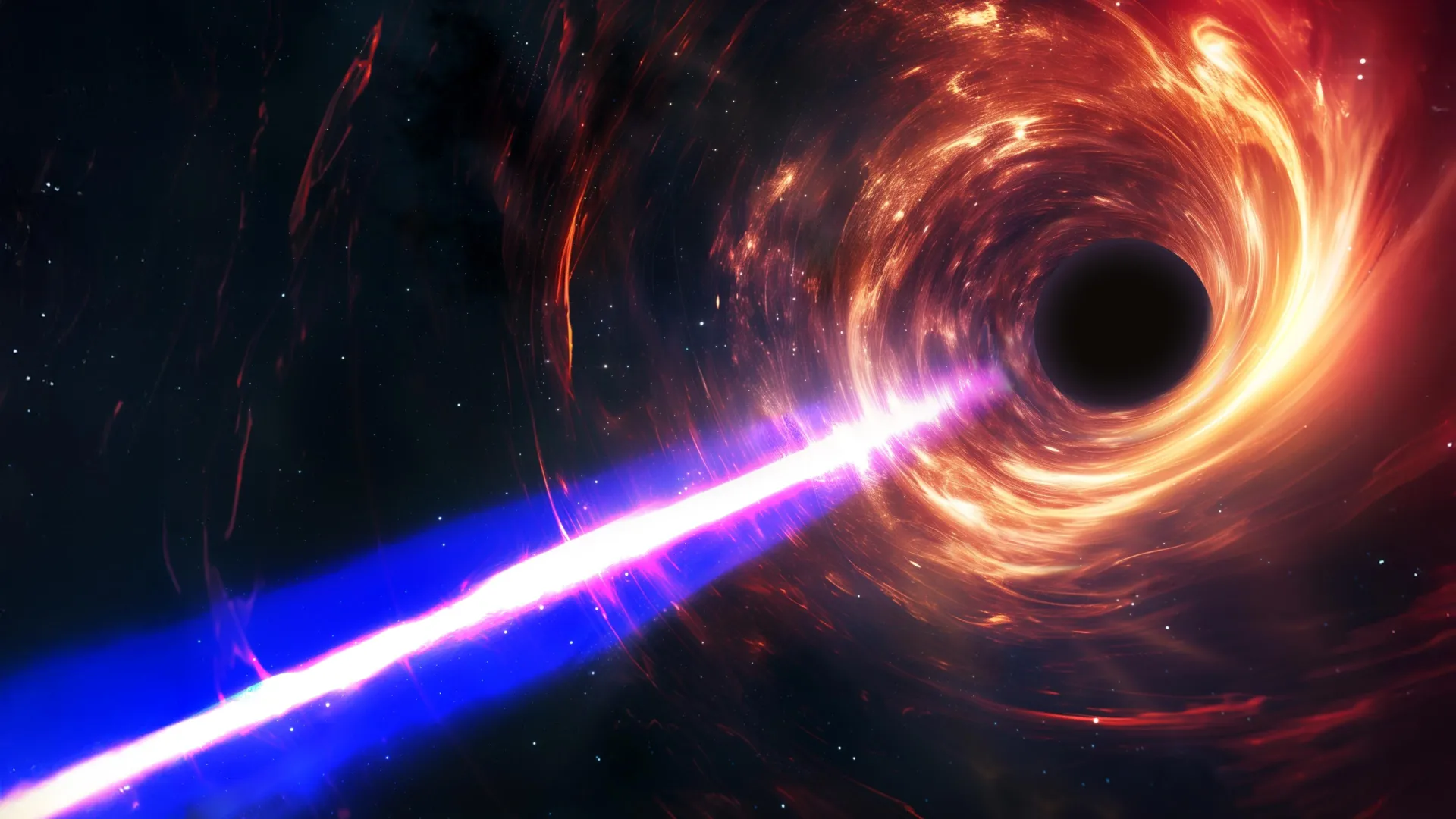
An international team of astronomers has identified what appears to be a universal principle governing jet production in black holes across vastly different mass scales. The research, published in Nature Astronomy, examined how black holes ranging from stellar-mass objects roughly ten times the sun’s mass to supermassive black holes millions of times heavier behave during their feeding cycles.
The study focused on tidal disruption events, which occur when stars pass too close to supermassive black holes and are torn apart by gravitational forces. These events provided researchers with a valuable opportunity to observe black hole behavior immediately after receiving a sudden influx of stellar material. The team combined observational data from telescopes across multiple continents and space-based instruments, analyzing information across optical, ultraviolet, X-ray, and radio wavelengths.
The key finding involves the critical accretion rate at which black holes produce jets. Researchers determined that jet formation occurs at two distinct phases: an early period when the black hole consumes material at extremely high rates, and a later phase occurring hundreds to thousands of days after the disruption event. During this delayed phase, the black hole’s feeding rate drops to approximately two percent of its Eddington limit, a threshold already known to trigger jet formation in smaller galactic black holes.
This discovery suggests that black hole physics operates according to the same fundamental principles across an enormous range of masses. The ability to predict when supermassive black holes will produce delayed jets could enhance observational efficiency for astronomers, allowing better scheduling of telescope time and increasing the likelihood of capturing these brief events. Such improvements may prove especially valuable as new observatories, including the Square Kilometre Array radio telescope project expected to begin operations in 2028, come online.
Article Attribution | Read More at Article Source
Article summary produced by Claude AI