

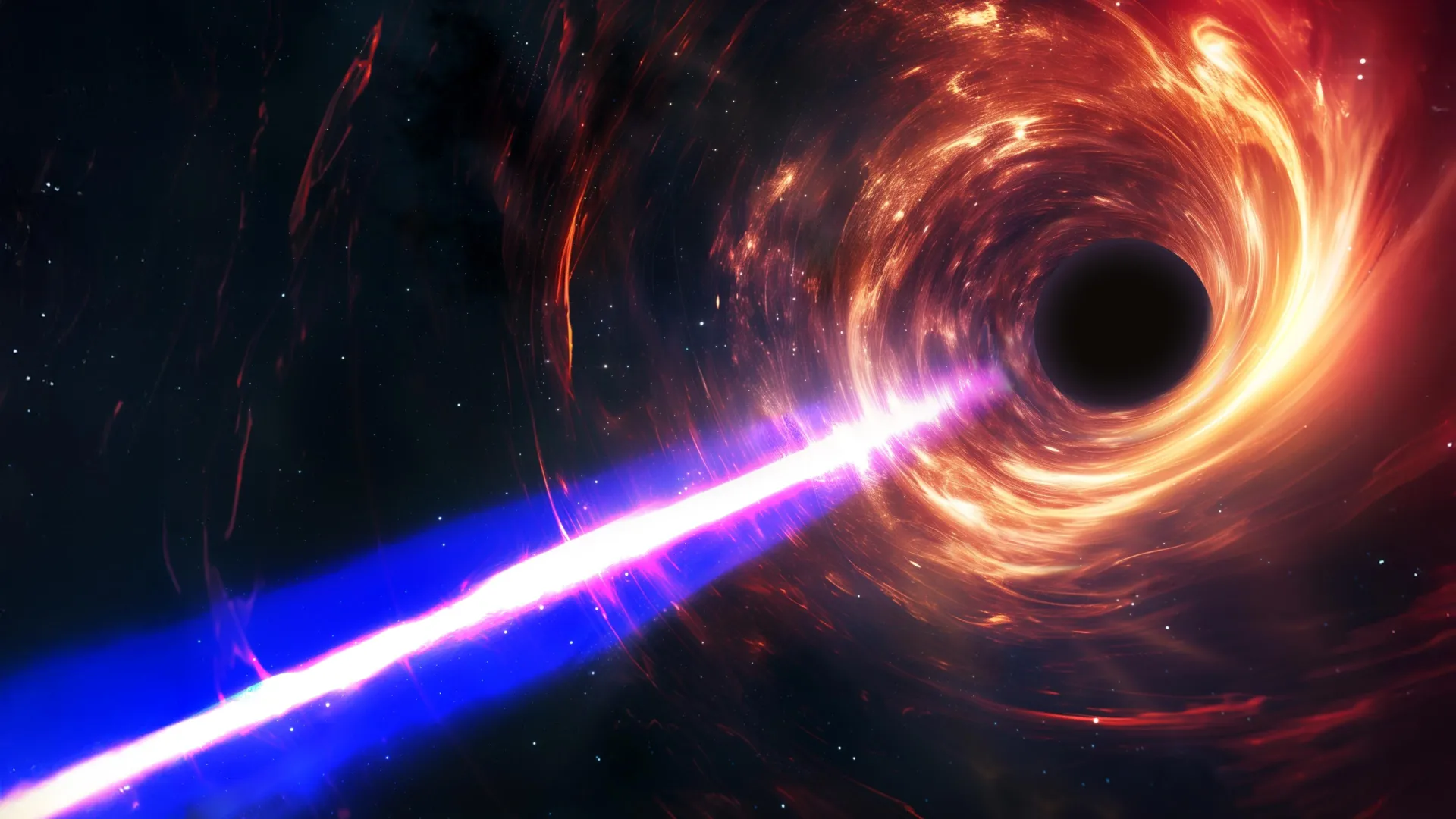
An international research team has identified what appears to be a universal physical principle governing jet production in black holes across a wide range of masses. The findings emerge from a study examining tidal disruption events—instances where stars pass close enough to supermassive black holes to be torn apart by gravitational forces. By analyzing observations from multiple telescopes across different wavelengths, researchers determined that black holes launch jets at consistent critical points during their feeding cycles, suggesting uniform physics operates regardless of black hole size.
The research team leveraged tidal disruption events as a natural laboratory for studying black hole behavior. When stars are shredded by supermassive black holes, the resulting feeding episodes unfold over just a few years rather than the thousands or millions of years typically required for observable changes around such objects. This compressed timeline allowed scientists to observe processes that would normally be difficult to track in real time. The team examined twenty tidal disruption events using optical, ultraviolet, X-ray, and radio observations, ultimately focusing on ten high-quality cases where feeding rates and jet timing could be reliably determined.
The analysis revealed two distinct phases when jets can form around supermassive black holes. An early phase occurs while material consumption reaches extremely high rates, followed by a delayed phase hundreds to thousands of days after stellar disruption. Notably, this delayed phase occurs when the black hole’s feeding rate drops to approximately two percent of its Eddington limit—the theoretical point where radiation pressure balances gravitational force. This same two percent threshold is already known to trigger jet formation in stellar-mass black holes within our galaxy, indicating the underlying physics operates uniformly across vastly different scales.
The discovery may offer practical benefits for future astronomical observations. By predicting when black holes are likely to produce delayed jets, researchers can schedule telescope observations more strategically, improving the chances of capturing these transient events while they occur. This efficiency gain could prove especially valuable for major future facilities such as the Square Kilometre Array radio telescope project, which is expected to become operational in 2028.
Article Attribution | Read More at Article Source
Article summary produced by Claude AI