

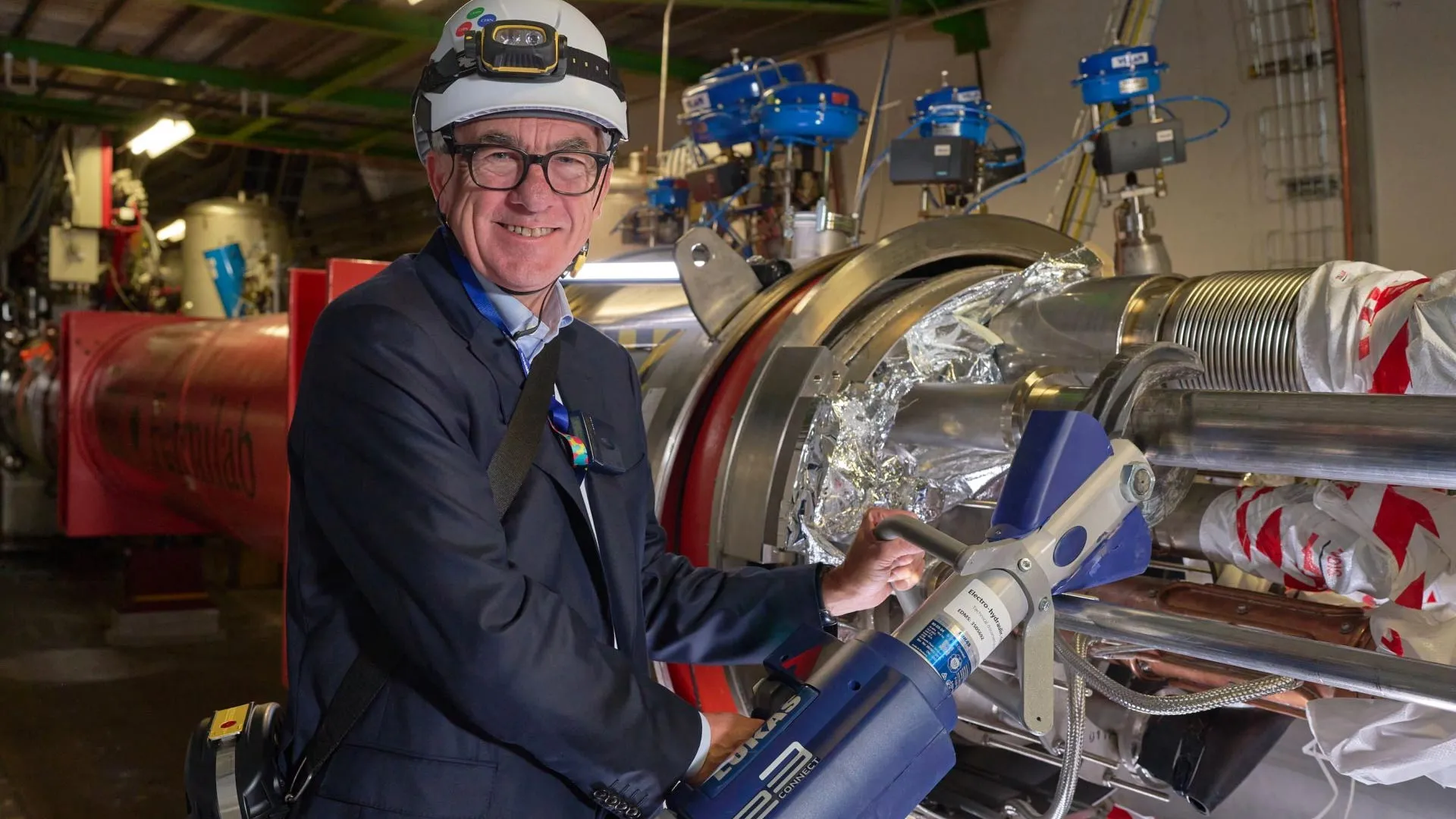
The European Organization for Nuclear Research has initiated a major upgrade of the Large Hadron Collider by removing key magnet systems that have operated since the facility’s construction. The organization began dismantling sections of the 27-kilometer collider in early September, targeting the removal of 28 superconducting magnets positioned around the ATLAS and CMS experiments.
The magnets being removed are known as inner triplets—groups of three quadrupole magnets that focus particle beams before collision. These components have been integral to the collider’s operation since their installation between 2005 and 2007. The new magnets, constructed using niobium-tin superconducting coils rather than the current niobium-titanium design, will generate magnetic fields approximately 40% stronger, reaching 11.3 tesla.
This replacement effort forms a central component of the High-Luminosity LHC project, an initiative designed to increase the number of particle collisions occurring within the detector systems. Higher collision rates provide researchers with greater quantities of data for analysis. The initial new quadrupole magnets are scheduled to arrive in the tunnel at the start of 2029, with a total of 16 cryostats and 28 cryo-assemblies to be installed throughout the upgrade process.
The magnets will be installed specifically at the ATLAS and CMS experimental sites, where increased instantaneous luminosity holds particular importance. The ALICE and LHCb experiments, which operate under different physics programs and pursue distinct research objectives, will retain their existing inner triplets, though these will receive upgrades to allow both experiments to benefit from the overall luminosity improvements achieved by the project.
Article Attribution | Read More at Article Source
Article summary produced by Claude AI