

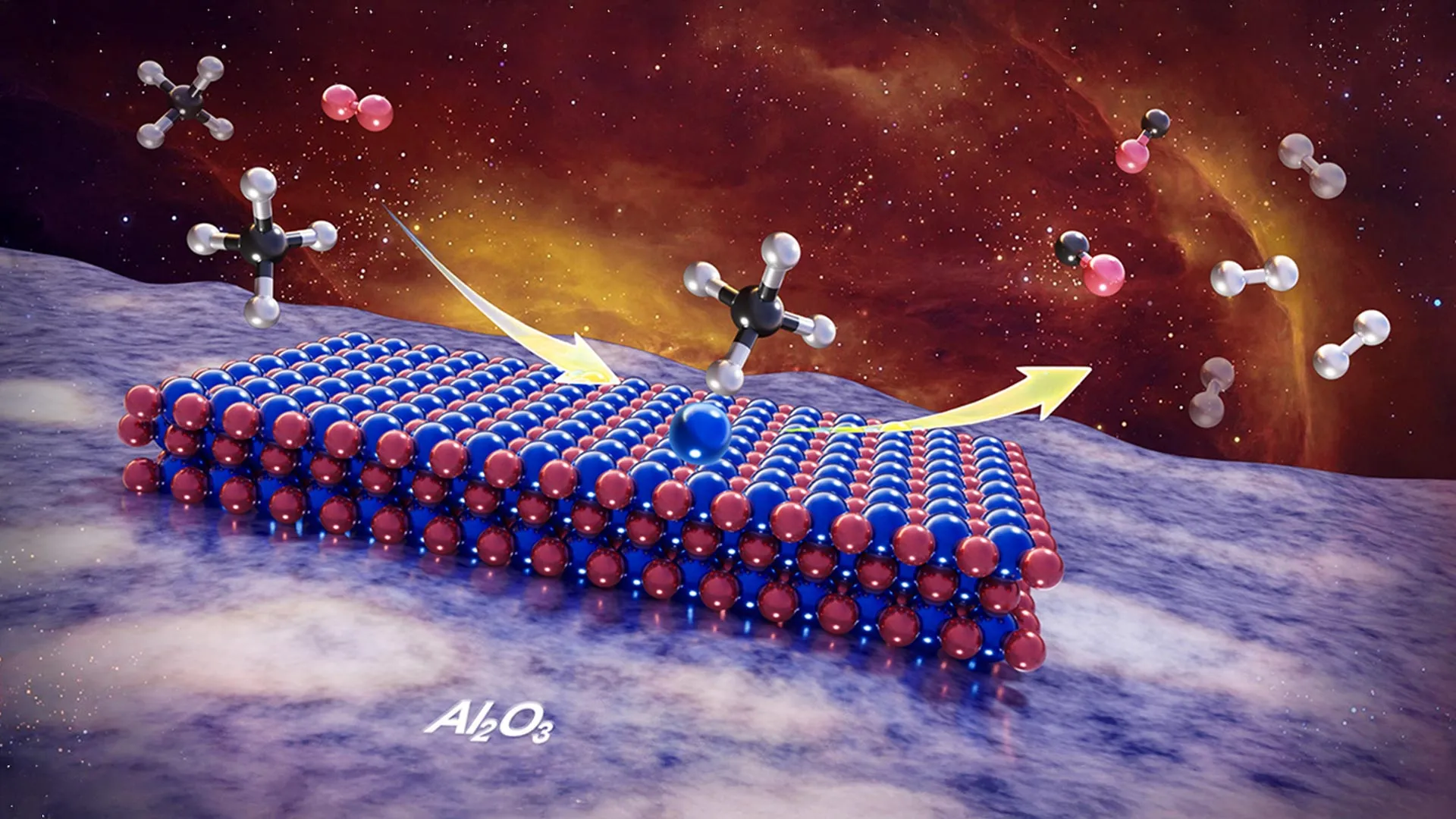
Researchers from the Dalian Institute of Chemical Physics and collaborating institutions have identified a previously unknown active structure that emerges during the partial oxidation of methane, a process used industrially to produce syngas for fuels and chemicals. The study, published in Nature Catalysis, challenges the long-held assumption that metallic nickel nanoparticles are the primary catalytic agents in this reaction.
The team developed a nickel catalyst containing only 0.8 weight percent nickel on an aluminum oxide support using a microemulsion preparation method. Despite its low metal content, the catalyst demonstrated strong performance, converting 92 percent of methane while achieving 87 percent selectivity for carbon monoxide and hydrogen products, with a stable hydrogen-to-carbon monoxide ratio of approximately 2.0. The low-loading catalyst performed comparably to a conventional catalyst containing ten times more nickel, suggesting a fundamentally different mechanism was responsible for the catalytic activity.
Through detailed examination and computational modeling, the researchers discovered that during the reaction, a specially reconstructed atomic structure designated as [Ni1O4Ni4] forms on the nickel oxide surface. This structure significantly reduces the energy barrier required to break carbon-hydrogen bonds in methane molecules, calculated at 12.5 kilocalories per mole compared to 38.5 kilocalories per mole for an unmodified nickel oxide surface. This dynamic reconstruction was found to be more effective than either pure metallic nickel or conventional nickel oxide alone.
The findings demonstrate that observable metallic nickel after reactions may not represent the actual active species but rather a byproduct of the high-temperature conditions. The research underscores the importance of studying catalysts during actual operation rather than after reactions have concluded, providing new insights for designing more efficient catalytic systems with reduced metal requirements.
Article Attribution | Read More at Article Source
Article summary produced by Claude AI