

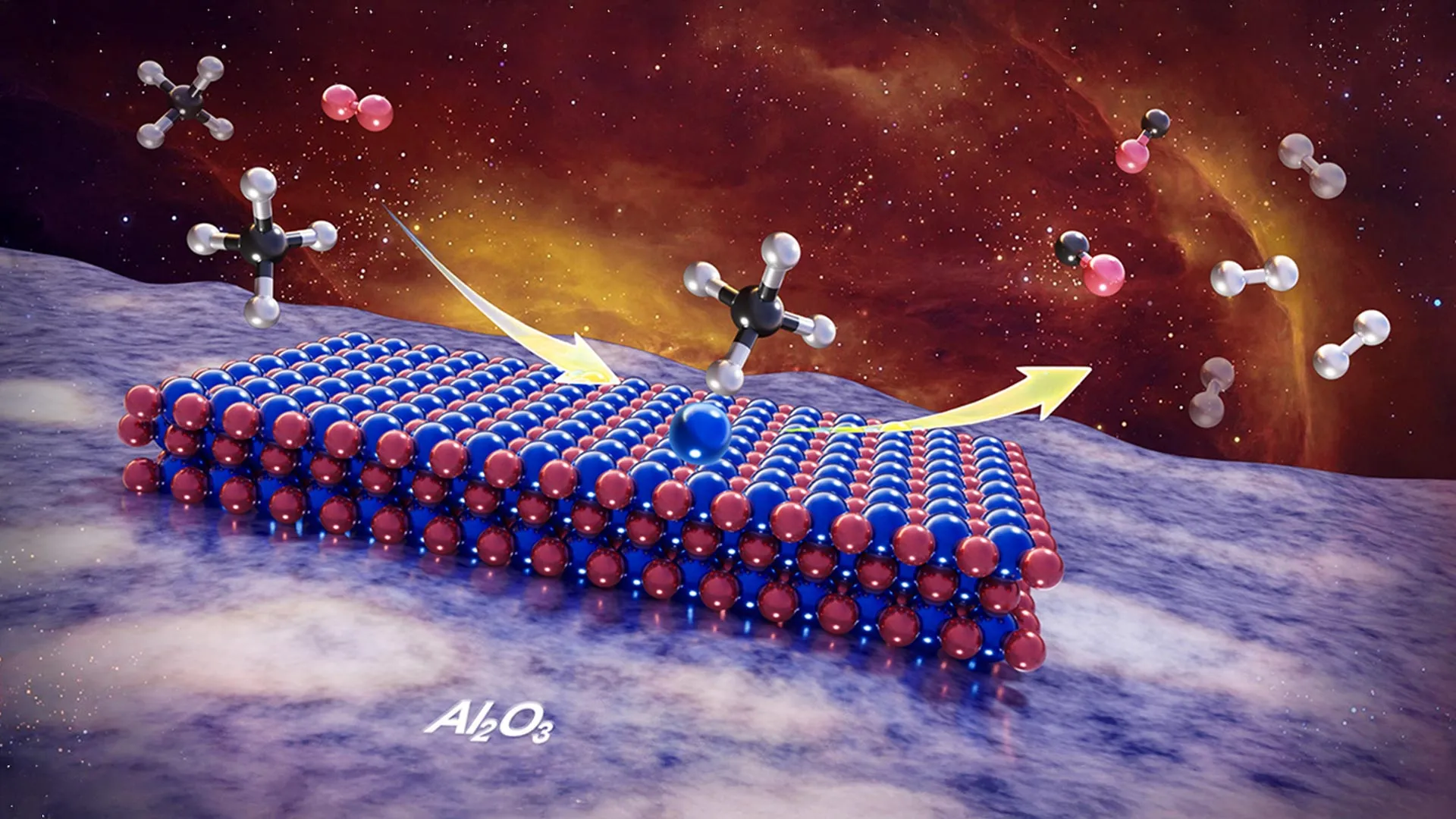
Scientists from the Dalian Institute of Chemical Physics and collaborating institutions have identified a previously unrecognized active structure that emerges during partial oxidation of methane, a key industrial process for producing syngas used in fuel and chemical manufacturing.
For years, researchers believed that metallic nickel nanoparticles were the primary catalytic centers driving this reaction. However, questions persisted about whether observed metallic nickel actually formed during catalysis or simply resulted from reduction of nickel oxide at high temperatures. The dynamic nature of nickel’s oxidation state and atomic arrangement under the reaction conditions made detailed tracking difficult until now.
The team developed a catalyst containing just 0.8 weight percent nickel on an aluminum oxide support using a microemulsion preparation method. Despite the low metal loading, the catalyst demonstrated strong performance, converting 92 percent of methane with 87 percent selectivity toward the desired carbon monoxide and hydrogen products. Notably, this catalyst matched the performance of a sample containing ten times more nickel prepared through conventional impregnation methods.
Investigations revealed that almost no metallic nickel remained detectable after the reaction, yet performance remained superior. The researchers found that the truly active structure consisted of a reconstructed [Ni1O4Ni4] unit that formed on the nickel oxide surface during operation. Computational modeling showed this reconstructed motif dramatically lowered the energy barrier needed to break carbon-hydrogen bonds in methane, making the molecule much easier to activate. The calculated barrier for the reconstructed surface was substantially lower than values for either pristine nickel oxide or metallic nickel surfaces.
These findings, published in Nature Catalysis, demonstrate that catalytic activity arises from dynamic structural changes occurring under reaction conditions rather than from static metallic or oxide phases. The research suggests that optimizing catalysts through understanding these in situ transformations could enable more efficient industrial processes while significantly reducing reliance on high metal loadings.
Article Attribution | Read More at Article Source
Article summary produced by Claude AI